AltcoinBuzzAltcoinBuzz
Subscribe
  • Crypto News
  • Crypto Research
  • Technical Analysis
AltcoinBuzzAltcoinBuzz

An independent digital media outlet delivering crypto research, news, and technical analysis to a community of 600,000+ users.

Follow us on:

Discover

  • Crypto Research
  • Crypto News
  • Technical Analysis
  • Key Opinions
  • Upcoming Launches

Categories

  • Bitcoin BTC
  • RWA
  • Technology
  • Altcoins
  • Regulation

Company

  • Affiliates
  • Partners & Sponsors
  • Careers
  • Contact
  • Terms of Use
  • Subscription Terms
  • About the ALTCOIN BUZZ
  • Privacy Policy
  • Contact ALTCOIN BUZZ
  • Advertise with us

Copyright 2026 ALTCOIN BUZZ. All rights reserved.Something is buzzzzzzzing.
HomeCrypto NewsCardano DeFi Falls as RealFi Launches Credit Tokens
Crypto NewsDeFiRWA

Cardano DeFi Falls as RealFi Launches Credit Tokens

Cardano DeFi TVL has fallen by more than half. RealFi's new credit tokens offer yield, but retail exits carry key risks.
AAnmol Billa•Oct 2, 2026
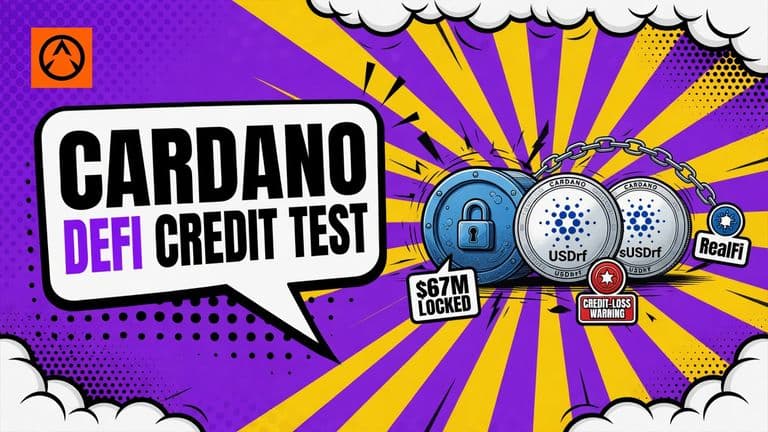
A pop-art illustration shows a shrinking Cardano DeFi vault beside USDrf and sUSDrf credit tokens, with a small $67M locked figure and a warning that credit and liquidity risks remain.
MentionedADA$0.253079+2.68%

RealFi has launched two credit-linked tokens on Cardano, but the network's DeFi market has contracted sharply. The launch puts the focus on whether real lending activity can rebuild usage, rather than simply attract temporary incentives.

For a holder, the important difference is how the tokens are redeemed. Retail users must sell USDrf on a supported decentralized exchange. Verified institutions can request direct redemption, subject to limits and fees. Staking USDrf for sUSDrf adds a seven-day cooldown and exposes that position to credit losses.

Cardano DeFi Value Has Fallen by More Than Half

Cardano had about $67 million locked across its DeFi applications, according to figures reported from DeFiLlama. That is less than half the roughly $150 million recorded in May.

At the same time, stablecoin supply on Cardano is approaching an all-time high near $70 million. The reported figures put stablecoin liquidity close to the value locked across the network's DeFi applications. More dollars are available, but much less is being deployed through DeFi.

That makes the new products a test of actual use. RealFi says USDrf can connect capital to direct loans, private-credit funds, public credit, investment-grade collateralized loan obligation ETFs, Treasuries and money-market instruments. The available reporting does not show how much has been deployed, the current token supply or the loan book's default performance.

Retail Exits Depend on DEX Liquidity

Eligible retail users can acquire USDrf and stake it for sUSDrf. The sUSDrf token provides variable returns generated by the underlying portfolio, so its yield is not fixed.

Direct minting and redemption through RealFi Reserve are reserved for verified institutional partners. Retail holders are instead directed to supported decentralized exchanges. Their exit therefore depends on available liquidity and USDrf's market price at the time of the sale.

Verified institutions can mint USDrf directly. They can request redemption at a nominal $1 per token, or the equivalent in eligible assets, less applicable fees. Redemptions run through a first-in-first-out queue with daily or monthly limits.

RealFi can suspend minting and redemptions in several circumstances, including reserve or liquidity stress, sanctions concerns, security incidents and wider market disruption. USDrf is not an insured bank deposit, and retail holders do not have a guaranteed dollar exit.

sUSDrf Takes the First Credit Losses

Staking USDrf for sUSDrf is not a risk-free way to collect yield. RealFi describes sUSDrf as a junior loss-absorbing instrument whose yield can fall to zero and whose principal can be impaired.

Its position in RealFi's loss waterfall matters. Protocol first-loss reserves absorb initial credit losses. If those reserves are exhausted, sUSDrf holders absorb losses before senior USDrf holders are affected.

Unstaking sUSDrf also takes seven days. Once the cooldown ends, the conversion into USDrf is not guaranteed to remain one-for-one. A loss in the underlying portfolio could therefore affect both the amount returned and the value of that amount.

The public reserve-attestation page named HT Digital, but the available page did not display a dated reserve quantity as of Oct. 1. The disclosures also lacked enough figures on first-loss capital and settled staking balances to model potential losses. The reporting did not establish HT Digital's role or reputation, so the reserve claim cannot be independently assessed from the available material.

The Test Is Durable Lending Demand

Cardano founder Charles Hoskinson said he invested several million dollars in RealFi. He said the team serviced loans in Kenya and Uganda while building the platform largely outside public view.

Hoskinson has described RealFi as the first part of Cardano's effort to “bank the unbanked,” with returns coming from lending outside crypto markets rather than primarily from token incentives. He has also outlined a later roadmap connecting RealFi with Bitcoin DeFi and Midnight, including borrowing against Bitcoin-linked assets and using privacy-preserving credentials for identity requirements.

The launch may help put idle stablecoin liquidity to work. The evidence is not yet enough to show that it can reverse Cardano's DeFi contraction. There are no confirmed figures for USDrf or sUSDrf deposits, loan performance or realized yield, and RealFi is unavailable to users in the United States, the EU and European Economic Area, the United Kingdom, Hong Kong and other restricted jurisdictions.

For now, the cleaner test is whether credit assets remain on Cardano after launch. Durable deposits and loan activity would suggest a rebuilding market. Incentive-driven balances and a sharp fall in the network's broader TVL would show that the launch had not changed the underlying picture.

The information discussed by Altcoin Buzz is not financial advice. This is for educational, entertainment, and informational purposes only. Any information or strategies are thoughts and opinions relevant to the accepted levels of risk tolerance of the writer/reviewers and their risk tolerance may be different than yours. We are not responsible for any losses that you may incur as a result of any investments directly or indirectly related to the information provided. Bitcoin and other cryptocurrencies are high-risk investments so please do your due diligence.

Copyright Altcoin Buzz Pte Ltd.

Related

A comic cover shows US sanctions striking the A7 Network while A7A5 tokens travel through a blockchain payment route toward USDT and a $166B volume counter.
Regulation
Oct 2, 2026

US Targets Russia-Linked Payment Network Behind $17B in Transactions

US sanctions target the A7 Network and its sub-agents. On-chain research links it to $166 billion in volume and a ruble-backed bridge into USDT.

Shashwat Gupta
A pop-art Bitcoin coin rises toward a resistance marker as short liquidations and ETF inflow bars show the tension behind the breakout.
Bitcoin BTC
Oct 2, 2026

Bitcoin’s $87K Test: $122M in Short Positions Get Liquidated

Bitcoin reached $86,857 as short liquidations topped $120 million. ETF demand returned, but remains below its late-September peak.

BTC
Shitij Gupta
LayerZero ZRO price jumps 13.5% as cross-chain volume and adoption grow
Altcoins
Oct 2, 2026

LayerZero Jumps 13.5% as CEO Highlights 10B-15B Monthly Volume

LayerZero's ZRO token jumped 13.5% as CEO Bryan Pellegrino highlighted 10B-15B in monthly volume, 91% cross-chain value share and growing adoption across stablecoins and tokenized assets.

ZRO
Bikash Deka