Circle Can Delay European holders USDC Redemptions Under Stress Rules
Circle can defer or cap EEA USDC redemptions if reserves cannot be rebalanced across borders. The right to redeem at par remains.

By Anmol BillaSenior Analyst
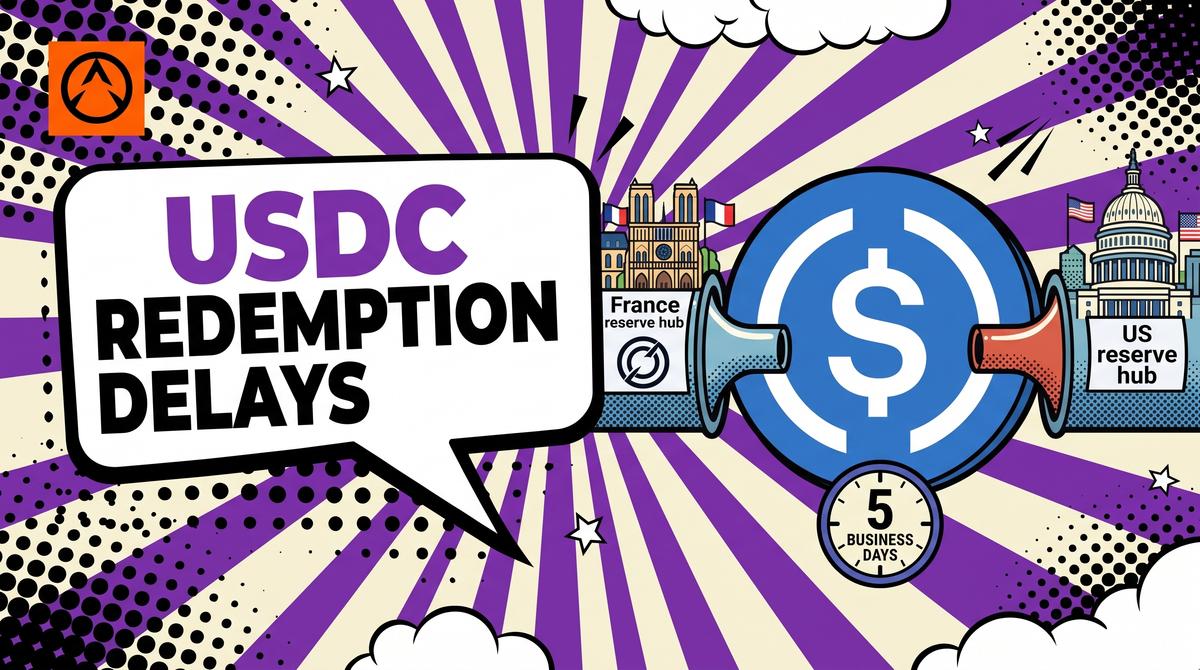
Circle can delay or cap USDC redemptions for European holders if it cannot rebalance reserves between its French and US issuers. The rule preserves the right to redeem at one US dollar, but it does not guarantee when the money arrives.
This applies to holders established in the European Economic Area, or EEA. They redeem through Circle France, while holders outside the EEA redeem through Circle LLC under a separate agreement. The distinction matters because Circle’s MiCA redemption policy makes the French entity responsible for processing eligible EEA requests.
What Counts as a Stress Event
Circle defines a Stress Event as a period in which reserves cannot be rebalanced between Circle France and Circle LLC. This happens before either the Recovery Plan or the Redemption Plan is activated.
The policy gives Circle France room to change how requests are processed during that period. It may defer execution beyond the standard redemption timeline. It can also impose a temporary limit on how much USDC an authorised crypto-asset service provider, or CASP, may redeem while distributing the token in the EEA. Requests above that limit wait until the Stress Event ends.
For an EEA retail holder, the normal timetable is no more than five business days after Circle receives the coins, completes verification and confirms that the holder meets all eligibility requirements. Discrepancies can extend the process. A Stress Event can add another delay on top of those checks.
The rules do not remove the redemption claim. Circle says any adjustment is temporary, applies on a non-discriminatory basis and does not affect a holder’s right to redeem at par value. The MiCA white paper derives that right from Article 49 of the regulation.
“Any such adjustment is temporary, applies on a non-discriminatory basis and is without prejudice to Circle Coins Holders’ right of redemption at par value.”
Why a Cross-Border Problem Could Restrict Redemptions
USDC has two issuers. Circle France issues it to holders established in the EEA, while Circle LLC issues it outside the region. A holder’s claim and the cash used to settle it can therefore sit within a cross-border structure.
Circle’s white paper names the risk directly. If USDC holdings and redemptions shift sharply toward the EEA, Circle LLC may be unable to rebalance reserves to Circle SAS, the entity identified elsewhere in the policy as Circle France. That could affect Circle France’s capacity to cover redemption requests.
The policy gives the issuer two main tools:
- It can temporarily limit the amount that a CASP may redeem. The white paper says the cap would be based on the provider’s total USDC holdings as last reported to Circle.
- For non-CASP holders, Circle may redeem only USDC that enhanced checks clearly identify as coming from EEA holdings held before the stress situation. Other requests may be deferred.
Circle says these measures are designed to preserve orderly redemptions and limit cross-border arbitrage risk. Arbitrage here would involve using differences in access or timing between jurisdictions to move funds in a way that strains the system.
There are practical requirements before a retail holder receives bank cash. The holder must provide an IBAN for an EEA bank account and complete Circle’s KYC and KYT checks. A right to redeem at par therefore does not mean an instant, unrestricted cash-out.
The Claim Can Survive a Delay
If reserve rebalancing is not restored, Circle says redemptions move under the Recovery Plan or the Redemption Plan. The policy ties that process to Article 55 of MiCA.
The white paper also says eligible holders retain their redemption rights even if Circle France suffers a loss at the safeguarded-asset level. It describes Circle France as well capitalised and subject to regulatory own-funds requirements, with the Redemption Plan acting as a backstop. USDC, however, is not covered by an investor compensation scheme or a bank deposit guarantee scheme.
The public position remains that USDC is redeemable 1:1 for US dollars. The policy adds the less comfortable operational detail: a claim worth one dollar and a payment arriving on time are separate questions.
No Stress Event or active redemption restriction had been established in the public documents reviewed as of October 4, 2026. The risk described in these documents is conditional, not evidence that Circle’s cross-border reserve transfers are currently failing.

Anmol Billa
Anmol Billa is a Senior Analyst at Altcoin Buzz, with over five years of experience working across cryptocurrency markets and the broader digital asset industry. His work focuses on technical analysis, market research, investment insights, and evaluating emerging opportunities within the crypto ecosystem. At Altcoin Buzz, Anmol contributes to technical market analysis, research-driven insights, pitch decks, and funding-related initiatives. His experience combines analytical thinking with a practical understanding of crypto markets, helping translate market trends and emerging projects into clear, actionable insights for readers and industry stakeholders.
More from AnmolNext up
Withdrawals Resume at Lighter After Leak Drained $10.39M
Lighter reopened withdrawals and returned about $5 million in USDC after reused signing nonces let an attacker derive private keys and drain its contract.
 ETH
Related
More in Crypto NewsRelated
DBS and Circle Bring 24/7 USDC Minting and Redemption to Asian Institutions

Crypto News Today: Russia's Crypto Shift, Institutional ETF Moves and Trezor Data Breach
 BTC

Crypto Derivatives Get US Approval as Backpack, tZERO Win Licences

$38,206 Drained From Curve Fee Contract in Signature Flaw
 CRVUSDC