The Tokenization Trade's Next Test: Who Actually Gets Paid
Circle's USDC split, Robinhood Chain fee data and Securitize's re-rating put hard numbers on who collects tokenization revenue, testing Citrini's list.

By Shitij GuptaResearcher
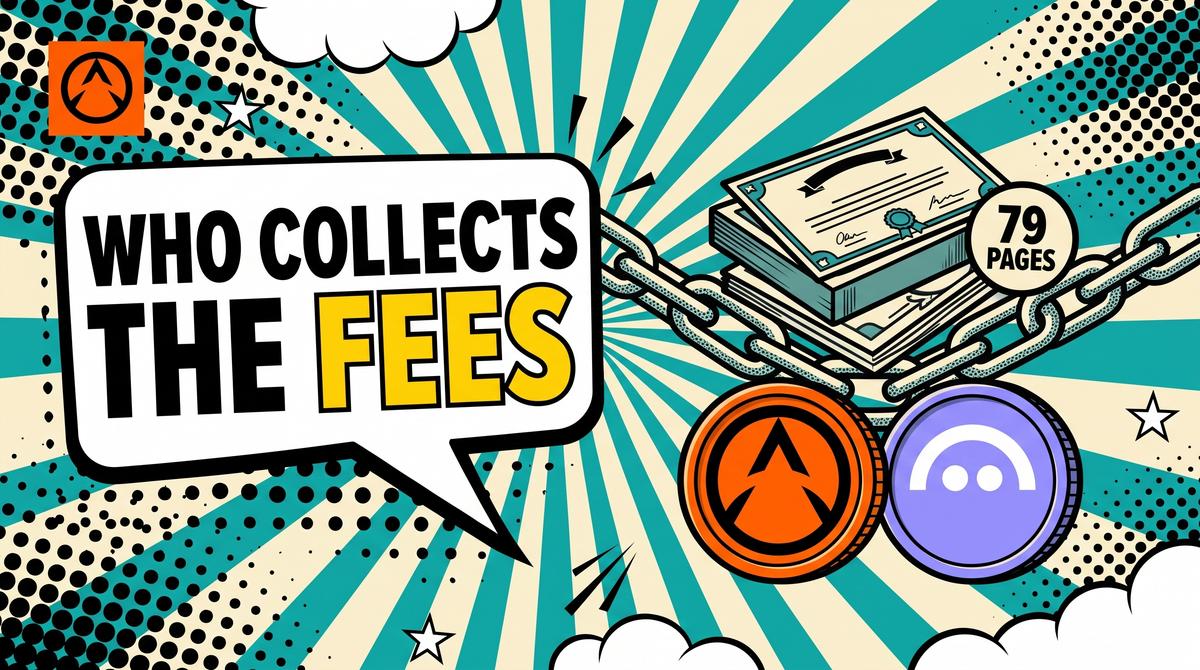
Updated 18 October 2026: Circle published its USDC revenue split and investors turned to the harder tokenization question: who actually collects the fees.
Circle published its own accounting for USDC on 16 October. The split it disclosed is the clearest number yet behind a question now running through the tokenization trade: not which asset gets tokenized, but who keeps the fee once it trades.
Of about $1.4 billion in first-half 2026 revenue, Circle said it paid about $819 million, 59 cents of every dollar, to distribution partners and transaction costs. It kept 7 cents of net profit per dollar. The post is attributed to Kash Razzaghi, who leads Circle's commercial business.
That is the test now being applied to the winner list Citrini Research published on 8 October. In a 79-page report, Breaking the Wall, the firm argued the biggest winners from putting stocks, bonds and other financial assets on blockchains are the companies and crypto protocols collecting fees from that activity, not bitcoin or ether. It said it could not be assumed that BTC and ETH would make new all-time highs from tokenization, and that "there are better expressions". The question a week later is which of the names on that list can show the money.
Circle's Numbers Show Where the Fees Go
Volume is not the constraint. Circle said USDC settled more than $36 trillion in onchain transaction volume in the first half of 2026. More than $315 billion was minted and redeemed, about $1.7 billion a day including weekends and holidays. By June, USDC carried roughly 77% of global stablecoin transaction volume, up from 60% a year earlier.
Costs are where the answer sits. After the $819 million of partner and transaction costs, Circle spent about $473 million, roughly 34 cents of every dollar, on licences, banking relationships, settlement liquidity, compliance and product investment. About $214 million of that was stock-based compensation. Net profit was 7 cents per dollar of revenue.
Two of the largest partners sit on both sides of the ledger. Coinbase, Circle's largest and longest-standing partner, reported that average USDC held in its products reached an all-time high of $20 billion in the second quarter, up 44% year over year. Binance signed a five-year commercial agreement in September, invested $100 million in Circle, and pays a fee tied to USDC held through Circle's wallet service. More than 150 other partners have an economic interest in USDC's growth, Circle said.
Redemption is part of the pitch. Standard USDC redemptions remain free and typically settle in up to two business days. Qualifying platform customers and payment flows through Circle Payments Network can now get near-real-time redemptions at no cost. "The costs of redemption, compliance, and resilience don't disappear just because the issuer declined to pay them," Razzaghi wrote.
Distribution is the contested part. Coinbase, Circle's largest USDC partner, also backs Open USD, unveiled in June with Stripe and BlackRock. The design lets businesses mint and redeem stablecoins without fees while passing reserve income minus a management fee to participants, and its OUSD token is live.
Where the Take Goes: Distribution, Networks or Post-Trade
Investors put the money in different places. Christian Magoon, CEO of Amplify ETFs, which runs the tokenization-focused TKNQ fund, said infrastructure providers could become "toll booths on the blockchain toll roads". Distribution may be just as valuable, he said: the Coinbase, Robinhood, banks and wealth platforms that already hold the customer relationships. The market remains "extremely early", he said. Tokenized assets are tiny against global financial markets, and future winners may differ from today's leaders.
Zach Pandl, head of digital asset research at Grayscale, said the most direct way to position for tokenization is to own the networks that host real-world assets and process transactions. He named Ethereum, BNB Chain and Solana. Avalanche and Canton, which have taken more institutionally focused approaches, could see rising demand as banks and asset managers move more activity onchain, he said.
Jeff Dorman, CIO of Arca, expects the tokenization process itself to become increasingly commoditized as competition grows. Stickier economics emerge after an asset is onchain and starts trading, being lent out or used as collateral, he said. He points to beneficiaries ranging from Securitize to Hyperliquid, Aave and Aerodrome.
Arthur Hayes, BitMEX co-founder and Maelstrom CIO, is less convinced by the base case. In an interview with The Rollup, he said recording a security that already sits in a digital database elsewhere does not necessarily create much value. "Where are you actually going to make money in tokenization?" he asked. His answer is that AI agents will run a person's financial services, which would need programmatic, always-on money and investments.
Robinhood Chain and Securitize Show Revenue Can Concentrate, Then Fade
The clearest onchain fee line so far runs through Robinhood Chain. Uniswap recorded record monthly protocol revenue of $14.81 million in September 2026, with Robinhood Chain contributing 53%, about $7.8 million. Tokenized stock trading helped, carrying higher fees than typical crypto trades: an average fee rate per trade of 0.465% on Robinhood Chain against 0.214% network-wide.
That revenue is concentrated and cooling. Robinhood Chain averaged 6.2 million daily transactions in the October 2 to 8 window, down 42% from 10.8 million in mid-September. Active addresses fell 31% to about 322,000 a day. Users paid about $65,000 in daily network fees, a 39% decline week on week and far below the roughly $8 million collected on the chain's busiest day in early September.
growthepie's 9 October quarterly review recorded about 793.7 million transactions between July and September, $51 million of network fees paid by users and about $591.4 million of application revenue. The 12 days from 30 August to 10 September accounted for roughly 74% of third-quarter network fees. A Bernstein note estimated Robinhood keeps about 90% of the chain's net protocol fee revenue, with the Arbitrum Expansion Program allocating 8% to the Arbitrum DAO treasury and 2% to the Arbitrum Developer Guild. On 9 October, Robinhood said it planned to explore a tokenized ETF with T. Rowe Price, which oversees about $1.9 trillion. No launch date has been announced and it remains subject to reviews and approvals.
Securitize is the other test case, and the argument is now about how it is valued. StoneX analyst Mark Palmer raised his price target 50% to $18 from $12 on 13 October, after Securitize launched trading for 12 tokenized US stocks on Solana. "While SECZ shares rallied last week following the announcement of the launch of Securitize Stocks, we believe the stock is still being valued as a tokenization vendor after it has evolved into a market operator," Palmer said. StoneX projects revenue of nearly $120 million in 2027 and $198 million in 2028, implying 65% annual growth. It applied 14.5 times enterprise value to revenue on its 2028 forecast.
Volume has not always meant revenue. Securitize has historically drawn much of its tokenization revenue from integration fees. Management reported $5.3 billion of transaction volume in the second quarter of 2026, and StoneX noted relatively little of it generated revenue. Securitize reported record first-quarter 2026 revenue of $19.5 million, up 39% year over year, with $1.9 billion of transaction volume and $3.4 billion of tokenized assets under management as of 31 March. FINRA approved it in May 2026 to custody tokenized securities and underwrite tokenized IPOs and secondary offerings. Benchmark analysts called it a "picks and shovels" play, estimating that capturing one basis point of the NYSE's roughly $44 trillion market capitalization would more than double its tokenized asset base.
The share price has not tracked the optimism. Securitize fell 14.18% on Monday, 12 October, closing at $11.86. It listed on the NYSE in early July through a merger with Cantor Equity Partners II, opening at $12.45 and peaking at $17.01 in late September.
Banks Call It a Growth Play, Without a Number
On third-quarter earnings calls, three large US banks framed tokenization as an opportunity rather than a threat. None put a revenue figure on it.
Goldman Sachs CEO David Solomon said tokenization could expand products, activity, clients and distribution. He noted that "the activity so far is small and at the margin". Wells Fargo CFO Michael Santomassimo said its tokenized deposit system is already in production, processing cross-border payments in two minutes or less, "and it's small volume so far". Morgan Stanley CFO Sharon Yeshaya said the tokenized world makes moving assets faster and easier, and that clients "will still need advice". Goldman built its own tokenized asset platform, GS DAP, in 2022 and joined a half-day run of DTCC's tokenization service in July.
The Citrini Baskets and What Still Isn't Confirmed
Citrini split its picks in two. The stock basket named Securitize (SECZ), Coinbase (COIN), Robinhood (HOOD) and Circle (CRCL), alongside Figure Technology Solutions (FIGR) for tokenized lending, SoFi (SOFI) for stablecoin payments and Bullish (BLSH). Hyperliquid exposure came through the Bitwise Hyperliquid ETF (BHYP) rather than the token.
The token basket, which Citrini said it was "actually more excited" about, included Aerodrome (AERO), Maple (SYRUP), Pendle (PENDLE), Ondo Finance (ONDO), Aave (AAVE), Uniswap (UNI), Ethena (ENA), ether.fi (ETHFI), Chainlink (LINK), LayerZero (ZRO) and Derive (DRV), plus perpetual futures venues Lighter (LIT) and Variational (VAR).
The report's own caution cuts against the easy version of the trade: growing trading volumes and network activity do not always translate into higher token prices. Investors need to check how a protocol makes money, who collects the fees and whether holders get a share. Citrini also flagged three risks: liquidity spread across competing blockchains, security risks that could slow adoption, and legal hurdles around synthetic tokenized stocks, which offer share-price exposure without voting rights or direct ownership.
Part of the case rests on unverified claims. The report's public page states that two days after the CLARITY Act fell short in the Senate, the SEC issued an innovation exemption for tokenized stock trading. It also states that Coinbase's proposed US stock perpetuals product is listed by the CFTC as "approval pending". Neither was checked against the underlying documents. The claim that Solana temporarily processed more trades than the NYSE in September is also Citrini's, unchecked against exchange or network data. The basket weights are the biggest gap: Citrini's post is paywalled after the introduction, and the weighting table circulating in secondary reports was not confirmed on the firm's own page.

Shitij Gupta
Shitij Gupta is an analyst and a researcher at Altcoin Buzz. Shitij has a vast banking experience at companies such as Morgan Stanley, ETRADE and UBS. He primarily built banking and lending products, Robo Advising solutions and Mutual Fund offerings for High Net worth clients. After his stint on Wall Street, Shitij runs a family office fund and consults businesses on strategy and execution.
More from ShitijNext up

UXLINK-Linked Whale Dumps $148M in ETH, SOL and XRP Longs on Hyperliquid.
A Hyperliquid wallet tied to the UXLINK exploit is unwinding $148 million of ETH, SOL and XRP longs, an expected $3.3 million loss booked by 10 November.
 ETH
 SOL
Across Protocol Warns Users After Domain Hijack Sends Visitors to Phishing Site
ETH BTC
Securitize and Ethena Activate $100M Liquidity Facility for BlackRock’s BUIDL
Kraken Parent Payward Takes xStocks Beyond US Shares With 200+ European Stocks
SOLETH
Across Protocol Restores Website After Phishing Attack, Losses Estimated at $350K
ETH ARB