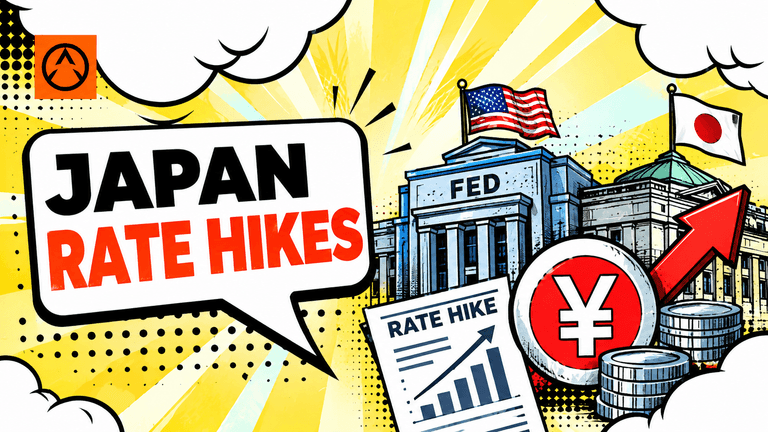
The Fed and Bank of Japan could raise rates within 48 hours this week, putting the yen, carry trades and global risk assets in focus.
 BTC$75,714.00-1.52%
Global markets are heading into an unusual 48-hour window, with the Federal Reserve and Bank of Japan both expected to raise interest rates this week.
The Federal Reserve is due to announce its decision on Wednesday, September 16, while the Bank of Japan will conclude its two-day meeting on Friday, September 18. Markets are widely expecting a 25-basis-point increase from both central banks, although the BOJ's decision remains less certain.
If both central banks tighten policy, the move could have important implications for the Japanese yen, global bond markets and risk assets heading into the fourth quarter.
The Bank of Japan has become increasingly likely to raise its policy rate to 1.25% this week.
A CNBC survey of 18 economists conducted between September 9 and 14 found that 89% expected the BOJ to increase rates by 25 basis points. The move would take the policy rate to its highest level in roughly three decades. Economists pointed to persistent inflation, stronger wages and external pressure as factors supporting further tightening.
Japan's headline inflation reached 1.9% in July, while real wages increased 2.4%, marking the seventh consecutive month of real-wage growth. Those developments have strengthened the case for the BOJ to continue moving away from its ultra-loose monetary policy.
A Reuters poll earlier in September also showed overwhelming expectations for a September BOJ hike, with most economists anticipating the policy rate reaching 1.25%.
However, economists are not unanimous on the pace. Some expect a larger move, while others believe the BOJ could keep rates unchanged if policymakers decide that current economic conditions do not justify faster tightening.
The Federal Reserve is facing a similar policy, although for different reasons.
Interest-rate markets are pricing a high probability of a 25-basis-point Fed hike at Wednesday's meeting. Recent reports have put the probability above 90%, with inflation remaining elevated and higher energy prices adding to concerns about future price pressures.
The change in expectations has been significant.
Earlier in the cycle, markets had been divided over whether the Fed would raise rates in September. Stronger labor-market data, persistent inflation and rising energy prices have since pushed expectations toward another increase.
Related: US jobs report sends Bitcoin lower as Fed rate hike bets return
More recently, Bitcoin also came under pressure as rising Treasury yields and higher Fed rate-hike expectations weighed on risk assets.

The key question for currency markets is what happens to the dollar-yen exchange rate.
A BOJ hike would normally provide support for the yen because higher Japanese interest rates make yen-denominated assets relatively more attractive. At the same time, a Fed hike would preserve a significant interest-rate advantage for the U.S. dollar.
That means the yen's reaction could depend heavily on the guidance from both central banks rather than simply whether they raise rates.
The dollar was trading close to the 155-yen level ahead of the Fed decision, while markets were also pricing roughly an 80% probability of a BOJ hike. The yen has already strengthened in recent weeks as expectations for Japanese monetary tightening increased.
If the BOJ signals that more increases are likely, the yen could receive additional support. Conversely, a cautious message from Governor Kazuo Ueda could limit the currency's gains even if rates rise.
The bigger market issue may be the impact on yen-funded carry trades.
For years, investors have been able to borrow cheaply in Japan and deploy that capital into higher-yielding assets elsewhere. As Japanese rates rise, the cost of maintaining those positions increases.
A stronger yen can add another layer of pressure because investors who borrowed yen and invested overseas may face losses when converting those assets back into the Japanese currency.
That dynamic can become particularly important for risk assets such as equities and cryptocurrencies.
If both the Fed and BOJ tighten policy while financial conditions remain restrictive, traders could become more selective about leveraged positions heading into the final quarter of 2026.
The Fed's decision itself may not be the only important event on Wednesday.
Markets will closely watch the central bank's economic projections and Chair Kevin Warsh's comments for clues about what comes next.
A 25-basis-point increase that is accompanied by guidance suggesting additional hikes could strengthen the dollar and Treasury yields.
On the other hand, if the Fed signals that Wednesday's increase is primarily a response to temporary inflation pressures and that future moves will depend heavily on incoming data, markets could interpret the decision as less hawkish.
That distinction could matter for Bitcoin and other risk assets.
The BOJ's communication on Friday may be even more important for the yen.
Markets are already heavily positioned for a rate increase, meaning much of the move could already be reflected in currency prices.
The bigger catalyst could therefore be whether policymakers signal another increase later this year or a faster normalization cycle.
Reuters reporting has pointed to expectations for further BOJ tightening into 2027, although the pace will depend on inflation, wages, economic growth and financial conditions.
A more hawkish BOJ could narrow the rate gap between Japan and the United States and potentially provide further support for the yen.
The synchronized policy decisions could also create volatility across cryptocurrency markets.
Higher interest rates generally make cash and fixed-income assets more attractive relative to riskier investments, while tighter financial conditions can reduce the liquidity available for speculative assets.
Bitcoin has already shown sensitivity to changes in Fed expectations this month. The asset fell below $77,000 earlier in September as traders increased bets on a September rate hike and Treasury yields moved higher.
If both central banks deliver hikes and maintain hawkish guidance, crypto markets could face another test from tighter global liquidity.
However, the impact will depend on how much of the policy shift is already priced into markets.
The Fed and BOJ decisions create an unusual sequence for global markets.
The two central banks are moving toward tighter policy within just 48 hours, even though their economic circumstances are very different. The Fed is dealing with persistent inflation and energy-related price pressures, while the BOJ is continuing its gradual exit from decades of ultra-loose monetary policy.
For the yen, the immediate focus will be whether the BOJ delivers the expected hike and signals further increases.
For global markets, the bigger question is whether synchronized tightening changes expectations around carry trades and liquidity.
With the Fed deciding Wednesday and the BOJ following Friday, traders will have little time to digest one central-bank decision before another arrives.

XRP plunges nearly 10% after the CLARITY Act fails to advance in the Senate, while Bitcoin falls toward $76,000 and major crypto assets slide.
 XRP
XRP
Bitcoin, Ethereum and XRP fell sharply after the CLARITY Act failed to clear a key Senate procedural vote, triggering $669.71 million in crypto liquidations.
BTC ETH+1 more
The CLARITY Act failed to clear a key Senate procedural hurdle after lawmakers voted 49 - 50 against invoking cloture, sharply reducing expectations for the crypto bill in 2026.
BTC
