AltcoinBuzzAltcoinBuzz
Subscribe
  • Crypto News
  • Crypto Research
  • Technical Analysis
AltcoinBuzzAltcoinBuzz

An independent digital media outlet delivering crypto research, news, and technical analysis to a community of 600,000+ users.

Follow us on:

Discover

  • Crypto Research
  • Crypto News
  • Technical Analysis
  • Key Opinions
  • Upcoming Launches

Categories

  • Bitcoin BTC
  • RWA
  • Technology
  • Altcoins
  • Regulation

Company

  • Affiliates
  • Partners & Sponsors
  • Careers
  • Contact
  • Terms of Use
  • Subscription Terms
  • About the ALTCOIN BUZZ
  • Privacy Policy
  • Contact ALTCOIN BUZZ
  • Advertise with us

Copyright 2026 ALTCOIN BUZZ. All rights reserved.Something is buzzzzzzzing.
HomeCrypto NewsInvestment firm Franklin Templeton brings tokenized money market funds to Bybit as collateral
Crypto NewsRWAStablecoins

Investment firm Franklin Templeton brings tokenized money market funds to Bybit as collateral

Bybit users may pledge Franklin Templeton's tokenized money market shares to borrow USDT or USDC, though launch terms remain unclear.
SShashwat Gupta•Sep 28, 2026
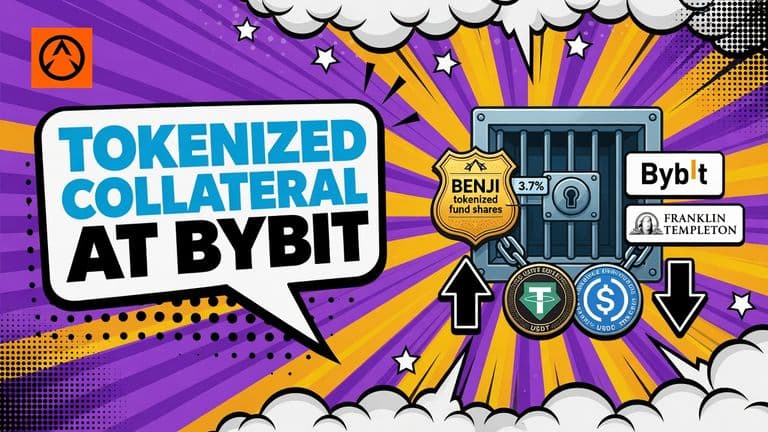
A pop-art cover shows Bybit and Franklin Templeton tokenized fund shares connected to off-exchange custody and borrowed USDT and USDC for trading liquidity.
MentionedUSDC

Bybit has added Franklin Templeton’s tokenized money market fund shares to its off-exchange collateral programme. The practical change is simple: eligible users may pledge the shares to borrow USDT or USDC while continuing to earn yield on the underlying assets.

The underlying holdings do not need to move to Bybit. Regulated custodian ByCustody keeps them off-exchange, while Bybit mirrors their value inside its trading environment. That mirrored value can support trading liquidity, although the source does not explain the margin rules, liquidation process or borrowing costs.

Why the collateral stays off Bybit

Tokenized money market shares represent an interest-bearing fund. Investors generally earn a return because the underlying assets remain invested. The design here separates that return from their use in crypto trading.

A user can pledge the shares as collateral, borrow stablecoins and use them in the trading environment. The shares continue to earn a yield based on the fund, while the stablecoin proceeds provide liquid buying power.

It’s a familiar collateral model with one unusual feature. The fund assets remain at ByCustody rather than being transferred to Bybit. Bybit only mirrors their value for trading purposes, according to CoinDesk’s report.

The shares are issued through Benji, Franklin Templeton’s blockchain-integrated record-keeping and transfer platform. Benji’s latest seven-day rate puts the annualized yield at 3.7%, though that figure can change and does not describe the total cost of the Bybit arrangement.

What’s live, and what isn’t clear

The announcement does not confirm whether the service is already available to every Bybit user. It may be rolling out in stages or limited to selected accounts, but the source does not say which.

The important terms are also missing:

  • Which users and wallet holders qualify.
  • Which Benji money market share class is accepted.
  • The collateral haircuts, leverage and credit limits.
  • The cost of borrowing USDT or USDC.
  • What happens if collateral falls enough to trigger a liquidation.

Those details determine whether the service is useful for a particular trader. Without them, the product is best understood as an announced extension of an existing collateral model, rather than a fully specified trading offer.

The tokenized shares represent about $686 million in net assets, according to Monday’s press release cited by CoinDesk. The report does not provide a fund-by-fund breakdown or show how much has been deposited or borrowed under Franklin Templeton’s earlier exchange partnerships.

A wider push for collateral outside exchanges

Bybit is not the first venue to offer Franklin Templeton’s tokenized money market funds as off-exchange collateral. Customers of Binance and OKX already have access to them, though their usage is also unconfirmed.

Other companies are testing similar arrangements. Crypto.com and Deribit let eligible institutional and professional users use BlackRock’s BUIDL fund to back trades, including derivatives positions. The common idea is to let an asset serve two purposes at once: earn its underlying return and support trading activity elsewhere.

Franklin Templeton’s digital assets chief, Sandy Kaul, described the aim in an interview with CoinDesk:

“So now I'm able to really look across the top exchanges and be able as an investor to use my collateral more optimally while earning yield on it.”

For Bybit users, the appeal is the separation of custody and trading. The fund holdings stay with ByCustody, the tokenized shares supply mirrored collateral value, and the borrowed stablecoins supply trading liquidity. The missing eligibility rules and risk parameters will show how useful that setup is in practice.

The information discussed by Altcoin Buzz is not financial advice. This is for educational, entertainment, and informational purposes only. Any information or strategies are thoughts and opinions relevant to the accepted levels of risk tolerance of the writer/reviewers and their risk tolerance may be different than yours. We are not responsible for any losses that you may incur as a result of any investments directly or indirectly related to the information provided. Bitcoin and other cryptocurrencies are high-risk investments so please do your due diligence.

Copyright Altcoin Buzz Pte Ltd.

Related

A bold comic illustration shows linked Robinhood Chain token launches, bundled wallet nodes, and a draining flow connected to a launchpad, with a $18.4M extraction badge and a warning headline.
MemecoinsAltcoins
Sep 28, 2026

Analyst Traced 53 Robinhood Chain Token Launches to One $18M Operation

An analyst linked 53 Robinhood Chain launches to one wallet network. On-chain checks confirm parts of the pattern, but not the full $18.4M total.

Saloni Rathi
A pop-art illustration shows a Chainlink cross-chain bridge protected by a 16-operator verifier network and optional independent checks, contrasted with a failed single-verifier path and an rsETH coin.
TechnologyAltcoins
Sep 28, 2026

Chainlink Upgrades its “CCIP” Crypto Bridge Tech with New Security Checks for Apps

CCIP 2.0 lets chains and apps add independent verifiers to bridge transfers, five months after a $292 million exploit.

LINK
Anmol Billa
A pop-art business checkout shows Coinbase and Citi marks connected to a stablecoin payment, an automatic conversion arrow, and a fiat settlement symbol, with a US launch badge.
StablecoinsTechnology
Sep 28, 2026

Citi and Coinbase Put Stablecoin Payments into Business Flow

Citi and Coinbase are bringing stablecoin payments to US businesses, with automatic conversion to fiat and settlement through Citi.

Pallavi