Kalshi to End Volume Incentives After Wash-Trading Scrutiny
Kalshi will end its volume incentive program. The change comes as the CFTC examines disputed ether perpetual futures volume.

By Shashwat GuptaFounder
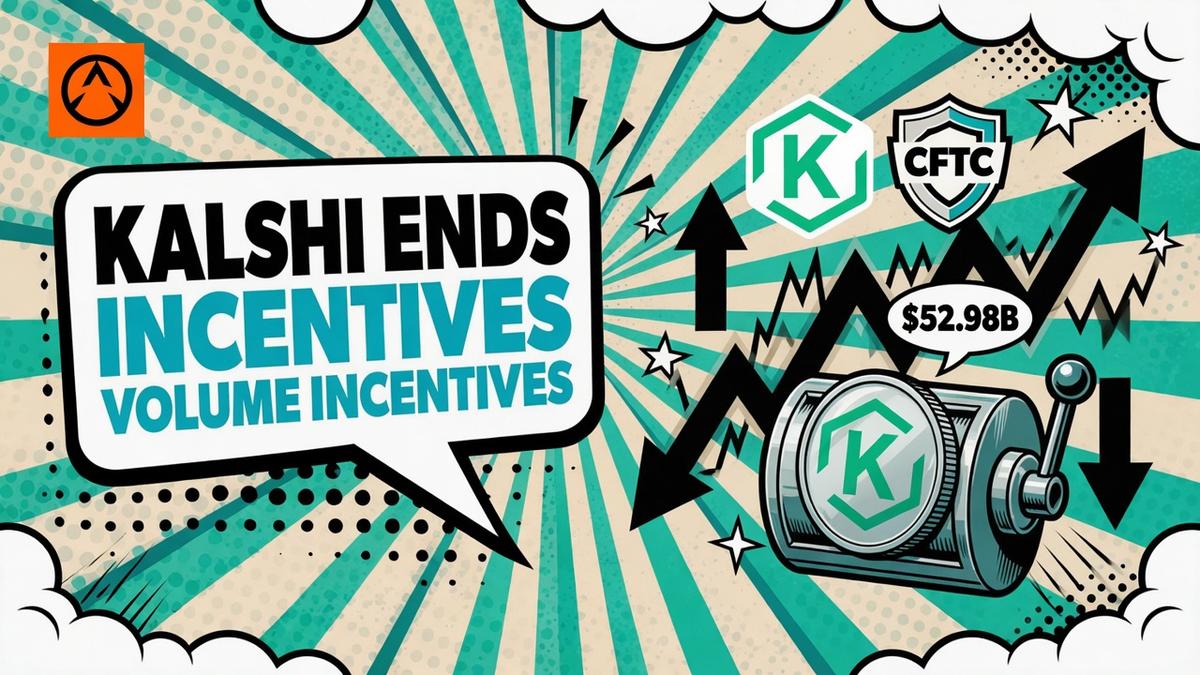
Kalshi plans to end its Volume Incentive Program no earlier than Oct. 13. The prediction market platform says the program, which launched in March 2023, rewarded traders for adding eligible volume.
The change comes as the Commodity Futures Trading Commission examines disputed trading activity. Kalshi has denied that it is under investigation and said wash trading does not occur on its platform. The filing gives no reason beyond the planned end date for retiring the incentive.
How the incentive worked
Kalshi paid traders from reward pools based on their share of eligible volume. Its stated aim was to bring more activity onto the central limit order book and improve pricing efficiency.
The rewards applied to trades in event contracts, usually priced between $0.03 and $0.97. The idea was fairly direct: pay for eligible trading and hope that the extra activity would make it easier to trade against someone else.
That design also creates the question at the centre of the current scrutiny. A reward based on volume rewards the volume itself, whether it comes from traders seeking an event outcome or from a pattern of activity that appears designed mainly to collect rewards.
The available reporting does not show the program's reward-pool size, payout history or exact payout formula. It also doesn't establish that the program generated the repeated trades now in dispute.
What CFTC examination covers
The Wall Street Journal reported that the CFTC was examining Kalshi trades after allegations involving repeated trades of around $5,500. Those prints accounted for more than $5 billion in ether perpetual futures volume over the previous month.
Open interest, or the value of outstanding derivatives contracts, is one measure traders use when judging reported trading activity. An X account named Beni cited about $539 million in 24-hour volume against $3.1 million in open interest on Kalshi's ETH perpetual futures pair. The account alleged that Kalshi inflated its volume. The original post and the full Wall Street Journal report were not checked for this article.
Kalshi instead said the repeated prints came from market makers posting fixed quotes that faster traders hit. That description points to automated or high-speed execution, but it does not resolve whether the trades are legitimate market activity or volume that lacks the economic substance often associated with an unincentivised trade.
The status of the examination is unclear. There is no confirmed finding, and Kalshi says it is not under investigation over the matter.
Record volume meets renewed scrutiny
Kalshi's monthly volume reached $52.98 billion in September through Sept. 29, according to The Block's data dashboard. That was above the $38.67 billion recorded in August and marked an all-time high, although the month was incomplete.
The figures show scale, not the quality of every trade counted within it. A platform can record strong headline volume while questions remain about how much of that activity reflects independent risk-taking. That distinction matters most for traders looking at order-book depth, prices and open interest rather than the raw volume number alone.
Kalshi's filing confirms when the program will end, not why it is ending now or whether the decision resolves the trading concerns. Until the CFTC's work and Kalshi's own review of the repeated prints become clearer, the cleanest takeaway is simple: the incentive is going away, while the meaning of some of the volume that grew under it remains disputed.

Shashwat Gupta
Shashwat Gupta is an entrepreneur, CEO and co-founder of the online media portal, Altcoin Buzz. Shash has been a crypto enthusiast since 2015 and entered the emerging cryptocurrency space full time in early 2017. His business expertise and extensive knowledge in the crypto space have helped shape Altcoin Buzz to be what it is today.
More from ShashwatNext up

KAVA Crashes 40% After Suspicious Activity in Kava Lend
KAVA plunged more than 40% after suspicious activity involving Kava Lend reportedly moved 48.36 million tokens to BNB Chain. South Korean exchanges suspended deposits and withdrawals as Kava investigated.
 KAVA
Related
More in Crypto NewsRelated
JPMorgan's Crypto-Linked Holdings Near $1B as Strategy Stake Jumps 36%
 BTCCOIN

Bitcoin ETFs Lose $2.35B as BlackRock's IBIT Extends Losing Streak
BTC
Bitcoin Wallet Named in $260B Lawsuit Moves 75 BTC After 15 Years
BTC