AltcoinBuzzAltcoinBuzz
Subscribe
  • Crypto News
  • Crypto Research
  • Technical Analysis
AltcoinBuzzAltcoinBuzz

An independent digital media outlet delivering crypto research, news, and technical analysis to a community of 600,000+ users.

Follow us on:

Discover

  • Crypto Research
  • Crypto News
  • Technical Analysis
  • Key Opinions
  • Upcoming Launches

Categories

  • Bitcoin BTC
  • RWA
  • Technology
  • Altcoins
  • Regulation

Company

  • Affiliates
  • Partners & Sponsors
  • Careers
  • Contact
  • Terms of Use
  • Subscription Terms
  • About the ALTCOIN BUZZ
  • Privacy Policy
  • Contact ALTCOIN BUZZ
  • Advertise with us

Copyright 2026 ALTCOIN BUZZ. All rights reserved.Something is buzzzzzzzing.
HomeCrypto NewsS&P Global Launches Risk Grades for Crypto Lending Vaults
Crypto NewsDeFiTechnology

S&P Global Launches Risk Grades for Crypto Lending Vaults

S&P Global's new framework grades risks across six areas of a crypto lending vault, but no vault has been assessed yet.
SShashwat Gupta•Oct 6, 2026
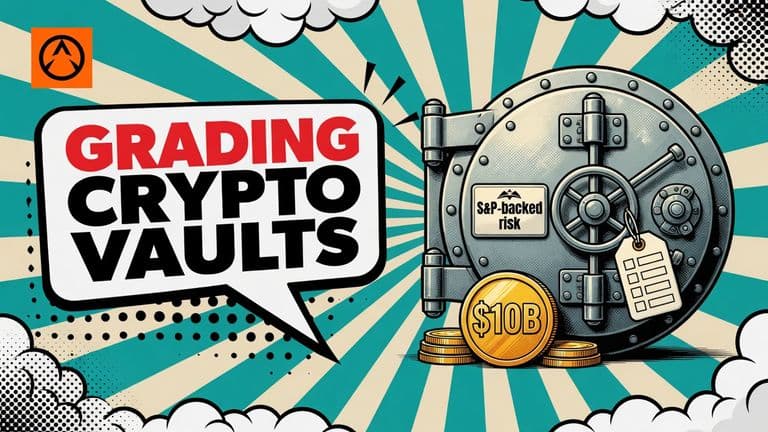
A comic-style bank vault door with an S&P risk badge on its face, coins and a share token at its base, beside a speech bubble reading GRADING CRYPTO VAULTS.

Crypto lenders can watch every transaction, but that doesn’t tell them whether the loans, the protocol or the vault itself are safe. S&P Global Ratings is now offering a structured way to assess those risks.

Its Vault Risk Assessment, or VRA, launched on Oct. 4, 2026, is a forward-looking opinion about the relative risk that an investor’s position in a digital asset lending vault could suffer impairment.

It is a framework, however, rather than a set of published grades. S&P hasn’t assessed a vault yet.

What a Crypto Lending Vault Does

A lending vault pools deposits and deploys them through a defined strategy. Those strategies can run automatically through smart contracts, be managed by people, or combine both approaches.

Depositors receive share tokens that represent a proportional claim on the vault’s assets and accrued returns. In practical terms, the vault works like an onchain managed fund, but its investments and risks depend on a combination of lending activity, smart contracts and human decisions.

That combination creates several places where losses can enter the picture. The borrowers may not repay. The assets backing a loan may lose value. A curator may manage the vault poorly. Or the blockchain, protocol or governance system may fail in a way that makes the assets harder to recover.

A transaction feed can show that funds have moved. It can’t, by itself, answer how those risks compare with those of another vault.

Six Risks Behind a VRA

The VRA examines a vault across six areas:

  • Portfolio credit quality: The quality of the loans and assets held by the vault.
  • Liquidity mismatch: The risk that assets can’t be accessed when depositors need them.
  • Curator: The risk attached to the person or organization managing the vault.
  • Blockchain: The underlying blockchain and its associated risks.
  • Protocol: The lending protocol used by the vault.
  • Vault security and governance: How the vault is secured and controlled.

That last category is especially broad. A vault may depend on smart contracts, share tokens, management decisions and governance rights. Each can shape what happens when something goes wrong.

The point isn’t to reduce the vault to a single yield number. It’s to give investors a common set of questions for comparing different designs and risk profiles.

A Risk Opinion, Not a Credit Rating

S&P is explicit about one boundary: a VRA is not a credit rating, and it does not comment on yield levels.

That distinction matters. Two vaults may offer different returns, but a higher yield doesn’t make a VRA better. The assessment is designed to describe relative impairment risk, not promise better returns or remove the possibility of loss.

The framework also isn’t backed by an initial set of ratings. S&P said it will publish the first Vault Risk Assessments in future announcements, but it didn’t provide a publication date, a list of vaults or an eligibility schedule. For now, there’s no way to see how the framework performs in practice.

Why $10 Billion Changes the Context

S&P’s decision comes as deposits in digital asset lending vaults reached a reported $10 billion in September 2026. The firm said those deposits stood at $1.5 billion in September 2024, an increase of roughly 6.7 times.

Those figures are S&P’s own, and they have not been independently checked for this article. Even so, the reported scale helps explain the need for a common risk language. More money in vaults means more institutions need a way to compare them without manually rebuilding the same analysis each time.

S&P says the VRA is intended to support institutional investment governance and vault selection. It’s also part of a wider expansion into digital assets. The firm previously launched Stablecoin Stability Assessments, rated the DeFi protocol Sky Protocol, and rated a bitcoin-backed structured finance transaction called Ledn.

That history doesn’t prove the VRA will work. It does show that S&P is applying its established credit vocabulary to a market that already handles lending and investment through blockchain-based systems.

The practical test will come with the first assessments. Until then, the VRA offers a useful map of the risks. It hasn’t graded the vaults themselves, and it can’t tell investors which one is right for them.

The information discussed by Altcoin Buzz is not financial advice. This is for educational, entertainment, and informational purposes only. Any information or strategies are thoughts and opinions relevant to the accepted levels of risk tolerance of the writer/reviewers and their risk tolerance may be different than yours. We are not responsible for any losses that you may incur as a result of any investments directly or indirectly related to the information provided. Bitcoin and other cryptocurrencies are high-risk investments so please do your due diligence.

Copyright Altcoin Buzz Pte Ltd.

Related

Zcash Activates NU7 Testnet Upgrade
Altcoins
Oct 6, 2026

Zcash Activates NU7 Testnet Upgrade, Cutting Block Times to 25 Seconds

Zcash has activated its NU7 upgrade on public testnet, cutting target block times to 25 seconds and adding changes designed to improve privacy capacity and network sustainability.

ZEC
Bikash Deka
A comic-style illustration of a hand adding one more Ethereum coin to a tall stack of coins, with a Bitmine badge on the stack and a speech bubble carrying the headline.
Ethereum ETH
Oct 6, 2026

Bitmine Adds 15,112 ETH, Taking Its Stake to 4.9%

Bitmine added 15,112 ETH worth roughly $41 million, taking its holdings to 4.9% of Ethereum's supply.

ETH
Shitij Gupta
A comic illustration of three columns made of stacked Bitcoin coins of different heights, the shortest one having another Bitcoin coin placed on top, next to a speech bubble reading STRIVE ADDS 2,000 BTC.
Bitcoin BTC
Oct 6, 2026

Strive Adds 2,000 BTC and Moves Closer to MARA

Strive added 2,000 BTC at an average $84,422, but remains fifth and carries $1.29 billion in preferred stock obligations.

BTC
Anmol Billa