AltcoinBuzzAltcoinBuzz
Subscribe
  • Crypto News
  • Crypto Research
  • Technical Analysis
AltcoinBuzzAltcoinBuzz

An independent digital media outlet delivering crypto research, news, and technical analysis to a community of 600,000+ users.

Follow us on:

Discover

  • Crypto Research
  • Crypto News
  • Technical Analysis
  • Key Opinions
  • Upcoming Launches

Categories

  • Bitcoin BTC
  • RWA
  • Technology
  • Altcoins
  • Regulation

Company

  • Affiliates
  • Partners & Sponsors
  • Careers
  • Contact
  • Terms of Use
  • Subscription Terms
  • About the ALTCOIN BUZZ
  • Privacy Policy
  • Contact ALTCOIN BUZZ
  • Advertise with us

Copyright 2026 ALTCOIN BUZZ. All rights reserved.Something is buzzzzzzzing.
HomeCrypto NewsSolana Launches DvP Settlement with JPMorgan Input to Settle Trades in Seconds
Crypto NewsAltcoinsRWA

Solana Launches DvP Settlement with JPMorgan Input to Settle Trades in Seconds

The Solana Foundation released Solana DvP, an open-source program for atomic institutional settlement with J.P. Morgan input.
SShitij Gupta•Oct 6, 2026
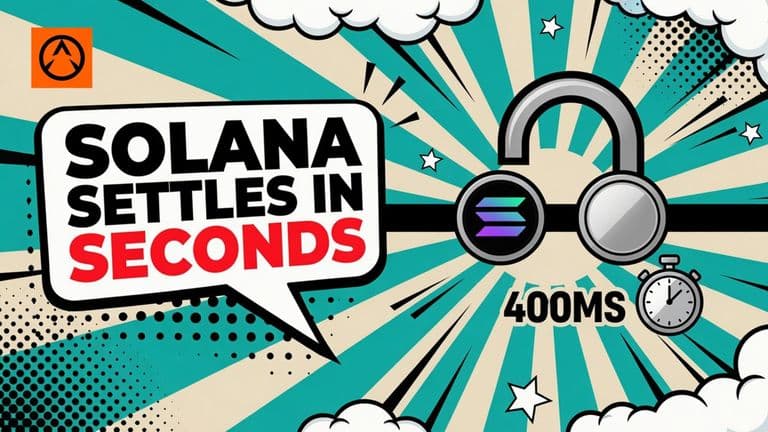
A comic-style illustration of a Solana-marked coin and a plain coin swapping places along a single rail through an open padlock, with a stopwatch badge and a speech bubble headline.
MentionedSOL$120.25-0.34%

On Oct. 6, the Solana Foundation released Solana DvP, an open-source delivery-versus-payment program that lets institutions settle both legs of a trade atomically on-chain, with finality in seconds instead of days. J.P. Morgan contributed input on settlement requirements. The announcement names no institution trading through the program, and no settlement volume has been published.

The program is out under the MIT license and is meant to work as a reusable standard rather than a one-off contract: atomically settled, with isolated escrow and enforced deadlines. Until now, institutional trades settling on-chain have typically relied on bespoke smart contracts, which the Foundation says Solana DvP replaces with a single rail.

What Delivery Versus Payment Changes

Delivery versus payment is the mechanism that stops one side handing over assets while the other side fails to pay. In traditional markets that job goes to a chain of clearinghouses and custodians over one to two days, which ties up capital and leaves principal risk open.

The Foundation's own technical guide sets the comparison at 2 days against under one second, a $50 to $500 transaction cost against under $0.01, and finality at about 400 milliseconds. Those figures come from a reference implementation the same page labels for exploration and educational purposes only, with a warning not to run the code in production without comprehensive security audits, key management, regulatory compliance review, legal consultation and testing.

The Foundation frames the release as bringing the settlement certainty banks need to public blockchain infrastructure, in its words, "for the first time as a reusable standard." Any two counterparties can use it with any settlement agent: a bank, a custodian or an exchange.

J.P. Morgan's Role Was Input, and the Release Says So

A shared, open standard for atomic delivery-versus-payment is exactly the kind of foundational infrastructure institutional market participants require to operate at scale without introducing settlement risk and counterparty exposure. We were pleased to contribute our settlement expertise.

That is Rhodel D'souza, head of markets digital assets at J.P. Morgan. The Foundation describes the contribution as input on institutional settlement practices and requirements, combining J.P. Morgan's securities settlement expertise with Solana's throughput. The bank's feedback helped shape requirements around deadlines, escrow isolation and the token extensions regulated issuers depend on.

The press release carries its own limit on that role: J.P. Morgan's involvement was limited to providing input regarding securities settlement practices, and should not be construed as the bank designing, developing, operating, approving, certifying, warranting, endorsing or guaranteeing Solana DvP or its performance in any way.

Catherine Gu, head of product for Digital Assets at the Solana Foundation, put the case from the Foundation's side: "Atomic settlement removes counterparty risk that is inherent in traditional finance. Solana DvP program provides institutions with one open standard across the Solana ecosystem, on public infrastructure, with finality in seconds instead of days."

What Is Actually Live

The Foundation says Solana DvP has undergone external security audits and is ready for use with real funds, and that it plans to add privacy so settlements can be private and confidential. The public record does not yet show a settlement.

  • No settlement volume has been published for the program.
  • No bank, custodian or exchange has been named as a participant beyond the J.P. Morgan input role.
  • The Foundation is welcoming design partners and early participants ahead of the production release.
  • The GitHub repository states that the address in declare_id!, and therefore the IDL and generated clients, is a temporary placeholder whose keypair is not available, so the program has not been deployed to that address.

The audit claim cannot be checked against the repository either. The heading for audits appears at the very end of the text with nothing beneath it, so the firm that performed them is not named in what was read.

The on-chain design adds its own controls. A third party, the settlement_authority, is the only address allowed to atomically settle a trade, and either counterparty, or the authority via a cancel instruction, can abort before settlement and recover its funded leg. CreateDvp rejects an expiry timestamp more than one year past creation, which bounds how long escrow rent can stay locked.

The Date, the License and the Token Standard

One housekeeping detail worth noting: the version hosted on solana.com is headed October 6, while the PR Newswire copy is datelined New York, Oct. 5, 2026, for the same announcement.

On the technical side, Solana DvP supports SPL Token and Token-2022, including the extensions regulated issuers rely on: permanent delegate, pausable tokens and transfer hooks. That list matters more than the speed claim for most institutions, because a transfer that cannot be paused or clawed back is hard to put on a regulated balance sheet.

Solana is not new to this kind of work. It already featured in a J.P. Morgan-arranged commercial paper deal for Galaxy Digital settled in USDC.

The next checkable step is a named design partner or a DvP transaction visible on a Solana explorer. Until one of those appears, the program's own documentation is the only evidence of what it does with real money.

The information discussed by Altcoin Buzz is not financial advice. This is for educational, entertainment, and informational purposes only. Any information or strategies are thoughts and opinions relevant to the accepted levels of risk tolerance of the writer/reviewers and their risk tolerance may be different than yours. We are not responsible for any losses that you may incur as a result of any investments directly or indirectly related to the information provided. Bitcoin and other cryptocurrencies are high-risk investments so please do your due diligence.

Copyright Altcoin Buzz Pte Ltd.

Related

An illustration of digital coins and smartphones exchanging value directly with a crossed-out bank tower in the background
StablecoinsRegulation
Oct 6, 2026

China Crypto Activity Reaches $176 Billion on P2P Flows

Chainalysis data shows China generated at least $176 billion in crypto activity through June 2026, with P2P transfers driving most volume.
Saloni Rathi
A flat vector illustration of a phone showing the OKX Money app with coins and a card floating nearby
StablecoinsTechnology
Oct 6, 2026

OKX Money Offers 10% Yield and Stablecoin Spending in One App

OKX Money is a new app for saving, earning up to 10% APY on USDG, and spending stablecoins with a card. Here is what is confirmed and what is not.
USDC
Shashwat Gupta
LayerZero Buys Back $347K in ZRO
Altcoins
Oct 6, 2026

LayerZero Buys Back $347K in ZRO as Token Jumps 10.7%

LayerZero bought back another $347,000 in ZRO, taking reported cumulative purchases to $5.4 million as the token jumps 10.7% and ATLAS approaches launch.

ZRO
Bikash Deka