AltcoinBuzzAltcoinBuzz
Subscribe
  • Crypto News
  • Crypto Research
  • Technical Analysis
AltcoinBuzzAltcoinBuzz

An independent digital media outlet delivering crypto research, news, and technical analysis to a community of 600,000+ users.

Follow us on:

Discover

  • Crypto Research
  • Crypto News
  • Technical Analysis
  • Key Opinions
  • Upcoming Launches

Categories

  • Bitcoin BTC
  • RWA
  • Technology
  • Altcoins
  • Regulation

Company

  • Affiliates
  • Partners & Sponsors
  • Careers
  • Contact
  • Terms of Use
  • Subscription Terms
  • About the ALTCOIN BUZZ
  • Privacy Policy
  • Contact ALTCOIN BUZZ
  • Advertise with us

Copyright 2026 ALTCOIN BUZZ. All rights reserved.Something is buzzzzzzzing.
HomeCrypto ResearchStarkWare Completes First Quantum-Resistant Bitcoin Transaction Without a Fork
Crypto ResearchTechnology

StarkWare Completes First Quantum-Resistant Bitcoin Transaction Without a Fork

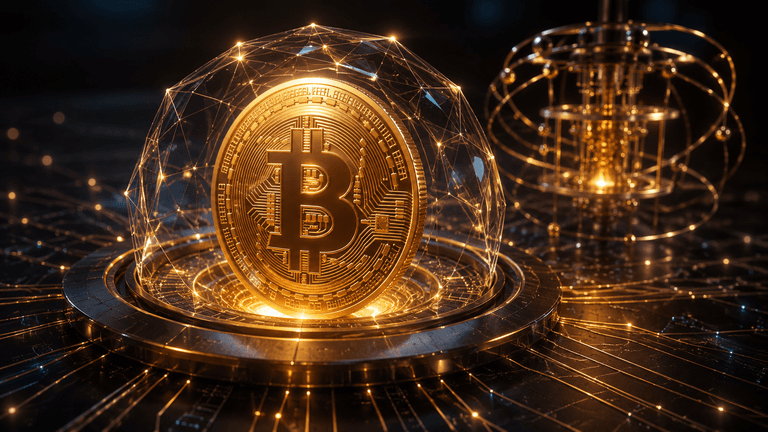
StarkWare has completed the first quantum-resistant Bitcoin transaction on mainnet without changing Bitcoin’s consensus rules. The method offers a potential interim defense against future quantum attacks.
SShitij Gupta•Aug 27, 2026
StarkWare quantum-resistant Bitcoin transaction on the Bitcoin network
MentionedBTC$80,748.00+2.74%

StarkWare says it has successfully completed the first quantum-resistant Bitcoin transaction on the mainnet, demonstrating a way to protect BTC from future quantum-computing attacks without changing Bitcoin’s consensus rules.

The test moves StarkWare researcher Avihu Levy’s Quantum Safe Bitcoin (QSB) method from research into a working transaction. The development comes as Bitcoin has recently returned above $80,000, putting renewed attention on the network’s long-term security as well as its market performance.

How StarkWare’s Quantum-Safe Method Works

The method is designed to address a specific weakness that could emerge when a Bitcoin transaction sits in the mempool waiting for confirmation.

Levy’s approach uses signature grinding. Instead of accepting the first valid signature, the system generates millions of candidates until it finds one with a structure designed to avoid exposing vulnerable public-key information to a future quantum attacker.

StarkWare says the transaction uses hash-based protection rather than relying on Bitcoin’s existing elliptic-curve cryptography. The company says this can protect coins against an attacker equipped with a sufficiently capable quantum computer.

However, the process is far from practical for everyday Bitcoin transfers. Generating the transaction can require hours of computation, making it deliberately expensive.

The Transaction Bypassed Bitcoin’s Normal Mempool

There is another major limitation.

The QSB transaction uses a nonstandard format, meaning ordinary Bitcoin nodes would not relay it through the public mempool. Instead, StarkWare had to send the transaction directly to a miner willing to accept it.

MARA mined the transaction through its Slipstream service, allowing the experiment to reach the Bitcoin mainnet despite its unusual format. StarkWare says the transaction was completed without requiring a network fork.

This makes the achievement an important proof of concept, but not yet a replacement for a network-wide upgrade.

StarkWare Still Wants a Bitcoin Upgrade

Levy does not view the method as the final answer to Bitcoin’s quantum-security problem.

StarkWare CEO Eli Ben-Sasson also supports a protocol-level solution that would provide broader protection across the Bitcoin network. The company instead sees QSB as a potential safety measure while developers work toward a permanent upgrade.

That distinction is important. The experiment shows that Bitcoin can support a quantum-resistant transaction under its existing rules, but it does not make the entire network quantum-safe.

For now, the test gives Bitcoin developers another option to consider as quantum computing technology advances.

What Happens Next for Bitcoin?

The main question is whether Bitcoin can eventually adopt quantum-resistant protections at the protocol level without creating major disruption for existing holders and applications.

StarkWare’s experiment shows that a network fork is not necessarily the only way to protect individual holdings today. However, the high computational cost and the need to bypass the standard mempool make the current approach more of a lifeboat than a permanent solution.

For Bitcoin, the next step will be turning that proof of concept into a broader and practical security framework before quantum computing becomes a serious threat.

The information discussed by Altcoin Buzz is not financial advice. This is for educational, entertainment, and informational purposes only. Any information or strategies are thoughts and opinions relevant to the accepted levels of risk tolerance of the writer/reviewers and their risk tolerance may be different than yours. We are not responsible for any losses that you may incur as a result of any investments directly or indirectly related to the information provided. Bitcoin and other cryptocurrencies are high-risk investments so please do your due diligence.

Copyright Altcoin Buzz Pte Ltd.

Related

Bitcoin Lightning Network security vulnerability
Bitcoin BTC
Aug 27, 2026

Bitcoin Lightning Developers Confirm Vulnerabilities, Fixes Coming

Core Lightning developers confirmed several vulnerabilities in Bitcoin's Lightning Network software and will release patches before publishing technical details in early September.

BTC
Saloni Rathi
XRP price rally and growing XRPL lending activity
Altcoins
Aug 27, 2026

XRP Could Hit $3 as XRPL Lending and Institutional Use Expand

XRP's recent rally has renewed attention on its long-term potential as lending, DeFi yield opportunities and institutional activity expand across the XRP Ledger.

XRP
Anmol Billa
XRP Price Rally
Altcoins
Aug 25, 2026

XRP Rally Stalls at $1.55: Key Support and Resistance Levels to Watch

XRP’s sharp August rally has stalled near $1.55, with an overbought RSI and lingering death cross putting the recovery to a key test.

XRP
Bikash Deka