AltcoinBuzzAltcoinBuzz
Subscribe
  • Crypto News
  • Crypto Research
  • Technical Analysis
AltcoinBuzzAltcoinBuzz

An independent digital media outlet delivering crypto research, news, and technical analysis to a community of 600,000+ users.

Follow us on:

Discover

  • Crypto Research
  • Crypto News
  • Technical Analysis
  • Key Opinions
  • Upcoming Launches

Categories

  • Bitcoin BTC
  • RWA
  • Technology
  • Altcoins
  • Regulation

Company

  • Affiliates
  • Partners & Sponsors
  • Careers
  • Contact
  • Terms of Use
  • Subscription Terms
  • About the ALTCOIN BUZZ
  • Privacy Policy
  • Contact ALTCOIN BUZZ
  • Advertise with us

Copyright 2026 ALTCOIN BUZZ. All rights reserved.Something is buzzzzzzzing.
HomeCrypto NewsTron Post-Quantum Signatures Go Live on Nile Testnet
Crypto NewsTechnologyAltcoins

Tron Post-Quantum Signatures Go Live on Nile Testnet

Tron's post-quantum signatures are live on the Nile testnet with Falcon-512 and ML-DSA-44. Mainnet still needs governance approval and security testing.
SSaloni Rathi•Oct 10, 2026
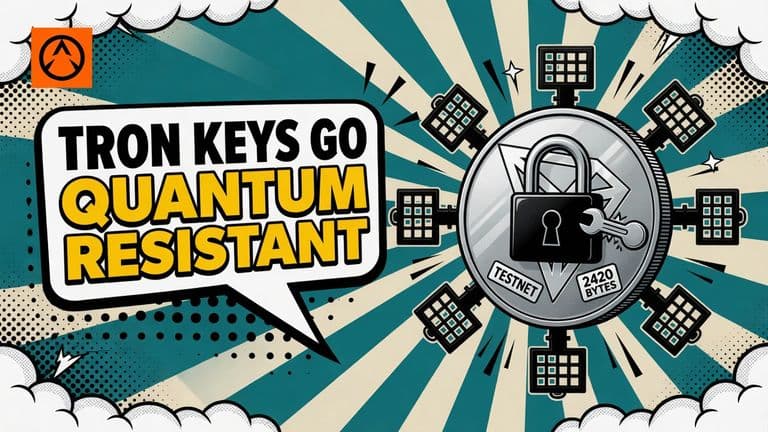
A comic-style illustration of a large Tron coin with a padlock clamped over it and oversized lattice keys beside it, on a TESTNET board, with a speech bubble headline about quantum-resistant keys.
MentionedTRX$0.331042-0.35%

Tron's post-quantum cryptography is live on testnet, Justin Sun said in a post on X on Saturday. The Tron founder added that the network is tracking advances in quantum computing and AI, and is ready to bring quantum resistance to mainnet at any time.

What that means for you, practically: the code to sign Tron transactions with quantum-resistant keys now exists on Nile, a developer testnet. Anything you hold, sign or bridge on Tron mainnet today still runs on the same elliptic curve cryptography as Bitcoin. The change has not reached the chain your assets sit on.

What the Nile Testnet Actually Runs

Nile's release page lists the current build as GreatVoyage-Nile-v4.8.2.3-PQ1-build1, codenamed Anaxagoras, updated on Thursday, October 8, 2026. Sun said the testnet activated Proposal No. 20628 to switch on post-quantum signature support.

Two schemes are supported, each turned on by its own committee proposal: FN-DSA-512, also known as Falcon-512, and ML-DSA-44, also known as Dilithium-2. Both are NIST standards. A hard fork, VERSION_4_8_2_PQ1, gates the two proposals, ALLOW_FN_DSA_512 and ALLOW_ML_DSA_44.

The coverage is wider than transaction signing. It includes block production signatures from Tron's super representatives, handshakes between peer-to-peer nodes, and signature verification inside smart contracts on the Tron Virtual Machine.

That is a lot of activity to re-secure. TRON DAO says the chain carries the largest circulating supply of USDT, over $94 billion, with more than 406 million user accounts, over 15 billion transactions and more than $28 billion in total value locked.

Bigger Keys Mean Fewer Transactions Per Block

The trade-off is size. Nile's notes give the numbers:

  • Falcon-512: a variable-length signature of up to 667 bytes, with an 896-byte public key.
  • ML-DSA-44: a fixed 2,420-byte signature and a 1,312-byte public key.

Those are heavy next to the ECDSA signatures Tron uses now, and the release notes show the team already managing the cost. The implementation counts a post-quantum authentication signature as bandwidth, and caps post-quantum transactions waiting in the pending pool at 1,000 per block.

Figures circulating that put the size penalty at roughly ten times an ECDSA signature come from secondary coverage and are not in Tron's own notes, so treat that multiplier as unverified. The direction is not in doubt: larger signatures take more room in every block, and Tron has put a ceiling on how many of them a block can carry.

Sun's Timeline Says Q3 2026, the Code Still Says Testnet

Tron's original plan called for a quantum-resistant testnet in the second quarter of 2026 and a mainnet rollout in the third. The migration to mainnet is projected for the third quarter of 2026, subject to approval through on-chain governance.

At Bitcoin Asia in Hong Kong on August 27, Sun said Tron plans to upgrade the blockchain to quantum-resistant security across the entire network by the end of 2026. He has also said Tron is set to be one of the few major blockchains that is quantum-resistant before Q-Day, the point where quantum computing can break current security standards. That comparison is his claim, not something independently verified.

The third quarter has passed. As of the Nile release page updated October 8, the post-quantum build is still testnet-only. Whether the Q3 mainnet target has been quietly pushed is not something we could confirm, and no source showed a completed mainnet migration.

How Ethereum and Solana Compare

Tron is not working alone on this. Ethereum's post-quantum page frames the job as a coordinated, multi-layer migration that will unfold over years, with milestones spread across the consensus, data and execution layers. Full post-quantum consensus and post-quantum transactions sit in the longer-term column, and Ethereum developers expect some Layer 1 upgrades to finish by 2029, with the wider execution-layer migration taking more years.

Solana chose a neighbour of Tron's approach. Anza and Firedancer, two of its validator client teams, worked separately and reached the same conclusion: a post-quantum signature scheme with compact signatures is needed for a high-throughput chain. Both settled on Falcon, the same family as Tron's Falcon-512, and built initial implementations. The Solana Foundation has also tested post-quantum signatures on a testnet. Solana notes that Blueshift's Winternitz Vault has been in place for over two years and calls it one of the few quantum-resistant primitives shipped and in use on a major blockchain today.

Elsewhere, a Strategy-led consortium pledged $15 million to fund Bitcoin quantum security research, the Ethereum Foundation published a proposal for migrating accounts to quantum-resistant cryptography, Algorand outlined plans for quantum-resistant accounts by 2027, and Coinbase CEO Brian Armstrong announced an advisory board in January 2026 focused on quantum computing and blockchain security.

What Has to Happen Before Mainnet

Going live for real needs three things: the two proposals, ALLOW_FN_DSA_512 and ALLOW_ML_DSA_44, approved through on-chain governance; a mainnet hard fork carrying the build; and security testing before the switch. Whether a mainnet committee vote exists right now is something we could not check, because the mainnet proposals page did not load.

Not everything is covered end to end either. Notes on the rollout list gaps in gas-free transfers, BIP-39 seed-phrase recovery and Ledger hardware wallets for post-quantum accounts, and argue it is too early to call Tron fully quantum safe. The wallet layer keeps turning up as the soft spot: Europol has said the quantum risk for crypto sits in wallet keys rather than blockchains. No independent third-party audit of Tron's post-quantum work turned up either.

For now the file to watch is the Nile release page, where version numbers and build notes change first, and Tron's mainnet governance proposals, which are how the feature would actually be switched on for the chain you use. We did not verify a TRX price move tied to the announcement, so we are not claiming one.

The information discussed by Altcoin Buzz is not financial advice. This is for educational, entertainment, and informational purposes only. Any information or strategies are thoughts and opinions relevant to the accepted levels of risk tolerance of the writer/reviewers and their risk tolerance may be different than yours. We are not responsible for any losses that you may incur as a result of any investments directly or indirectly related to the information provided. Bitcoin and other cryptocurrencies are high-risk investments so please do your due diligence.

Copyright Altcoin Buzz Pte Ltd.

Related

A pop-art comic cover showing a large Bitcoin coin sliding downward with a few small red bars falling from it, next to a tall empty chart column, with the headline Leverage Has Not Returned in a speech bubble.
Bitcoin BTC
Oct 10, 2026

A Year After the $19 Billion Crash, Crypto Leverage Has Not Returned

Twelve months after a record $19 billion liquidation day, the anniversary flush was one-nineteenth the size, and leverage has not returned.

BTC
Shitij Gupta
TOKEN2049 Singapore 2026 Sells Out
SocialFi
Oct 10, 2026

TOKEN2049 Singapore 2026 Sells Out, Drawing 25,000 Attendees to the World’s Largest Crypto Event

Crypto’s biggest week kicks off as TOKEN2049 Singapore returns on 7-8 October, convening 25,000 attendees from 160 countries with hundreds of side-events to light up the city

Shitij Gupta
A comic-style illustration of a life insurance policy document with a seal, a large bitcoin coin resting on it and a small beneficiary tag on the corner.
Bitcoin BTC
Oct 10, 2026

Bitcoin Life Insurer Meanwhile Raises $37.5M to Grow Bitcoin Life Cover Overseas

Meanwhile raised $37.5 million led by Bain Capital Crypto for its bitcoin-denominated life policies, which pay a death benefit in BTC outside the US.

BTC
Pallavi Malviya Gupta