XRP Ledger Starts Mirroring Brazilian Fund Records Tied to $4 Trillion
Brazilian financial-market operator CSD BR has begun copying ownership records for selected BTG Pactual investment funds onto the XRP Ledger.

By Anmol BillaSenior Analyst
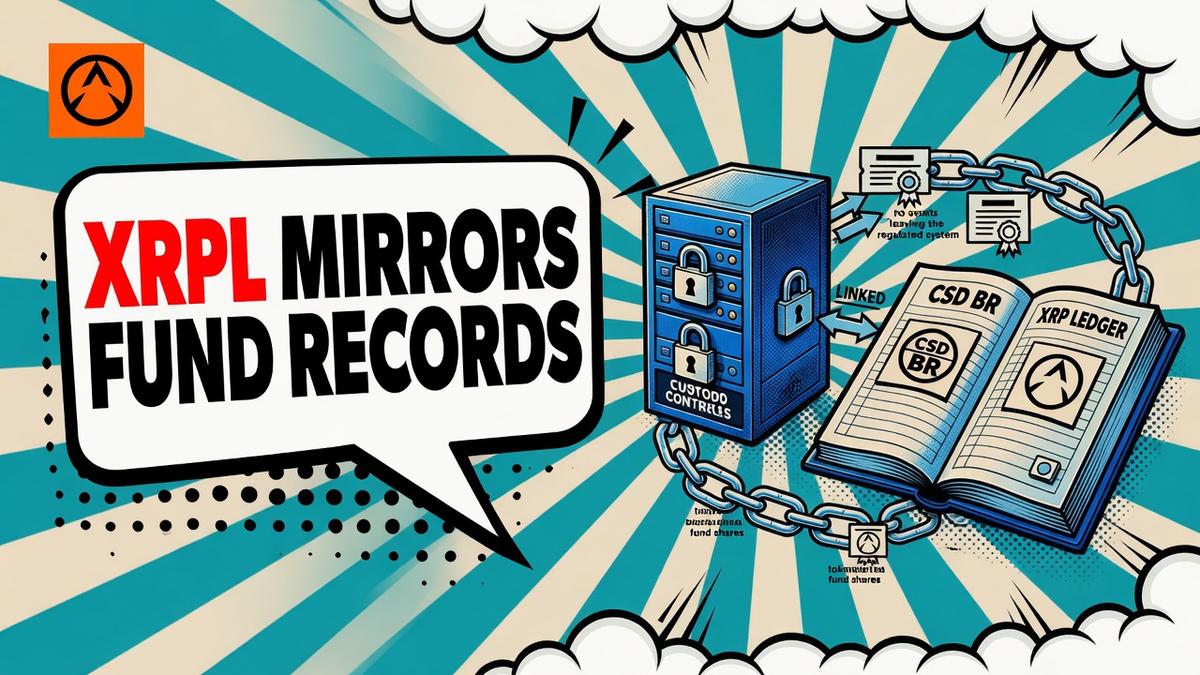
Brazilian financial-market operator CSD BR has begun copying ownership records for selected BTG Pactual investment funds onto the XRP Ledger. CSD BR's own database remains the official record for registration, custody and settlement.
For an XRP holder, the important distinction is that the assets are not moving onto XRPL. The widely reported $4 trillion figure covers assets registered across CSD BR's wider systems, not tokens issued on the ledger. The source provides no evidence that the project has increased demand for XRP or changed its price.
Live records, but no assets moving
CSD BR operates regulated registration, securities depository and settlement systems in Brazil. The company, founded in 2018, is authorised by both the country's central bank and securities regulator. Its systems register positions in securities, derivatives and other financial assets.
The XRP Ledger project is narrower. Selected fund shares held through CSD BR will be represented as tokens, while the public ledger will serve as a second record of ownership changes. CSD BR retains legal control of registration, custody and settlement.
That makes this more than a test with made-up assets. The records being copied relate to live funds. It is also less than a full transfer of those funds onto a public blockchain, because the existing system remains the final authority.
The reported scale needs care. More than 22 trillion reais in assets registered across CSD BR's systems, converting that figure to roughly $4 trillion. The report did not provide the exchange rate or conversion date, nor did it define whether the registered figure represented custody, administration or nominal value.
The records are public, control is not
CSD BR chose a public blockchain instead of a private network open only to invited members. Anyone can read the token movements on XRP Ledger, but CSD BR controls who may hold or transfer the fund tokens.
Participants must also pass identity and anti-money-laundering checks. CSD BR can restrict access and freeze assets or reverse transactions when required by a regulator or court.
The tokens use XRP Ledger's Multi-Purpose Token standard. It is designed for assets whose issuers need more control than cryptocurrencies such as XRP provide. Being visible on a public ledger therefore does not make these fund tokens freely tradable.
The system is also reversible. CSD BR's corrections, including reversals, will appear on the ledger. That creates a public trail which approved banks and companies can compare with CSD BR's database, but it does not give the public ledger final legal authority.
Why banks need a second record
Banks check their own accounting records against those held by a securities depository. This process, called reconciliation, can be slow and costly. If the records do not match, a trade may be delayed.
CSD BR says the XRP Ledger copy will let approved institutions check ownership changes in real time. If CSD BR's database and the blockchain record diverge, the gap should be visible without waiting for the usual comparison after the fact.
The claim is that the shared record will reduce reconciliation work while preserving existing identity checks and regulatory controls. The source did not provide measured savings, reconciliation times or evidence from participating institutions.
Direct on-ledger trading remains a later test
After testing the live record system, CSD BR and Ripple plan to explore issuing assets directly on XRP Ledger and allowing approved participants to trade them there. Candidate assets include Brazilian real-estate and agribusiness receivables, both established fixed-income segments.
Direct issuance could allow assets to change hands and settle on the blockchain in seconds. Ordinary securities trades can take a day or more to finalise. That settlement difference only applies if assets are eventually issued and traded directly on XRPL, which has not yet happened under the current project.
For now, the useful achievement is narrower: live ownership records are being copied to a public ledger, while CSD BR keeps control of the official record and the tokens. Whether that model lowers reconciliation costs or eventually supports direct settlement is not yet established in the reported evidence.

Anmol Billa
Anmol Billa is a Senior Analyst at Altcoin Buzz, with over five years of experience working across cryptocurrency markets and the broader digital asset industry. His work focuses on technical analysis, market research, investment insights, and evaluating emerging opportunities within the crypto ecosystem. At Altcoin Buzz, Anmol contributes to technical market analysis, research-driven insights, pitch decks, and funding-related initiatives. His experience combines analytical thinking with a practical understanding of crypto markets, helping translate market trends and emerging projects into clear, actionable insights for readers and industry stakeholders.
More from AnmolNext up
Lighter Blames Leaked API Key for Reported $15.5M Drain
Lighter blames a leaked API key, not its contracts, for the 16 November incident that halted withdrawals; researchers estimate a $15.5 million loss.
 LITUSDC
Related
More in Crypto NewsRelated
NVIDIA Posts 103% Revenue Growth as AI Crypto Projects Watch GPU Demand
 TAORENDER
Solana Foundation Acquires Majority Stake in CoinGecko
 SOL
Vitalik Buterin Flips to 'Total Bull' on leanPCS as Ethereum Eyes Quantum-Safe Future
 ETH
Zoom, CNN & Ledger Caught in Major Crypto Malware Attack Across 178 Sites
 BTCETH