Pudgy Penguins-backed Abstract will shut down on December 15 after Igloo lost tens of millions of dollars funding the consumer-focused Ethereum Layer 2.
 PENGU$0.008938-5.20%
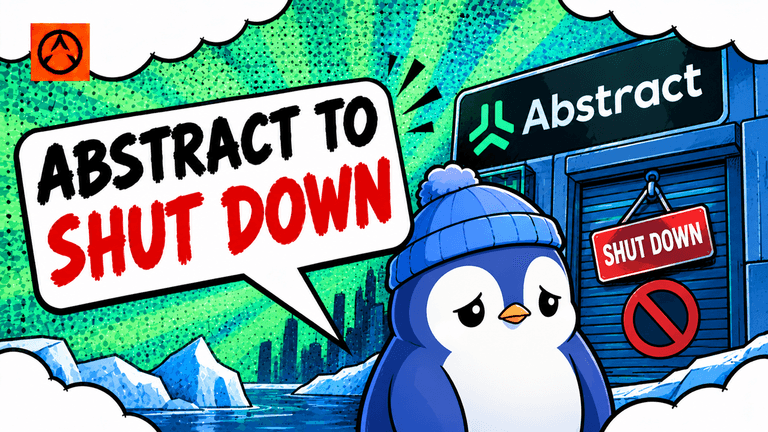
Abstract, the Ethereum Layer 2 backed by Pudgy Penguins parent company Igloo Inc., will shut down on December 15, 2026.
Igloo CEO Luca Netz said the company spent about 18 months funding Abstract and lost tens of millions of dollars while trying to build a sustainable consumer crypto business.
The decision comes despite Abstract onboarding more than 400,000 users, deploying more than 144 apps and processing over 325 million transactions.
The company ultimately concluded that running a blockchain focused mainly on consumer crypto was not sustainable as a standalone business.
Abstract launched its mainnet in January 2025 with a specific goal: bring mainstream consumers into crypto through games, entertainment and other easy-to-use applications.
The network was built as an Ethereum Layer 2, meaning it processes transactions separately before settling activity back to Ethereum.
Igloo hoped the popularity of Pudgy Penguins could help Abstract attract a large consumer audience.
That strategy brought users and major brand partnerships, including Disney and Red Bull Racing. But the network struggled to turn that attention into enough sustained activity and liquidity.
Abstract said stalled growth, thin liquidity, a limited DeFi ecosystem and weak institutional adoption were among the problems it faced.
Abstract's numbers show the difficulty of turning blockchain usage into a profitable business.
The network reported more than 325 million transactions and around 4 million wallets. Businesses operating on the chain generated more than $40 million in revenue, according to figures reported by CoinDesk.
But revenue generated by applications does not automatically become revenue for the blockchain itself.
A game or trading application can earn money from its users while the underlying Layer 2 receives only a smaller share through transaction fees.
DefiLlama data showed Abstract generating only about $3,900 in chain fees over a recent 24-hour period, compared with roughly $39,000 in revenue generated by applications on the network.
That gap highlights one of the central problems facing specialized Layer 2 networks.
High user numbers and transaction counts do not necessarily translate into enough recurring revenue to cover the cost of operating a chain.
Igloo also considered another way to fund Abstract: launching a native token or conducting an initial coin offering.
The company decided against it.
Netz said a token would only make sense if there were genuine demand driving its value. He argued that launching a token without confidence in the underlying business would not be fair to the community.
Instead, Igloo will redirect its resources toward Pudgy Penguins, its NFTs and PENGU.
That decision is notable because token launches have become an important funding mechanism for many blockchain networks.
Abstract's closure therefore shows that a project can choose not to create another token simply to extend the life of an unsustainable business model.
The shutdown also creates an immediate requirement for Abstract users.
Users need to move their assets off the network before December 15.
Abstract has provided a Migration Hub and its native bridge for users to transfer funds. The native bridge can take about three hours, according to reporting on the shutdown.
Funds left on the network after the deadline could become inaccessible.
That makes the December deadline more than an administrative closure date.
Users holding assets on Abstract need to complete their migration before the network stops operating.
The timing makes Abstract's closure even more significant.
Just days earlier, Blast announced that it would also shut down its Ethereum Layer 2 because operating costs had exceeded revenue.
Altcoin Buzz recently covered Blast to Shut Down After TVL and Revenue Collapse.
The two projects have different histories, but their closures point to the same underlying challenge: operating a Layer 2 requires sustained economic activity, not just users and liquidity attracted during periods of high crypto interest.
For Abstract, the challenge was particularly difficult because it deliberately focused on consumer applications rather than building a broad DeFi ecosystem.
Abstract was built around the idea that crypto could reach mainstream users through familiar experiences such as games, entertainment and digital collectibles.
Pudgy Penguins provided a strong brand for that strategy.
But the chain's experience suggests that attracting consumers is only one part of building a successful blockchain network.
A sustainable chain also needs enough transactions, liquidity, developers, applications and fee revenue to support its operating costs.
Abstract said the broader Layer 2 market had changed significantly since the project was conceived. Larger networks have also competed aggressively for developers, liquidity and users.
That made it increasingly difficult for a specialized consumer chain to justify its own operating costs.
With Abstract closing, Igloo will now put its resources back into the Pudgy Penguins ecosystem.
The company plans to focus on Pudgy Penguins, Pudgy NFTs and PENGU rather than continuing to subsidize a separate blockchain.
For Igloo, that means ending an expensive experiment rather than continuing to spend money without a clear path to profitability.
The move also reinforces the difference between building a successful crypto brand and operating a blockchain network.
Pudgy Penguins has expanded beyond NFTs into toys, games and other consumer products. Abstract attempted to turn that consumer reach into a dedicated blockchain ecosystem, but the economics did not work.
Abstract's closure is another reminder that the Layer 2 market is becoming more competitive.
Launching a chain can attract users through incentives, partnerships and speculation. Keeping those users active after the initial excitement is much harder.
Abstract managed to attract hundreds of thousands of users and major brands, yet still could not generate enough sustainable economics to justify continued funding.
That could push future Layer 2 projects to focus more heavily on revenue, liquidity and recurring demand from the beginning.
For Abstract, the experiment will end on December 15.
For the broader Ethereum ecosystem, the shutdown raises a larger question: how many specialized Layer 2 networks can survive when user growth does not translate into sustainable revenue?

Orca's ORCA token jumped 24% as reported year-to-date tokenized-stock volume reached $1.2 billion and revenue reached $1.4 million.
 ORCA
ORCA
Muneeb Ali pledged to move Stacks Labs' intellectual property to a shareholder-free Endowment.

Bitcoin fell as low as $83,840 and CoinGlass recorded $485.21 million in long liquidations over 24 hours, as oil climbed on Iranian tanker attacks.
 BTC
BTC ETH+3 more

