AltcoinBuzzAltcoinBuzz
Subscribe
  • Crypto News
  • Crypto Research
  • Technical Analysis
AltcoinBuzzAltcoinBuzz

An independent digital media outlet delivering crypto research, news, and technical analysis to a community of 600,000+ users.

Follow us on:

Discover

  • Crypto Research
  • Crypto News
  • Technical Analysis
  • Key Opinions
  • Upcoming Launches

Categories

  • Bitcoin BTC
  • RWA
  • Technology
  • Altcoins
  • Regulation

Company

  • Affiliates
  • Partners & Sponsors
  • Careers
  • Contact
  • Terms of Use
  • Subscription Terms
  • About the ALTCOIN BUZZ
  • Privacy Policy
  • Contact ALTCOIN BUZZ
  • Advertise with us

Copyright 2026 ALTCOIN BUZZ. All rights reserved.Something is buzzzzzzzing.
HomeCrypto NewsAptos Turns On Encrypted Mempool, Doubling the Minimum Gas Price
Crypto NewsPrivacyTechnology

Aptos Turns On Encrypted Mempool, Doubling the Minimum Gas Price

Aptos put encrypted transactions on mainnet on October 12. The feature hides your order from frontrunners, and it doubles the minimum gas price.
AAnmol Billa•Oct 13, 2026
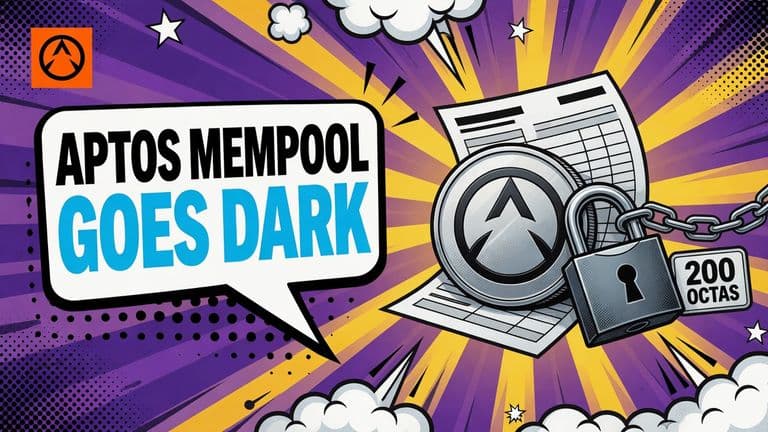
A pop-art comic illustration of an Attos coin with a padlock sealing a transaction sheet, with a headline bubble reading Aptos mempool goes dark.
MentionedAPT$0.851118-4.50%

Aptos switched on encrypted transactions for its mainnet on Monday, October 12. The feature is optional, and it does one thing: it keeps what a transaction contains hidden until the order of the block is locked in, so the bots that watch pending transactions have nothing to read.

That privacy shows up on the fee schedule. Encrypted transactions carry a minimum gas-unit price of 200 Octas per unit, twice the network's base minimum, plus a flat 375 gas units charged for decryption, per Aptos's developer documentation. The same page works through one example. A transfer using 150 gas units costs 15,000 Octas in the clear at 100 Octas per unit. Encrypted, it costs about 105,000 Octas, or 0.00105 APT. That is seven times the bill for the same transfer.

What It Changes If You Trade on Aptos

If you hold APT and never send a transaction, this changes nothing about your position. If you swap on an Aptos venue or move size through it, opting in gives you a way to stop bots reading your order before it executes, and it makes that order more expensive. Both halves of that trade are real, and only one of them is optional.

Aptos says the feature was built for institutions submitting large transactions to the chain, traders wanting to avoid MEV risk, AI agents and builders. Your wallet has to support it. Petra is the first wallet to fold the encrypted mempool into its signing flow, Decibel is a planned user, and the Aptos TypeScript SDK can handle the encryption from version 7.0.0 onward, according to the SDK's page on the feature.

How a Blind Mempool Works

When you opt in, a compatible wallet or app encrypts the transaction's contents on your device before sending it to Aptos. The assets and amounts stay hidden. The sender's address and the gas fee remain visible to anyone watching.

Validators then agree on the order without seeing what they are ordering. AIP-144, the protocol spec behind the feature, describes it plainly:

the transaction's payload will be encrypted client-side before submission, and the block leader will order these transactions while being completely blind to their payloads.

Once ordering is final, the validators decrypt the transactions together and execute them. No single validator can decrypt a pending transaction on its own. In practice, the fullnode your app talks to has to expose a ledger encryption_key when encrypted submission is switched on.

Some accounts cannot use it at all. Keyless, federated keyless and account abstraction accounts cannot sign encrypted transactions, a rule enforced on both the client and the server side.

What Stays Visible

The docs are direct about the limits. Treat encrypted pending as payload privacy, not anonymity of the whole transaction. Clients may still see metadata such as the sender, gas parameters, expiration and signatures. The AIP says the first version's goal is to hide transaction payloads, and that hiding the sender and other metadata is out of scope.

There is also a way to defeat the encryption by accident. The SDK page warns that simulating an encrypted transaction is not supported. Building a plaintext twin to simulate it and then submitting the encrypted version can let observers correlate the two and infer the encrypted payload's contents. The docs discourage it.

Encrypted pending transactions are also not the same thing as confidential assets transactions, which keep balances and amounts private even after confirmation. This feature only covers the trip to execution.

Why Aptos Is Betting on MEV Losses

The numbers behind the pitch are large. Sandwich attacks, one form of MEV attack, cost Ethereum traders about $60 million over the 12 months through October 2025, based on an analysis of EigenPhi data. On Solana, Bitquery data showed sandwich attacks generated $29.7 million for bots over an 11-month period, with nearly 6.9 million attacks touching about 2.2 million wallets.

Aptos is not first to the idea. Gnosis Chain launched an encrypted mempool with Shutter in July 2024, and Ethereum's Flashbots Protect routes transactions privately to block builders. Aptos says its distinction is that its existing validators handle both the ordering and the decryption, rather than a separate decryption committee or trusted builders. That is also where the latency cost lands: Aptos says the system adds around 20 milliseconds per block in tests involving 50 nodes, against its existing consensus implementation.

What Is Still Unsettled

The governance record behind the launch is thinner than the launch itself. AIP-144 lists Rex Fernando of Aptos Labs as its author, is of type Core, carries the status Accepted and a created date of January 9, 2026. What it does not show is a verified onchain vote result. The governance portal did not resolve when it was checked, and the claim that proposal 206 passed appeared only in search snippets, so the turnout and approval numbers are not ones this article can give you.

The AIP also claims the encrypted mempool will support over 1,000 transactions per second at launch with minimal latency overhead, using a new batch threshold encryption scheme. It says that scheme needs a one-time trusted setup ceremony that each validator must store and use during decryption, and it argues the system adds no trust assumptions beyond those the network already operates under. Those are two claims worth holding next to each other.

Aptos said the implementation went through an independent security review by ZKSecurity. The announcement did not detail what the review found.

The timing is worth noting too. The launch landed the day after an unlock of 11,455,550 APT, worth about $9.95 million, on October 11.

For a holder, the practical question is simple and still unanswered in dollars. On the next trade you make through an Aptos wallet that supports this, is the extra encrypted fee cheaper than the sandwich you avoid? The feature is live, the opt-in is yours, and the answer will be different at every size.

The information discussed by Altcoin Buzz is not financial advice. This is for educational, entertainment, and informational purposes only. Any information or strategies are thoughts and opinions relevant to the accepted levels of risk tolerance of the writer/reviewers and their risk tolerance may be different than yours. We are not responsible for any losses that you may incur as a result of any investments directly or indirectly related to the information provided. Bitcoin and other cryptocurrencies are high-risk investments so please do your due diligence.

Copyright Altcoin Buzz Pte Ltd.

Related

A comic-style illustration of mining rigs with a cable pulled out of the front and a Bitcoin coin on the machine, beside a Binance-badged plug, under a speech bubble reading BINANCE POOL SHUTS DOWN.
Altcoins
Oct 13, 2026

Binance to Shut Its Mining Pool Nov. 10, Ending a Six-Year Run

Binance will discontinue Binance Pool and related services on Nov. 10, 2026.

BTC
Anmol Billa
Bitcoin falls below $82,000 as crypto liquidations exceed $770 million
Bitcoin BTC
Oct 13, 2026

Bitcoin Falls Below $82,000 as $770M in Crypto Liquidations Hit Traders

Bitcoin fell below $82,000 as $771 million in crypto positions were liquidated over 24 hours. Long traders took most of the losses as ETF outflows and a sharp decline in South Korean stocks added to market pressure.

BTC

Bikash Deka
Canton Network records $155 million in third-quarter 2026 fees
Altcoins
Oct 13, 2026

Canton Network Records $155 Million in Q3 Fees

Canton Network recorded $155.36 million in third-quarter fees, topping CertiK’s comparison. Its average daily fee pace was lower than the rate reported in June.

CC
Bikash Deka

Altcoin Buzz
Altcoin Buzz
@Altcoinbuzzio
·Follow

Aptos just launched an encrypted mempool on mainnet to hide pending trades from front-running bots. The market's response? aptos:native dropped 12% the same day, the second-worst move in the top 100. The bots weren't the only ones who left...

Image
4:17 AM · Oct 13, 2026
4
Reply
Read 2 replies