AltcoinBuzzAltcoinBuzz
Subscribe
  • Crypto News
  • Crypto Research
  • Technical Analysis
AltcoinBuzzAltcoinBuzz

An independent digital media outlet delivering crypto research, news, and technical analysis to a community of 600,000+ users.

Follow us on:

Discover

  • Crypto Research
  • Crypto News
  • Technical Analysis
  • Key Opinions
  • Upcoming Launches

Categories

  • Bitcoin BTC
  • RWA
  • Technology
  • Altcoins
  • Regulation

Company

  • Affiliates
  • Partners & Sponsors
  • Careers
  • Contact
  • Terms of Use
  • Subscription Terms
  • About the ALTCOIN BUZZ
  • Privacy Policy
  • Contact ALTCOIN BUZZ
  • Advertise with us

Copyright 2026 ALTCOIN BUZZ. All rights reserved.Something is buzzzzzzzing.
HomeCrypto NewsESMA Sets 8 January 2027 Deadline for Non-Compliant Stablecoins
Crypto NewsRegulationStablecoins

ESMA Sets 8 January 2027 Deadline for Non-Compliant Stablecoins

ESMA's opinion gives MiCA-licensed crypto firms three months, until 8 January 2027, to stop serving EU clients with non-compliant stablecoins.

SShashwat Gupta•Oct 8, 2026
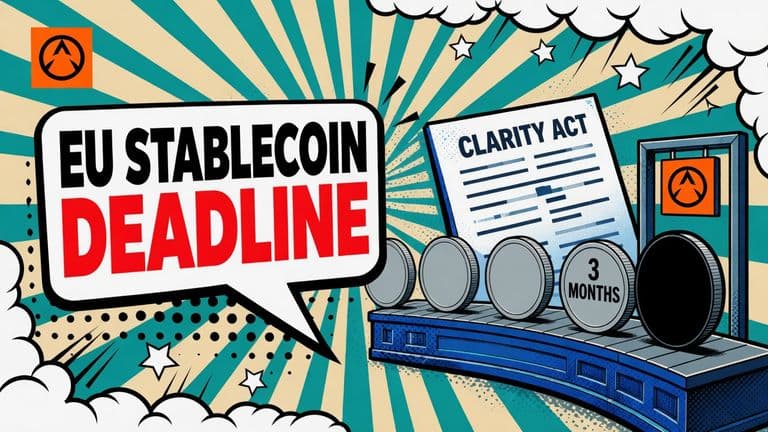
A pop-art comic illustration of plain coin discs moving along a conveyor through a one-way gate as a heavy shutter closes behind them, with a calendar block and a regulator badge beside the gate.

ESMA has put a date on the end of the line. The EU regulator published an opinion on 8 October 2026 telling MiCA-authorised crypto firms to stop serving EU clients with stablecoins that do not meet MiCA rules, and it set three months as the outside limit for clearing what is left.

For anyone still holding one of the older tokens, that is the change worth understanding. The expectation was already there. Now it is on the clock. Three months from 8 October 2026 lands on 8 January 2027.

The Clock Is the News, Not the Ban

We wrote in early October about the possibility that EU firms would be barred from holding non-compliant stablecoins. The opinion published on 8 October answers a narrower question: how long firms have to unwind what they already carry.

The direction was set earlier. ESMA's January 2025 statement, published on 17 January 2025, told national regulators to get crypto-asset service providers compliant as soon as possible, and no later than the end of the first quarter of 2025. That gave firms a target without naming the services in scope or a hard stop.

The opinion says what firms should stop doing:

Crypto-asset service providers (CASPs) authorised under MiCA should cease providing services related to non-MiCA-compliant stablecoins to clients in the European Union.

That covers the full range of MiCA crypto-asset services, and ESMA names ten of them: operating trading platforms, exchange services, execution of orders, placing of crypto-assets, reception and transmission of orders, investment advice, transfers, custody and administration, and portfolio management, whether offered alone or combined. It applies to asset-referenced tokens and e-money tokens whose offer or admission to trading does not satisfy MiCA, including tokens leaning on exemptions or transitional arrangements.

Three Months Is a Ceiling, Not an Entitlement

The timeline is easy to misread, and ESMA seems to know it. National Competent Authorities are told to require remediation as soon as possible and no later than three months after publication. The regulator is explicit that this is an outside limit for legacy positions that still need clearing, not permission to keep serving clients for another quarter.

Where a service does continue, it narrows sharply. ESMA says any continuation should be strictly limited to what is necessary for liquidation, conversion, withdrawal, transfer or safekeeping, and should stay time-limited, risk-based and closely supervised. In practice that reads like a one-way exit door for existing positions rather than a venue where clients can keep trading.

To enforce it, the opinion asks National Competent Authorities to supervise that market participants neither maintain, introduce, nor facilitate client access to these tokens. Firms are expected to build technical, contractual and organisational controls, including controls that stop clients from acquiring or increasing exposure.

Why a Warning Screen Will Not Do

One design decision stands out for anyone who has watched exchanges handle a delisting: disclosure is not treated as a fix. ESMA says warnings and customer acknowledgments cannot replace the issuer protections MiCA requires, because the user would still be exposed to an asset that does not meet the rules.

The reasoning is about what a platform can control. ESMA argues that services involving unauthorised stablecoins expose customers to risks from missing issuer protections that a crypto platform cannot correct on its own. Under MiCA, issuers of qualifying e-money tokens must be authorised as a credit institution or an electronic money institution and meet disclosure and redemption requirements, while asset-referenced tokens face separate rules on reserves, governance and supervision. A trading venue can add a banner. It cannot add those.

ESMA also leans on Article 66(1) of MiCA, the duty to act honestly, fairly and professionally in clients' best interests.

What to Watch Before January

The opinion is addressed primarily to National Competent Authorities, which supervise authorised firms in their own jurisdictions, so the practical timeline depends on how each one acts. ESMA's MiCA register lists authorised crypto service providers, asset-referenced token issuers, e-money token issuers and entities identified as non-compliant, supplied by national authorities and the European Banking Authority.

The opinion is not a blanket prohibition on holding these tokens outside regulated services, and it is not the only move ESMA has made. On 30 September 2026, a week before the opinion, ESMA called for MiCA itself to be amended so that regulated crypto firms face an explicit legal rule against services linked to non-compliant stablecoins. An opinion guides supervisors. An amended regulation binds.

Two things stay open. There is no public list of which issuers or tokens still carry EU exposures after the deadline, and no figure for how much is still held. Nor has any national regulator yet published a date earlier than 8 January 2027, which the three-month ceiling allows.

The information discussed by Altcoin Buzz is not financial advice. This is for educational, entertainment, and informational purposes only. Any information or strategies are thoughts and opinions relevant to the accepted levels of risk tolerance of the writer/reviewers and their risk tolerance may be different than yours. We are not responsible for any losses that you may incur as a result of any investments directly or indirectly related to the information provided. Bitcoin and other cryptocurrencies are high-risk investments so please do your due diligence.

Copyright Altcoin Buzz Pte Ltd.

Related

A large coin marked with the NEAR logo rides a rising arrow with a stack of leverage arrows behind it and a small badge showing the market-cap figure.
Altcoins
Oct 8, 2026

NEAR Rises 137% in 30 Days as Perps Reach 40% of Market Cap

NEAR climbed 137% in 30 days to the edge of crypto's top 20. Here's what the Bitwise ETF, Intents volume and a 40% open-interest ratio show.

NEARXLM
Saloni Rathi
Meteora MET rises after DLMM Pro launch and new WLD pairs on Solana
Altcoins
Oct 8, 2026

Meteora Jumps 67% as DLMM Pro Expands Solana Liquidity Tools

Meteora's MET token surged more than 67% as the protocol unveiled DLMM Pro and expanded its Solana ecosystem with new WLD trading pairs.

MET
Bikash Deka
A comic-style illustration of a TRON coin and a Polygon coin joined by one arrow carrying a small USDT coin, with a phone showing a deposit address and a speech bubble headline.
StablecoinsAltcoins
Oct 8, 2026

Polygon Adds TRON Support for Cross-Border Transfers and Stablecoin Payments

Polygon's Open Money Stack now supports TRON, routing USDT between the networks in one flow.

POLTRX
Saloni Rathi