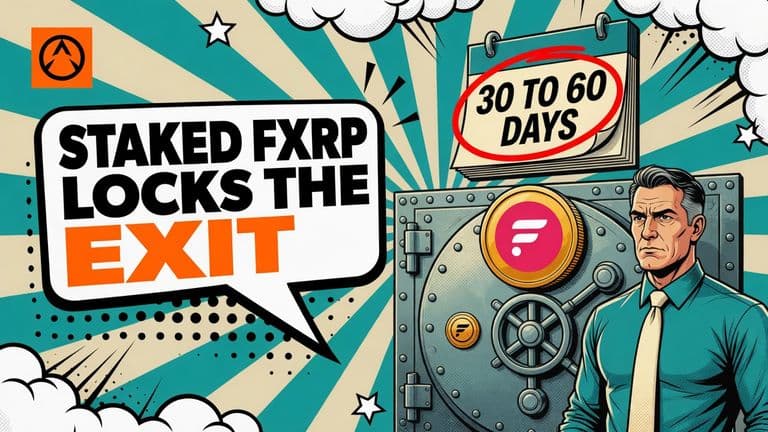
Firelight's October 6 activation moved existing staked FXRP into pooled cover backing. Exits now run 30 to 60 days and emissions stop at unstake.
 XRP$1.31-4.71%FLR
  FXRP$1.31-4.71%
Firelight's October 6 activation did something quiet: it moved staked FXRP into the protocol's coverage phase, and holders did not have to sign anything to end up there. No migration transaction, no separate opt-in. Firelight's withdrawal docs say stXRP held in Phase 1 converts automatically to an active staked position, and Flare describes the same cutover as Phase 1 positions converting on their own.
The tidy part is the conversion. The part holders will feel is the exit. It now runs 30 to 60 days, and the rewards stop at the start of the wait.
FXRP is the XRP-backed asset on Flare, and stXRP represents a position in Firelight's vault, the single pot of capital that every covered vault draws on. Because the change happened on Firelight's side, an existing depositor's position became part of the pool backing cover without them lifting a finger.
Firelight's launch post frames the design as a deliberate departure: the capital behind its cover comes from participants staking to the protocol, rather than from an insurer holding one contractual risk position. Existing depositors are now those participants. The same post says the unstaking window widened to match the 30-day coverage periods as cover was switched on, and the docs date that period change to October 6, 2026.
The withdrawal docs state the rule plainly: the unstaking window is one full period after the period in which the unstake is initiated. With 30-day periods, that is 30 to 60 days, depending on how early or late in a period the request lands. The window exists so capital cannot leave ahead of the coverage obligations it backs.
There are two stretches inside that wait. In the first, the remainder of the period in which the unstake was initiated, the capital still backs coverage, and if an exploit lands in that window the pending withdrawal takes the same pro-rata slash as an active position. In the second, the reconciliation window, capital stops backing new cover and is not exposed to incidents in that period, but a slash attributed to a period when it did back coverage still applies to the pending withdrawal.
Emissions stop at the start. The docs say accrual ends the moment an unstake is initiated, because stXRP is redeemed then and its redemption value is snapshotted, so a position in the unstaking window earns neither the base rate nor a share of protocol emissions.
The withdrawal itself is not automatic either. A staker who initiates an unstake and never comes back leaves the assets in the vault until they submit the withdrawal transaction.
Pooled cover means pooled exposure. The risk docs are direct about it: a staker is not backing a single market, the exposure is to the aggregate claim experience of the protocol across all covered markets during the periods their collateral is active. Flare puts it more bluntly, saying a deposit backs cover and has no cover of its own.
Losses arrive in layers. A validated claim first draws on the First-Loss Buffer, a protocol-owned stablecoin reserve funded by Network top-ups and, in some configurations, a share of premium flow. Only if that buffer is exhausted does a loss reach vault positions pro rata. Smaller incidents never reduce a staker's balance, and the buffer's own balance counts toward coverage capacity. Firelight's capital adequacy docs add a floor of 1.2 on its capital adequacy ratio, enforced on-chain so capacity that would push the ratio below it cannot be allocated. Because part of the supporting capital is denominated in volatile assets, a price drawdown can push that ratio lower with no claim activity at all.
Every cover event is reviewed before any payout by the Firelight Risk Consortium, a five-firm panel made up of Hypernative, Native, Credora, Cyfrin and GFX Labs. Approving or rejecting an assessment sits with a 3-of-5 multisig, so the quorum is enforced by the signing threshold.
On the income side, the architecture docs say fees paid in USDC convert back to FXRP and flow into each staker's position with no separate action, lifting the redemption value over time. Compounded rewards carry the same slashing exposure as the original contribution.
DefiLlama shows $66.96 million in Firelight total value locked, down 11.1% over 30 days and second among the insurance protocols it tracks. The wallet Firelight identifies as its First-Loss Buffer held 1,000,002.59 USDT0 when the Flare explorer token balance was read.
Flare also states the deposit cap for aggregate staked positions is now $115 million XRP, and that FXRP has passed 150 million minted, with more than 90% of it deployed in onchain finance across seven networks. Its framing of the wider market is worth keeping: capital backing onchain cover equals about 0.14% of the nearly $100 billion in DeFi.
There is also a reward pool with a deadline attached. The early contribution campaign allocates 230,000 FXRP pro rata by Firelight Points, open for claims from October 7 at 10 a.m. ET until December 7 at 10 a.m. ET, with unclaimed allocations forfeited. Eligibility needs at least 200,000 points plus either DeFi participation on Spectra, Sparkdex, Enosys or Mystic, or a single stXRP held at the October 6 check.
The emissions wording does not line up. Firelight's launch post says stakers continue to earn emissions, and remain subject to slashing, until they have fully exited the unstaking queue. Its withdrawal and emission documentation says accrual stops at the moment an unstake is initiated. Both are Firelight's own pages, and neither read for this piece says which one governs a position sitting mid-queue.
The queue itself is a blank. No page read here gives a number for pending withdrawals, how many holders are in them, or how fast the line is filling, and no project statement or on-chain query confirming that the queue has grown turned up. The wait is documented. Its current length in practice is not.
What a holder can plan against is the published range: 30 days if an unstake lands at the start of a period, 60 if it lands at the end. Everything else about the line remains unpublished.

US spot XRP ETFs added $11.31 million in the week ended October 9, extending inflows to 13 weeks, while net assets fell to $1.57 billion from $1.66 billion.
XRP BTC+2 more
ASIC has opened consultation on licensing, custody and capital rules for crypto platforms in Australia. Applications close 7 October 2027.

Bitcoin fell about 3% to near $81,000 after September CPI hit 3.7%, below the $81,500 cost basis of US spot ETFs, with whale holdings at 3.03 million BTC.
BTC
