AltcoinBuzzAltcoinBuzz
Subscribe
  • Crypto News
  • Crypto Research
  • Technical Analysis
AltcoinBuzzAltcoinBuzz

An independent digital media outlet delivering crypto research, news, and technical analysis to a community of 600,000+ users.

Follow us on:

Discover

  • Crypto Research
  • Crypto News
  • Technical Analysis
  • Key Opinions
  • Upcoming Launches

Categories

  • Bitcoin BTC
  • RWA
  • Technology
  • Altcoins
  • Regulation

Company

  • Affiliates
  • Partners & Sponsors
  • Careers
  • Contact
  • Terms of Use
  • Subscription Terms
  • About the ALTCOIN BUZZ
  • Privacy Policy
  • Contact ALTCOIN BUZZ
  • Advertise with us

Copyright 2026 ALTCOIN BUZZ. All rights reserved.Something is buzzzzzzzing.
HomeCrypto NewsGoogle Cuts Quantum Errors 40-Fold as Crypto Watches the Clock
Crypto NewsTechnologyBitcoin BTC

Google Cuts Quantum Errors 40-Fold as Crypto Watches the Clock

Google cut magic state errors about 40-fold on its Willow chip. The result sharpens the quantum timeline Bitcoin and Starknet are already planning around.

AAnmol Billa•Oct 16, 2026
A comic scientist holds one clean glowing quantum state above the Willow chip while discarded flawed ones fall away, with a Bitcoin coin and clock face at the lower right.
MentionedBTC$82,217.00+1.19%

Google Quantum AI said on Thursday it cut errors about 40-fold on its Willow chip using a technique called magic state cultivation, producing magic states at 99.99% fidelity. The work is published in Science.

For anyone holding crypto, the 40-fold figure is not the part that matters most. The cost of the resource Google just got better at making is.

Magic states are single-use, and Google says some estimates put up to 95% of a quantum computer's entire capacity into producing them, leaving little room for actual computing. Google calls this one of quantum computing's most severe resource bottlenecks, and says the Willow run is the first demonstration of a practical fix. Cheaper magic states do not break Bitcoin on their own, but they are one more part that a machine big enough to try would need.

Google's Fix Started as a 2024 Theory

In 2024, Google Quantum AI researchers Craig Gidney, Noah Shutty and Cody Jones developed what the company now calls magic state cultivation. A noisy state goes into a small region of the chip, then a chain of measurements throws out every attempt that shows a flaw and keeps growing the survivors.

Google says the Willow experiment is the first time cultivation has been shown to work on real hardware. In its own words: "On Google Quantum AI's Willow processor, our protocol achieved an extraordinary 40-fold reduction in errors relative to un-cultivated states. And we got T-states with a record logical fidelity of 99.99%."

Most of the Attempts Get Thrown Away

The gain comes at a cost. Only about 8% of attempts passed every check, meaning the chip discarded more than nine out of every 10 tries to keep one clean state.

Google is not claiming it is finished. It says it still has to demonstrate cultivation at a larger scale to make it realistic for practical quantum computing, and that plenty of technical challenges remain.

The measurement itself proved awkward. Google says a particular kind of lab noise, caused by electrical equipment drift and temperature variation, was interfering with the benchmark's validity, so the team added extra control to the system and invented a benchmarking technique that uses cultivation to measure itself. The company calls the result a new state of the art in quantum metrology.

Why Bitcoin Holders Are Watching the Clock

Cultivation feeds the estimates that worry crypto. In March, Google researchers published an analysis putting the cost of breaking Bitcoin's elliptic curve cryptography, the math that stops anyone deriving your private key from your public address, at fewer than 500,000 physical qubits. The analysis was co-authored with Ethereum Foundation researcher Justin Drake and Stanford cryptographer Dan Boneh.

The exposure is the key, not the chain. Europol has argued the quantum risk sits in wallet keys rather than blockchains, which is why signature schemes rather than ledgers are where the work is going.

Starknet Is Voting on Its Own Answer

Starknet's community forum opened a non-binding poll on 15 October asking whether the network should become an independent post-quantum L1. It runs for seven days, closing on 22 October.

StarkWare, the company behind the chain, announced on 8 October that it was exploring the move and has since said which way it leans. Two days after the announcement it posted that "Starknet becoming an independent L1 is our clearest path forward." Co-founder and chief executive Eli Ben-Sasson wrote on X: "Becoming an L1 is a big deal. So is post-quantum security. We want to hear what the community thinks."

Part of the technical case is already in place. Starknet runs on hash-based STARK proofs and native account abstraction, and the forum says the core protocol is provably safe from quantum computers while user accounts can adopt post-quantum signatures without a protocol upgrade. The parts under Starknet's own control can be quantum-resistant soon, it says. The parts that depend on Ethereum, such as the bridge and data availability, are tied to Ethereum's timeline.

The poll commits nobody to anything. It gauges whether holders want to explore the idea further. If the answer is yes, a research effort starts and leads to more detailed proposals and polls. If the answer is no, the post-quantum work continues with Starknet as a layer-2. Either way, the post says STRK remains the token with no new token, and bridges between Ethereum and Starknet stay open.

Holders look ready to say yes. By about 14:40 UTC on 15 October, 293 votes had been cast and 99.9% of roughly 179.8 million in voting power backed Yes. The poll has no quorum requirement, so the early tally is a signal rather than a mandate.

The token moved too. STRK rose roughly 20% to 25% intraday on 15 October, from around $0.07 toward $0.09, with futures volume near $895 million against about $116 million in spot and a scheduled unlock of 127 million STRK in the mix.

Google's Next Step Is Scale

Google's next step is a demonstration at larger scale, and it has not put a date on it. Starknet's poll closes on 22 October. The quantum machine that could threaten Bitcoin's keys is not built, and on Google's own account plenty of work remains. What changed this week is the price of one component, and how seriously crypto is treating the clock.

The information discussed by Altcoin Buzz is not financial advice. This is for educational, entertainment, and informational purposes only. Any information or strategies are thoughts and opinions relevant to the accepted levels of risk tolerance of the writer/reviewers and their risk tolerance may be different than yours. We are not responsible for any losses that you may incur as a result of any investments directly or indirectly related to the information provided. Bitcoin and other cryptocurrencies are high-risk investments so please do your due diligence.

Copyright Altcoin Buzz Pte Ltd.

Related

A comic-style illustration of a Solana wallet sending stablecoins along a thick arrow into a large elUSD coin on Ethereum, with a small badge marking $34B.
StablecoinsEthereum ETH
Oct 16, 2026

Aurora Intents Opens Elara's Ethereum Yield to Solana Wallets

Aurora Intents connects Solana wallets to Elara Finance's Ethereum treasury product, so stablecoins can be deposited and staked in two signatures.

SOL
Saloni Rathi
A comic-style illustration of Brad Garlinghouse ringing a bell at a Nasdaq podium beside a stack of XRP coins, with a speech bubble reading 473M XRP PUT TO WORK.
RegulationAltcoins
Oct 16, 2026

Garlinghouse Rings Nasdaq Bell as Evernorth Puts 473M XRP to Work

Ripple's Brad Garlinghouse and David Schwartz marked Evernorth's Nasdaq moment as the XRP treasury tapped Ripple, Kraken, Coinbase and BitGo.

XRP
Saloni Rathi
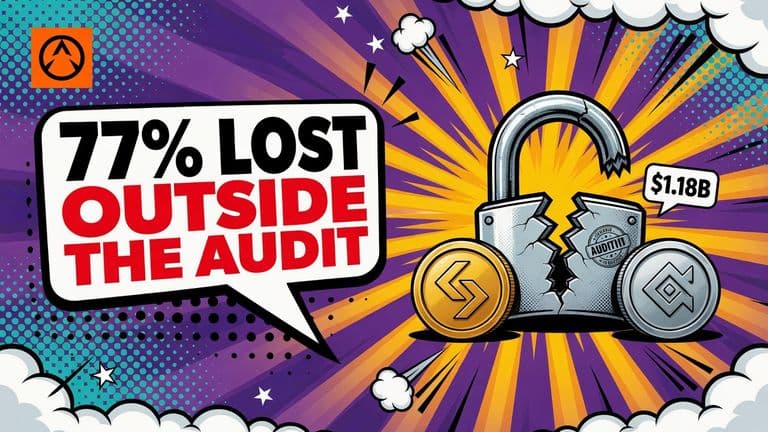
A comic-style broken padlock between two coins marked Bitget and Liquid Network, with a speech bubble reading 77 percent lost outside the audit.
Technology
Oct 16, 2026

Q3 Crypto Hacks Hit $1.18B, 77% Outside Security Audits

Crypto hacks stole $1.18 billion across 107 incidents in Q3 2026, up 55%. Hacken traces 77% of the losses to suppliers and developer tools outside audits.

Shashwat Gupta