India starts tokenizing $620 billion corporate bond market with digital rupee settlement
India has launched Demat 2.0, a pilot that tokenizes corporate bonds and settles transactions using the RBI's wholesale digital rupee, bringing blockchain technology deeper into regulated financial markets.

By Anmol BillaSenior Analyst
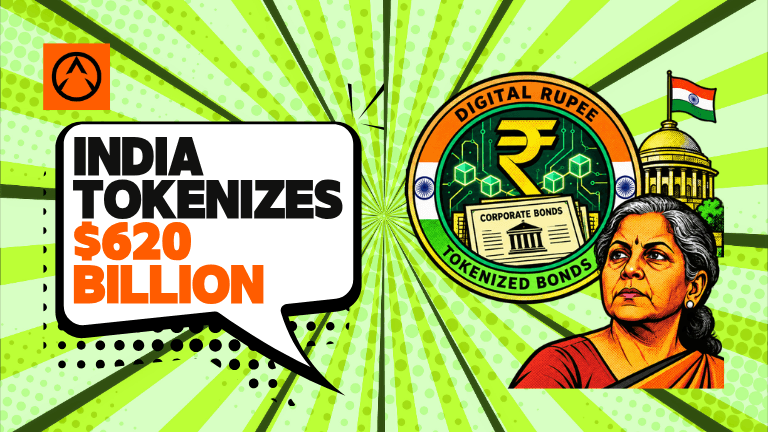
India has started testing blockchain-based settlement for corporate bonds, taking tokenization deeper into the country's traditional financial markets through a new pilot that combines digital securities with the Reserve Bank of India's wholesale digital rupee.
The Securities and Exchange Board of India (SEBI) launched the Demat 2.0 pilot on September 10, building on India's existing dematerialized securities infrastructure. Under the program, corporate bonds can be represented as digital tokens on a distributed ledger operated within the regulated financial system.
Three issuers are participating in the initial pilot. State-owned power-sector lender REC issued ₹500 crore of tokenized bonds, while Larsen & Toubro issued another ₹500 crore and IIFL Finance issued ₹25 crore, taking the total issuance under the pilot to ₹1,025 crore.
The bonds themselves remain conventional debt securities, with their existing interest rates, maturity dates and investor rights. What changes is the infrastructure used to record ownership and settle the transactions.
How Demat 2.0 works
Demat 2.0 connects the tokenized securities infrastructure with the RBI's wholesale central bank digital currency (CBDC) through the Unified Market Interface.
That allows the tokenized bond and the digital rupees used to purchase it to settle together. The approach is known as atomic delivery versus payment, reducing the settlement risk that can arise when securities and payment move through separate systems.
In a conventional transaction, the transfer of securities and the corresponding payment are coordinated across different systems. Connecting the two legs through a shared digital infrastructure can reduce reconciliation requirements and make settlement more direct.
The pilot also uses smart contracts to automate parts of the bond lifecycle. Interest payments and redemptions can be handled through programmable processes rather than requiring every step to be coordinated manually.
The approach is similar in principle to the broader tokenization trend developing across crypto and traditional finance. Robinhood Chain coverage, examined how tokenized equities are being used as on-chain assets. India's Demat 2.0 model is different, however, because the securities remain inside a regulated market infrastructure rather than being issued into an open crypto market.
Related: Robinhood Built a Chain for Tokenized Stocks. Memecoins Took Over
REC, L&T and IIFL test the system
REC became the first issuer in the pilot with a ₹500 crore tokenized corporate bond issue. L&T subsequently issued another ₹500 crore, while IIFL Finance completed a ₹25 crore issuance.
The initial transactions are aimed at institutional participants rather than the broader retail market.
The pilot is therefore less about immediately replacing India's existing corporate bond market and more about testing whether distributed-ledger technology can make issuance, settlement and asset servicing more efficient within the country's existing regulatory framework.
The first tokenized bonds also have a three-month lock-in period, with secondary-market activity expected to be introduced later.
Secondary trading and retail access come later
The initial phase focuses on primary issuance and settlement. Secondary-market trading is expected to be tested in later stages, while retail participation could eventually be expanded as the system develops.
That distinction is important because tokenizing an asset does not automatically create a liquid market for it.
A fully functioning tokenized bond market would require buyers and sellers to interact on compatible infrastructure, along with rules covering custody, settlement, taxation, accounting and investor protection.
SEBI and the RBI are therefore using the pilot to test the infrastructure before expanding participation.
India is taking a controlled approach to tokenization
Demat 2.0 is notable because India is pursuing blockchain-based financial infrastructure while maintaining tight regulatory control over the underlying assets.
Rather than moving corporate bonds onto open, permissionless networks, the pilot places banks, securities depositories, market infrastructure institutions and central-bank money at the center of the system. The initial pilot involves institutions including CDSL, NSDL, BSE, NSE, HDFC Bank, ICICI Bank and NPCI.
That approach allows India to experiment with some of the benefits associated with tokenization including faster settlement, programmable asset servicing and potentially lower reconciliation costs without opening the underlying securities infrastructure to unrestricted market access.
It also demonstrates that blockchain adoption does not necessarily require private cryptocurrencies to be part of the equation.
From dematerialization to tokenization
India's original dematerialization system transformed securities markets by replacing physical certificates with electronic records.
Demat 2.0 extends that idea by exploring whether the securities record and the money used to settle the transaction can both exist in programmable digital form.
The potential benefit is not simply putting a bond on a blockchain. The larger objective is to bring issuance, ownership, payment and servicing closer together in a single digital workflow.
If the pilot succeeds, tokenized corporate bonds could eventually provide a foundation for broader experiments involving other financial assets. SEBI has indicated that tokenization could eventually extend beyond bonds to areas such as equities, mutual funds and gold.
For now, however, Demat 2.0 remains a controlled pilot.
The ₹1,025 crore of tokenized bonds issued so far is small compared with India's broader corporate bond market. The significance of the project lies less in the size of the initial transactions and more in the infrastructure being tested.
India is effectively experimenting with a regulated version of on-chain finance, using tokenized securities, smart contracts and central-bank digital money while keeping the entire system inside the country's existing financial architecture.

Anmol Billa
Anmol Billa is a Senior Analyst at Altcoin Buzz, with over five years of experience working across cryptocurrency markets and the broader digital asset industry. His work focuses on technical analysis, market research, investment insights, and evaluating emerging opportunities within the crypto ecosystem. At Altcoin Buzz, Anmol contributes to technical market analysis, research-driven insights, pitch decks, and funding-related initiatives. His experience combines analytical thinking with a practical understanding of crypto markets, helping translate market trends and emerging projects into clear, actionable insights for readers and industry stakeholders.
More from AnmolNext up

Sentora Launches the First Externally Curated Markets on Aave V4
Sentora runs three new Aave V4 markets on Ethereum for borrowing RLUSD, PYUSD and OUSD. Here is how Hubs, Spokes and external curators fit together.
 AAVE
AAVE RLUSD
RLUSDRelated
More in Crypto NewsRelated
Lighter's LIT Jumps as Founder Plans CFTC Application in November
 LIT
LIT
Tokenized SECZ Shares Halve in 30 Days as Circle Tokens Gain
 SOLUSDC
Phantom Brings Kalshi Prediction Markets to US Users on Solana
SOL
Initia Halts Chain After $2.7M MoveVM Exploit, No Restart Date Yet
 INIT
INIT ETH
ETH