AltcoinBuzzAltcoinBuzz
Subscribe
  • Crypto News
  • Crypto Research
  • Technical Analysis
AltcoinBuzzAltcoinBuzz

An independent digital media outlet delivering crypto research, news, and technical analysis to a community of 600,000+ users.

Follow us on:

Discover

  • Crypto Research
  • Crypto News
  • Technical Analysis
  • Key Opinions
  • Upcoming Launches

Categories

  • Bitcoin BTC
  • RWA
  • Technology
  • Altcoins
  • Regulation

Company

  • Affiliates
  • Partners & Sponsors
  • Careers
  • Contact
  • Terms of Use
  • Subscription Terms
  • About the ALTCOIN BUZZ
  • Privacy Policy
  • Contact ALTCOIN BUZZ
  • Advertise with us

Copyright 2026 ALTCOIN BUZZ. All rights reserved.Something is buzzzzzzzing.
HomeCrypto NewsLedger Opens Bitcoin-Backed Loans Inside its Wallet
Crypto NewsBitcoin BTCDeFi

Ledger Opens Bitcoin-Backed Loans Inside its Wallet

Ledger's Crypto Loan lets you pledge cbBTC or wBTC and borrow USDC or USDT inside Ledger Wallet, with variable rates and approval on your device.
SShashwat Gupta•Oct 7, 2026
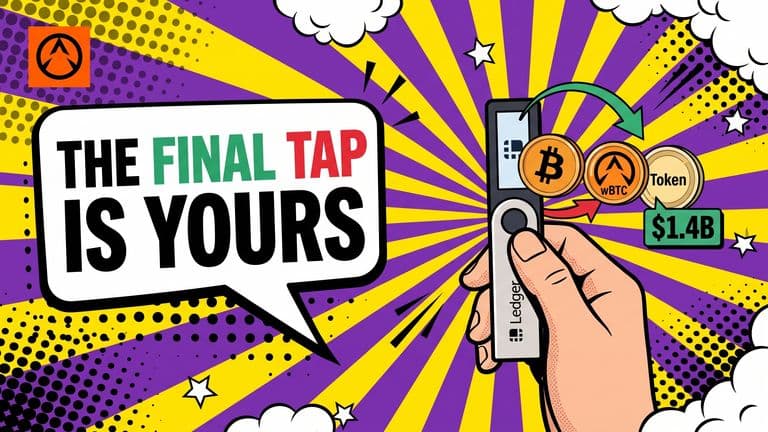
A hand holds a hardware wallet signer with a Bitcoin coin against its screen, flanked by a wrapped-Bitcoin coin and a stablecoin token, under a bright comic sunburst.
MentionedBTC$83,220.00-3.67%USDC

You can now borrow against Bitcoin from inside Ledger Wallet, with the last tap happening on the hardware device in your hand. Ledger unveiled the feature, called Crypto Loan, at the TOKEN2049 conference in Singapore. Eligible users pledge wrapped Bitcoin as collateral and take out a loan in stablecoins, so the coins don't have to be sold.

Ledger says the rollout began on October 7 and expands over time. Whether you get access depends on your country.

What the Loan Actually Asks of You

The collateral is wrapped Bitcoin, in the form of Coinbase's cbBTC or the older wBTC. The loan comes in USDC or USDT. From the Ledger Wallet app you open the loan, watch its loan-to-value ratio, add collateral, repay the debt, or borrow more. Key actions, including anything that touches collateral, are signed on a Ledger signer before they execute.

Ledger leans on the word self-custodial, and it is worth being precise about what that covers. The Bitcoin you pledge is a wrapped token sitting in a lending market, not a coin resting untouched in your wallet. What stays with you is the key and the approval: Ledger says key transactions use its Clear Signing feature and require physical confirmation on the device before they go through.

One smaller design choice is worth noting. Before committing, eligible users can run a simulation to explore their options. For a product where the main risk is a number moving against you, letting the borrower rehearse the decision first is the difference between a form and a plan. Ledger had already listed crypto loans as coming soon in its release notes.

Who Is on the Other Side of the Trade

Ledger is not lending the money itself. Morpho, a decentralized lending network, supplies the lending infrastructure, while Yield.xyz handles the loan flow and the position monitoring inside Ledger Wallet. Neither function was built in-house. Yield.xyz CEO Serafin Lion Engel described the integration as supplying transaction construction and position monitoring rather than requiring Ledger to build those itself.

Coinbase relies on the same technical provider for its own Bitcoin-backed loans. Those loans had grown to more than $1.4 billion in active borrowing, backed by roughly $3 billion of collateral, according to figures supplied with its own announcement.

Paul Frambot, who co-founded Morpho, tied the new product to Ledger Earn, where idle stablecoins sit in a similar setup:

stablecoins deposited through Earn can fund the very loans Bitcoin holders now access through Crypto Loan, all within the same self-custodial environment.

Separately, Ledger announced that its signers can connect directly to Morpho without routing through a browser extension or a software wallet. That connection was said to open to all users on October 7.

What Happens If Bitcoin Falls

The liquidation mechanics come from Morpho, not from Ledger. On Morpho, a position becomes liquidatable when its loan-to-value ratio crosses the market's liquidation threshold. That can happen two ways: the collateral loses value, or the debt grows.

Once a position is liquidatable, any outside party can repay part or all of the borrower's debt and take an equivalent amount of collateral plus a liquidation bonus. Morpho's own documentation gives the example of a market with an 86% liquidation threshold, where the bonus works out to about 5%. Liquidations there can be partial or full, and Morpho says they are driven by economic incentives rather than absolute guarantees.

Ledger has not published where its own threshold sits. Coinbase's version of a Morpho-backed loan tells users their ratio must stay under 86% or the position is automatically liquidated and a penalty fee is charged. That figure belongs to Coinbase's product, not Ledger's, and should not be read across.

The Numbers Still Missing

Ledger's terms state that interest rates on Crypto Loan are variable, set by utilization in the underlying isolated lending markets. In plain terms, the rate is not fixed: it moves with how much of a given market is being borrowed. There is no advertised rate to compare against other lenders.

Neither a specific rate or range, a fee or spread, repayment terms, a minimum loan size, nor a list of eligible countries appeared in the announcement material available. Ledger states that liquidation risks apply and describes itself as a technology provider rather than a financial adviser.

The scale is what makes this worth watching. Ledger says its devices secure almost 30% of Bitcoin held by retail investors, with more than 8 million signers sold across over 165 countries. That is a large population of long-term holders, and now a credit product sits inside the app they already use.

It lands in a busy field. Coinbase recently rolled out fixed-rate Bitcoin-backed loans after expanding the product to UK users, while JPMorgan has explored lending against Bitcoin and Ethereum.

Until Ledger publishes its own rate mechanics and liquidation threshold, the cost of a Crypto Loan stays a variable the borrower cannot yet pin down.

The information discussed by Altcoin Buzz is not financial advice. This is for educational, entertainment, and informational purposes only. Any information or strategies are thoughts and opinions relevant to the accepted levels of risk tolerance of the writer/reviewers and their risk tolerance may be different than yours. We are not responsible for any losses that you may incur as a result of any investments directly or indirectly related to the information provided. Bitcoin and other cryptocurrencies are high-risk investments so please do your due diligence.

Copyright Altcoin Buzz Pte Ltd.

Related

Quantus QTC Jumps After NEAR Intents Integration
Altcoins
Oct 7, 2026

Quantus Jumps 9.5% as NEAR Intents Opens QTC to Cross-Chain Liquidity

Quantus QTC jumped 9.5% to $92.11 after integrating with NEAR Intents, opening the quantum-resistant token to cross-chain liquidity and wider market access.

QTC
Bikash Deka
A comic-style illustration of a wallet with a large key sticking out of it as the exposed point, an intact chain of ledger blocks behind it, and a quantum atom symbol above the key.
Technology
Oct 7, 2026

Europol Says Quantum Risk Sits in Wallet Keys, Not Blockchains

Europol's two new reports say quantum machines threaten the wallet keys that control crypto, not blockchain hashes, and urge the industry to prepare now.

Shashwat Gupta
The Bitcoin.de logo shield stands next to a MiCA license file under a BaFin stamp, with an arrow pointing to a new bank badge.
RegulationAltcoins
Oct 7, 2026

Bitcoin.de Turns to Regulated Partners After BaFin Rejects MiCA License

BaFin refused futurum bank's MiCA licence more than 15 months after the application. Bitcoin.de will trade through a regulated German partner instead.

Anmol Billa