Bitcoin.de Turns to Regulated Partners After BaFin Rejects MiCA License
BaFin refused futurum bank's MiCA licence more than 15 months after the application. Bitcoin.de will trade through a regulated German partner instead.

By Anmol BillaSenior Analyst
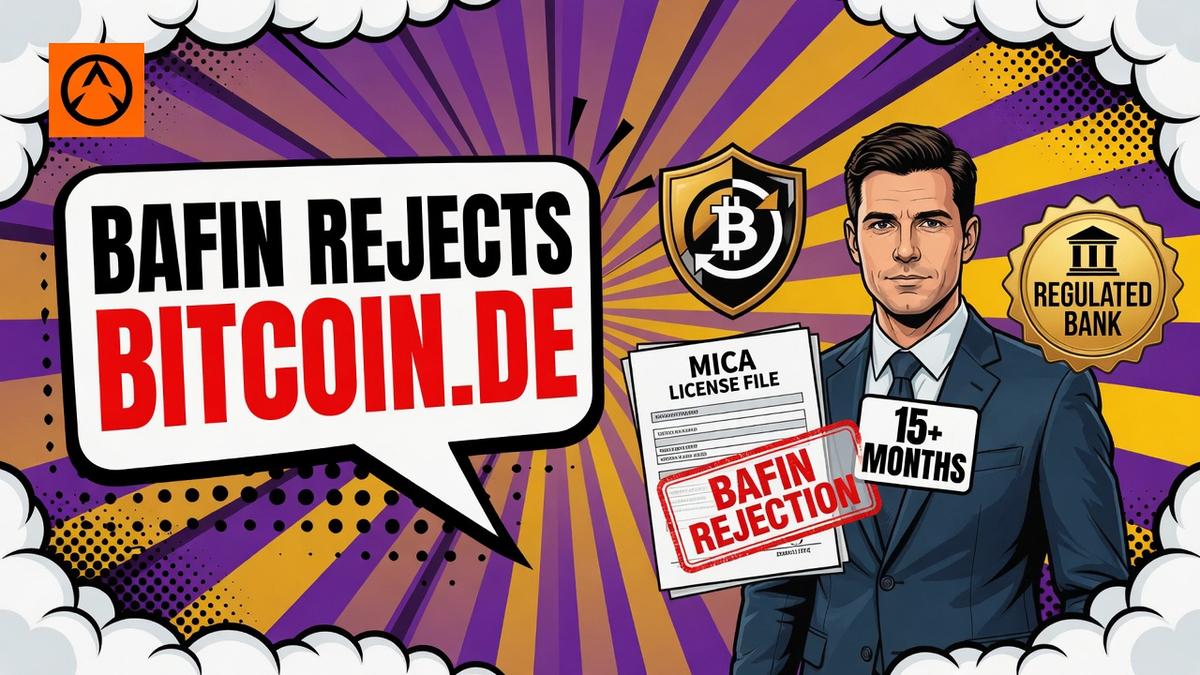
BaFin has refused futurum bank AG's application to be authorised as a crypto-asset service provider under MiCA, the EU's Markets in Crypto-Assets Regulation. Bitcoin Group SE, the parent company, disclosed the refusal on Oct. 6, 2026, as a regulatory inside-information release. The application was filed on 27 June 2025, so the review had been running for more than 15 months.
For anyone holding an account at Bitcoin.de, the change is concrete. Trading has been largely suspended since 12 June 2026, and it will not restart under futurum bank's own licence. Instead, the company says futurum bank "intends to enter into a cooperation agreement with a regulated institution based in Germany" to act as the customer's trading partner, with "another regulated party based in Germany" acting as custodian.
The EQS announcement gives no timeline beyond the phrase "in a timely manner", and no confirmation of how far beyond Germany the new setup would reach.
A Fifteen-Month Wait Ends in a Refusal
futurum bank's management had prepared for this outcome. The filing states that "due to the delay of more than 15 months in the authorisation process to date", the bank's management "had already prepared for the possibility of a refusal".
BaFin also drew a line under the interim arrangement. The filing says the regulator "pointed out that its previous tolerance of the provision of crypto-asset services by futurum bank AG no longer applies." That tolerance is what let the platform keep operating while the application sat with the regulator.
Under MiCA, firms offering covered crypto services need authorisation from the national regulator. ESMA states that eligible providers could operate under national arrangements until July 1, 2026, or until their MiCA application was approved or refused, whichever came first. Bitcoin.de stopped most trading on 12 June 2026, before that date.
What Happens to Customer Assets
futurum bank stays in the picture until the handover is done. The filing says it "will continue to securely custody customers' assets until they are transferred to the alternative regulated custodian", and adds: "All customer claims remain fully intact."
The company had already migrated customer crypto holdings to new custody infrastructure and switched off the old trading system as part of the changeover, according to its account.
BaFin Has Not Published Its Reasons
Bitcoin Group's version of the decision is that BaFin considered futurum bank's "current implementation and operational readiness insufficient for authorization", and that the progress achievable in the short term was not enough to clear the remaining requirements.
That is the company's account, not the regulator's. BaFin has not published a detailed decision setting out its reasons, so the explanation here comes from Bitcoin Group's Oct. 6 statements.
The Platform Was Ready a Week Before the Refusal
One week before the decision, Bitcoin Group said the rebuilt platform, website and mobile application had been technologically completed and had passed functional and security testing.
Bitcoin.de had been rebuilt from a peer-to-peer marketplace into a conventional trading platform. The planned product range covered more than 100 cryptocurrencies, crypto swaps, savings plans and staking, with transactions settled through a reference account and investments starting from €1. The redesigned app and website were released in June; the trading launch did not proceed while futurum bank waited for BaFin.
Germany Still Licenses Plenty of Providers
Germany had 79 authorised crypto-asset service providers by late August 2026, ahead of France and the Netherlands. The refusal is not a signal that the country has gone cold on MiCA licensing, only that one applicant did not get through.
There is a working template nearby. Nexo routes custody through Tangany and brokerage through DLT Finance to keep services available for customers across the European Economic Area. Whether Bitcoin.de's arrangement copies that scope, or covers Germany alone, is not stated.
What Bitcoin.de Can Do Next
Bitcoin Group and futurum bank say they are reviewing the decision. An objection may be lodged within one month of notification, and futurum bank "remains free to apply for authorisation again in the future", according to the filing.
The share price barely moved on the day. Bitcoin Group shares closed at €27.98 on Xetra on Oct. 6, down 1.96% for the session, with the regulatory announcement released shortly after regular German trading ended. On Sept. 29 the company had said the restart of crypto trading depended on completion of the licensing process.
"The refusal of authorisation has significant implications for the future business model of the Bitcoin.de platform operated by futurum bank AG."
For a platform with more than 1.1 million registered users, a figure reported by ChainCatcher and carried by KuCoin rather than published by Bitcoin Group itself, the question now is whether a partner-run model can restore trading before users drift elsewhere. The next fixed points are the one-month window for an objection and the signing of the cooperation agreement, neither of which has a date attached.

Anmol Billa
Anmol Billa is a Senior Analyst at Altcoin Buzz, with over five years of experience working across cryptocurrency markets and the broader digital asset industry. His work focuses on technical analysis, market research, investment insights, and evaluating emerging opportunities within the crypto ecosystem. At Altcoin Buzz, Anmol contributes to technical market analysis, research-driven insights, pitch decks, and funding-related initiatives. His experience combines analytical thinking with a practical understanding of crypto markets, helping translate market trends and emerging projects into clear, actionable insights for readers and industry stakeholders.
More from AnmolNext up
Injective Rallies 13% on Tokyo Partnership and SEC Transfer-Agent News
Injective gained around 13% after partnering with the University of Tokyo's Blockchain Innovation program. The development comes as its SEC-registered affiliate adds a regulated securities recordkeeping function to its institutional tokenization push.
Related
More in Crypto NewsRelated
Crypto News Today: Russia's Crypto Shift, Institutional ETF Moves and Trezor Data Breach
 BTC
Crypto Derivatives Get US Approval as Backpack, tZERO Win Licences
Solana Foundation Acquires Majority Stake in CoinGecko
 SOL
Evernorth Holds 346M XRP at $341.9M After 60% Write-Down
 XRP