SEC Staff Says Token Buybacks Aren’t Essential if the Network Works
SEC staff say buybacks alone aren’t essential managerial efforts for a functional crypto network, but the guidance is not a binding SEC position.

By Shashwat GuptaFounder
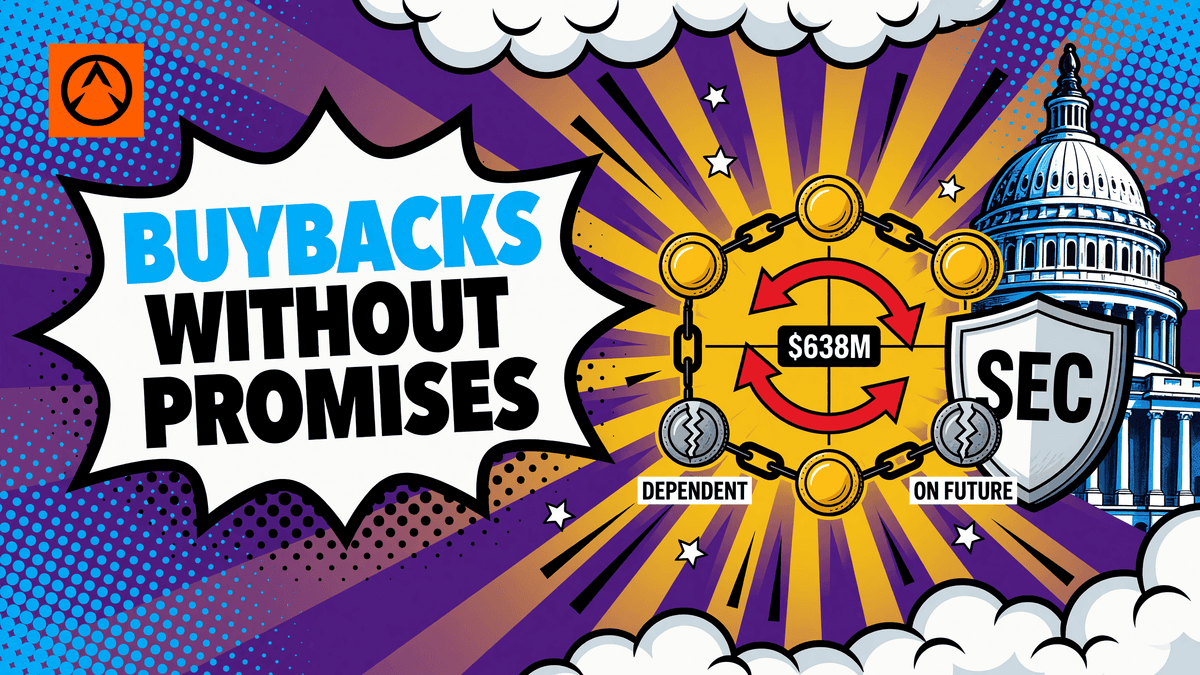
The SEC’s Division of Corporation Finance says an issuer can announce a token buyback without promising essential managerial efforts, provided the crypto system already works. The catch is that this applies to a functional network, not a token still relying on an issuer’s promise of future development or returns.
That distinction matters because buybacks have become a major use of crypto project revenue. Crypto projects spent about $638 million on token buybacks through late August 2026, according to Allium Labs data. Hyperliquid and Pump.fun accounted for close to 90% of that total.
A buyback can look different before and after launch
In the SEC staff’s new crypto FAQs, staff said an announced buyback program would not, by itself, represent a promise of essential managerial efforts for a functional crypto system.
The timing can change the answer. If the system is not yet functional, an issuer may be making such a promise when it presents a buyback as producing yield or a return for token holders.
So the useful question isn’t simply whether a buyback exists. It’s what the buyback represents at that point in the project’s development. A network that already works can treat the program as a separate issuer activity. A network that still needs promised work from the issuer may still be relying on that work when it markets a return to holders.
The network has to do the work
The staff’s definition is tied to a functional crypto system. Under the SEC’s March interpretation, a network reaches that point when its native token can be used according to its programmed utility.
Once that threshold is met, services to secure, maintain, improve or enhance the network generally would not count as essential managerial efforts. Neither would efforts designed to encourage network effects, according to the FAQs.
That doesn’t give every development team a blanket exemption. The staff response specifically concerns functional systems, and it doesn’t establish that all development or maintenance work can be separated from an investment contract.
The issuer also determines the thresholds it has represented as necessary for functionality or decentralization. That leaves an important question: has the network crossed the line the issuer previously set for itself?
This is guidance, not a new rule
There’s a limit on how much weight these answers can carry. They are staff responses with no legal force. The SEC Commission neither approved nor disapproved them, and the FAQs do not change applicable law or create new obligations.
The SEC’s March 17 interpretive release remains the broader framework. The new FAQs do not create a safe harbor.
The distinction between staff guidance and Commission action is easy to miss. Staff can explain how they currently read a concept, but their answers do not bind the Commission or settle every case. An issuer’s own statements and the system’s actual condition still matter.
Buybacks are already concentrated in two projects
Hyperliquid has bought and burned roughly $1.3 billion of HYPE since launch. Its documentation says more than $1 billion in annualized fees now flows into programmatic HYPE purchases.
Pump.fun says half its revenue goes toward buying and permanently burning PUMP. Its dashboard shows $462.5 million in cumulative purchases and 167.7 billion tokens destroyed, equal to 16.8% of the original supply.
Those programs make the SEC’s distinction practical. A buyback can be a large, visible part of a project’s economics while still sitting outside the category of essential managerial efforts, as the staff understands it. That is not a declaration that every token is free of securities-law risk.
The narrow version is easier to explain: on a functional network, a buyback announcement alone is not an essential promise. Before the network functions, or when the program is presented as generating returns for holders, the same announcement can look like part of the promised effort. The legal status of the token itself remains a separate question.

Shashwat Gupta
Shashwat Gupta is an entrepreneur, CEO and co-founder of the online media portal, Altcoin Buzz. Shash has been a crypto enthusiast since 2015 and entered the emerging cryptocurrency space full time in early 2017. His business expertise and extensive knowledge in the crypto space have helped shape Altcoin Buzz to be what it is today.
More from ShashwatNext up
TAO Rises as Bitcoin Falls, Bittensor Subnet Revenue Gains Attention
TAO showed relative strength as Bitcoin fell below $69,000. Meanwhile, Bittensor's subnet economy is attracting paying customers, with Lium's GPU rental spending reaching a $34.6 million annualized pace.
 TAO
Related
More in Crypto NewsRelated
KAVA Crashes 40% After Suspicious Activity in Kava Lend
 KAVA

JPMorgan's Crypto-Linked Holdings Near $1B as Strategy Stake Jumps 36%
 BTCCOIN
TON Edges Past Robinhood Chain in Daily App Revenue, Fragment Drives the Lead
Bitcoin Wallet Named in $260B Lawsuit Moves 75 BTC After 15 Years
BTC