STRK jumps 322% in four weeks as Starknet weighs Layer 1 shift
Starknet’s STRK token climbed 322% in roughly four weeks, far outpacing Bitcoin and Ether, as StarkWare advocates for an independent Layer 1 and a quantum-resistant roadmap.

By Bikash DekaAuthor
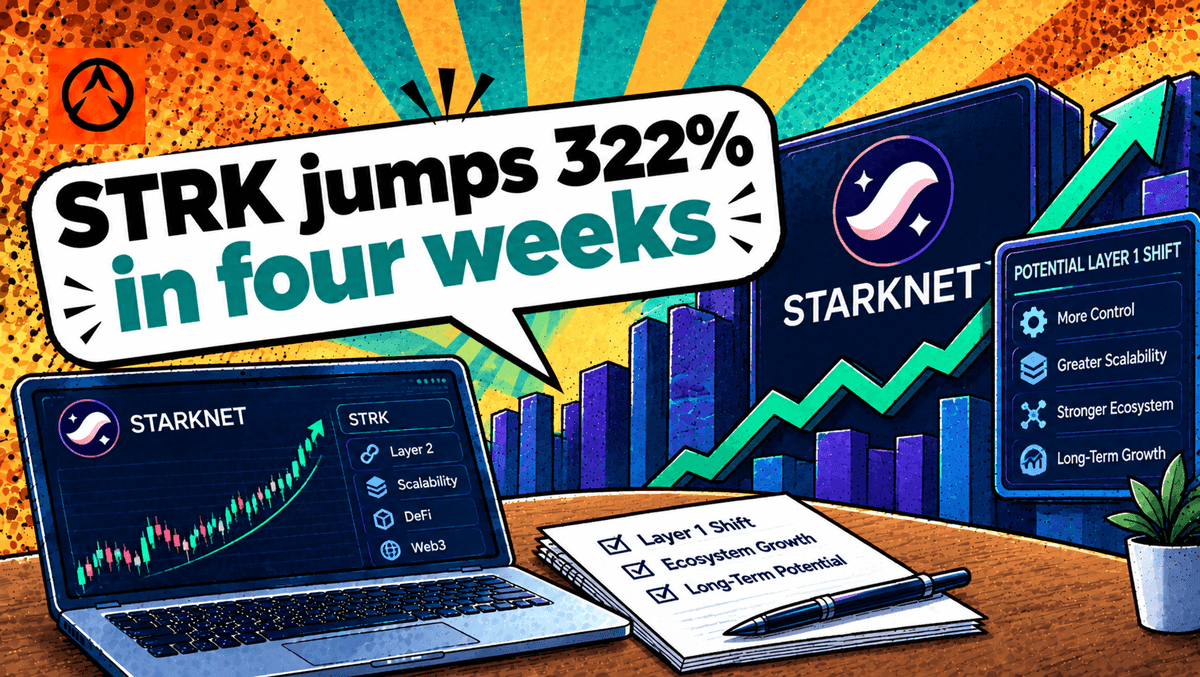
Starknet’s STRK token has surged 322.26% in roughly four weeks, significantly outperforming Bitcoin and Ether as the network’s backers discuss a possible move from Ethereum Layer 2 to an independent Layer 1 blockchain.
STRK traded at approximately $0.1182 at 8:49 p.m. ET on October 11, up from around $0.0280 on September 13, according to CoinGecko data. Over the same period, Bitcoin gained 9.17%, while Ether rose 2.69%.
The rally has accelerated even though Starknet’s underlying DeFi metrics have grown much more slowly. Its total value locked (TVL) increased by about 5.1% over a slightly shorter period, while decentralized exchange activity expanded sharply.
STRK outpaces Bitcoin and Ether
STRK’s performance has been particularly strong over the past week. Between October 4 and October 11, the token gained approximately 101.70%, while Bitcoin fell 3.04% and Ether declined 6.70%.
The move was not a straight climb. STRK dropped roughly 17% between late October 4 and early October 8 before recovering and extending its rally.
The contrast with the two largest cryptocurrencies has put Starknet in focus, but the price increase alone does not establish what drove demand. The proposed Layer 1 transition has become a major topic in the Starknet community, although the available data does not prove that it accounts for the entire rally.
DeFi growth remains modest compared with the rally
DefiLlama data show Starknet’s DeFi TVL rising from $159.6 million on September 14 to $167.8 million on October 11, an increase of approximately 5.1%.
TVL measures the dollar value of assets held in a network’s DeFi protocols. It can change because of deposits and withdrawals, but also because the market prices of those assets move. The increase therefore does not represent a direct measure of new capital entering Starknet.
Trading activity grew more quickly. Starknet’s daily decentralized exchange volume rose from approximately $6.3 million on September 14 to $41.4 million on October 10, according to DefiLlama’s daily series.
These figures cover DEX trading across Starknet, rather than trading in STRK alone. Higher activity may reflect greater interest in the ecosystem, but it does not independently explain the token’s price performance.
StarkWare pushes for an independent Layer 1
The proposed network transition has become a central part of Starknet’s strategic discussion. On October 11, StarkWare CEO Eli Ben-Sasson wrote on X: “World needs Starknet as a quantum-safe L1.” He added: “Market says it.”
The statement followed StarkWare’s October 10 position that an independent Layer 1 was “our clearest path forward.” Starknet’s own October 9 explanation was more cautious, describing the idea as “a question, not a decision.”
The distinction is important. StarkWare’s leadership is advocating for independence, but the transition has not been formally approved or implemented.
Today, Starknet operates as an Ethereum Layer 2. It processes transactions on its own network and publishes cryptographic proofs to Ethereum for verification. Its relationship with Ethereum is therefore part of the network’s security and settlement design.
An independent Layer 1 could give Starknet greater control over its protocol upgrades and security migration schedule. It would also represent a major architectural change, rather than a routine software update.
Quantum security is central to the proposal
Ben-Sasson has linked the independence discussion to Starknet’s goal of achieving full quantum resistance by 2027. The argument is that an independent network could control its own security upgrades instead of depending on changes to Ethereum or Bitcoin where those systems create technical dependencies.
StarkWare published a quantum-readiness roadmap in June outlining a phased approach. It describes changes to cryptographic components, work to support existing contracts and dependencies that remain tied to Ethereum’s own migration.
Starknet’s STARK proof system is built around collision-resistant hash functions rather than elliptic-curve assumptions, giving it an existing foundation for post-quantum security. However, the roadmap also identifies components that rely on Ethereum’s cryptography, including parts of the bridge and data-availability infrastructure.
Moving to an independent Layer 1 would not automatically complete the quantum-security work. StarkWare’s roadmap states that protocol-level changes remain subject to Starknet governance approval.
The debate comes as Ethereum continues its own technical development and longer-term roadmap.
Related: Ethereum’s ‘Lean’ era: Vitalik reveals a major three-year overhaul which provides broader context for the infrastructure decisions facing projects built around Ethereum.
What comes next for STRK and Starknet
STRK’s four-week gain has far outpaced both Bitcoin and Ether, but the network’s TVL growth has been much smaller. The gap highlights the difference between a token rally and measurable expansion in the ecosystem’s DeFi activity.
The Layer 1 proposal could become an important strategic decision for Starknet, particularly if greater independence helps the network manage its quantum-security roadmap. For now, however, the proposal remains under discussion, and governance approval would be required for protocol-level changes.
Investors will be watching both sides of the story: whether STRK can sustain its rally and whether Starknet’s activity and governance decisions begin to support the expectations reflected in the token’s price.

Bikash Deka
Bikash Deka is a crypto and Web3 analyst and writer focused on making blockchain, cryptocurrency, and digital asset developments easier to understand. His work covers crypto markets, emerging blockchain projects, industry trends, and major developments across the digital asset ecosystem. With a background in Technology and Web3, Bikash combines analytical research with clear, beginner-friendly writing. He follows market movements, evaluates industry developments, and turns complex crypto topics into accessible insights for readers. At Altcoin Buzz, Bikash contributes research driven news and educational content designed to help readers better understand what is happening in the fast-moving world of cryptocurrency and blockchain.
More from BikashNext up
Pyth Adds Live NYSE Data From Five Exchanges as ARR Reaches $13.67 Million
Pyth Network has added real-time stock and ETF data from all five NYSE Group exchanges to its Data Marketplace. The move follows its Nasdaq distribution agreement and comes as October ARR reaches $13.67 million.
 PYTH
Related
More in Crypto NewsRelated
Tokenomist Flags Aztec's 797.5M Token Unlock, Recipient Details Remain Unclear

Top Trending Cryptocurrencies Today: Lighter, Akedo and Hyperliquid
 AKE
 LIT
Sui Ecosystem Faces Another Exit as Suiet Ends Wallet Services
 SUI
Zcash Community to Vote on Moving 50,000 ZEC From the Grants Treasury
 ZEC