AltcoinBuzzAltcoinBuzz
Subscribe
  • Crypto News
  • Crypto Research
  • Technical Analysis
AltcoinBuzzAltcoinBuzz

An independent digital media outlet delivering crypto research, news, and technical analysis to a community of 600,000+ users.

Follow us on:

Discover

  • Crypto Research
  • Crypto News
  • Technical Analysis
  • Key Opinions
  • Upcoming Launches

Categories

  • Bitcoin BTC
  • RWA
  • Technology
  • Altcoins
  • Regulation

Company

  • Affiliates
  • Partners & Sponsors
  • Careers
  • Contact
  • Terms of Use
  • Subscription Terms
  • About the ALTCOIN BUZZ
  • Privacy Policy
  • Contact ALTCOIN BUZZ
  • Advertise with us

Copyright 2026 ALTCOIN BUZZ. All rights reserved.Something is buzzzzzzzing.
HomeCrypto NewsTether Paid $6.3M to Firm Co-Owned by a White House Crypto Aide
Crypto NewsStablecoinsRegulation

Tether Paid $6.3M to Firm Co-Owned by a White House Crypto Aide

A Wall Street Journal investigation links Tether to about $6.3 million paid to a consulting firm Bo Hines co-owned while he shaped the GENIUS Act.
SShashwat Gupta•Oct 15, 2026
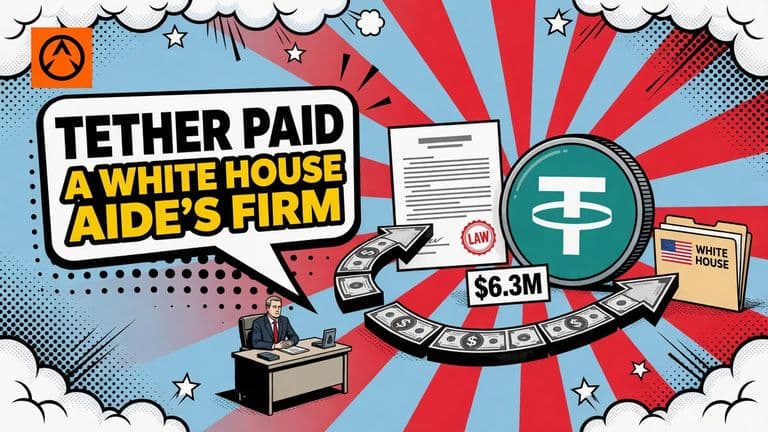
A comic illustration of a large Tether coin with arrows carrying money across to a small office desk and a stamped law document, with a speech bubble headline about payments.
MentionedBTC$82,492.00+0.90%

A Wall Street Journal investigation has linked Tether to about $6.3 million in payments to Nxum, a small consulting firm co-owned by Bo Hines while he ran the White House's digital assets council and helped shape the stablecoin law that now governs the industry.

Hines held a one-third stake in Nxum for his entire time in government, from January to August 2025. The payments began in May 2025, months before he left. He joined Tether soon after, first as a strategic adviser, and he now runs USAT, its US-regulated stablecoin.

The Money Took a Detour Through a Marketing Firm

Nxum did not sign with Tether directly. The contract went to Notorious, a marketing firm run by Peter Vincer, at $415,000 a month, billed six months at a time over at least two years.

The Journal reported the arrangement began taking shape in April 2025, when Hines's father and another Nxum partner met Tether chief executive Paolo Ardoino in New York. Vincer arranged that meeting and presented a proposal covering public relations, branding and lobbying. The final contract, signed through Notorious, dropped the lobbying language.

Then the first payment shows how the plumbing worked. On May 11, 2025, $2.49 million left Bitfinex, an exchange under the same parent company as Tether. Vincer kept $498,000 and forwarded the remainder to a wallet tied to Nxum. Two more transfers of the same size landed in December 2025 and April 2026, after Hines had left government and the contract had been handed to Nxum. Net of the intermediary's cut, the Journal calculated Nxum took in roughly $6.3 million.

What the GENIUS Act Does, and Why 36 Months Mattered

The GENIUS Act, signed into law on July 18, 2025, is the first federal framework for dollar-backed stablecoins. Its compliance window started as a proposal of 18 months, the period favored by some Democratic lawmakers and US-based stablecoin companies. Hines pushed to stretch it to 36 months, the Journal reported.

That extra time mattered most to Tether. The longer window gave foreign issuers more runway before restrictions on noncompliant tokens applied to US platforms, and the law contained a separate pathway letting foreign issuers operate under approved regulatory jurisdictions. Restrictions on US platforms offering noncompliant stablecoins are scheduled to apply in July 2028.

The pathway comes with a condition. It requires a Treasury determination that the issuer's home jurisdiction offers comparable oversight. USDT is issued by a company incorporated in the British Virgin Islands, and as of August 2026 the Treasury had not issued that determination. Tether, meanwhile, has kept up the quieter diplomatic work of a company that wants to be seen as a regulated one, including a study with Kazakhstan's central bank on a tenge stablecoin.

Nxum Denies Wrongdoing, and the Trail Stops at the Firm

Nxum told the Journal that Hines was unaware of and uninvolved in its Tether business while he was in the White House. In a statement, the firm said he:

did not receive any Tether-derived funds during that period, and had no economic relationship of any kind with Tether while serving in the White House.

Nxum also calls his stake a passive investment and says ethics rules did not require him to sell it.

That denial is where the trail ends. The records described by the Journal show money reaching the firm. No available account says Hines himself was paid Tether money while in office. Tether did not respond to the Journal's requests for comment. Vincer told the Journal he served only as an intermediary and disputed how much he ultimately received, an account Nxum rejected.

Ethics lawyers see the arrangement as the kind of thing the rules exist to catch. Cynthia Brown, senior ethics counsel at Citizens for Responsibility and Ethics in Washington, told the Journal that federal officials generally face restrictions on taking part in government matters involving their financial interests.

A PAC Paid Nxum $6.55 Million

Nxum was involved in the September 2025 launch of Fellowship PAC, a pro-crypto political action committee chaired by Jesse Spiro, Tether's head of government affairs. Federal Election Commission records cited by the Journal show the committee paid Nxum Group $6.55 million across five disbursements between January and April 2026, mostly for issue advocacy advertising, and that the PAC had raised at least $11 million from Cantor Fitzgerald and other contributors.

Separately, an investor presentation reviewed by the Journal described plans for Tether to buy 25% of Nxum for $56 million, with another 10% sold to outside investors and the founders keeping 65%.

Federal Agencies Still Have to Write the Rules

The political fight is largely over. The paperwork is not. An August 2026 review of the law's implementation found federal agencies had missed their July deadline for the required rules, and the Office of the Comptroller of the Currency is targeting November 2026 to finalize its framework. The Federal Reserve has released two proposals covering reserve requirements and bank-issuer licensing.

Two other threads are worth tracking. The CLARITY Act, a follow-on bill, stalled in the Senate in September 2026. And Tether is already under scrutiny in Washington: Sen. Richard Blumenthal urged Treasury and the Justice Department to investigate the company last month, after Democratic staff of the Senate Permanent Subcommittee on Investigations released a report on Iran's use of USDT.

For all the detail in the Journal's account, the plainest question is the one still unanswered. Hines spent eight months helping write the rules for a market that a firm he part-owned was being paid from, and nobody involved has produced a document showing he took a dollar of it himself.

The information discussed by Altcoin Buzz is not financial advice. This is for educational, entertainment, and informational purposes only. Any information or strategies are thoughts and opinions relevant to the accepted levels of risk tolerance of the writer/reviewers and their risk tolerance may be different than yours. We are not responsible for any losses that you may incur as a result of any investments directly or indirectly related to the information provided. Bitcoin and other cryptocurrencies are high-risk investments so please do your due diligence.

Copyright Altcoin Buzz Pte Ltd.

Related

A Starknet coin stands where two chains split apart, one curving down toward Ethereum and the other rising toward a padlock and key badge, with a speech bubble beside it.
AltcoinsTechnology
Oct 15, 2026

Starknet Opens Vote on Leaving Ethereum to Become a Post-Quantum L1

STRK holders have seven days to vote on whether Starknet should explore leaving Ethereum to run as an independent post-quantum layer 1. The poll closes Oct. 22.

STRKETH
Shitij Gupta
A comic-style illustration of a large Zcash coin with the Zcash logo dropping beside a thick red down arrow, with a speech bubble headline reading ZEC LONGS FLUSHED and a small badge showing -16.4%.
AltcoinsPrivacy
Oct 15, 2026

Zcash Sheds 16% in a Week as $17.8M of Longs Are Flushed

Zcash fell 16% in a week as CoinGlass showed $17.76 million in ZEC futures liquidations, mostly longs, with $2.25 billion of open interest still unwinding.

ZECBTC+3 more
Shashwat Gupta
A comic-style illustration of a swap loop of arrows between a Ripple roundel and a Hyperliquid roundel, with a basket of labelled asset chips at its centre, beside a large speech bubble reading Ripple Prime opens 24/7 RWA swaps.
RWADeFi
Oct 15, 2026

Ripple Prime Opens 24/7 RWA Swaps to Institutional Clients

Ripple Prime now clears 24/7 perpetual swaps on more than 100 reference markets, from equities to FX, through Trade.xyz contracts on Hyperliquid.

XRPHYPE+1 more
Pallavi Malviya Gupta