Thailand finalizes rules for Bitcoin and Ether ETFs, with October 16 start
Thailand’s SEC has finalized its crypto ETF framework, allowing locally listed funds tracking Bitcoin and Ether under rules taking effect October 16.

By Saloni RathiSenior Editor
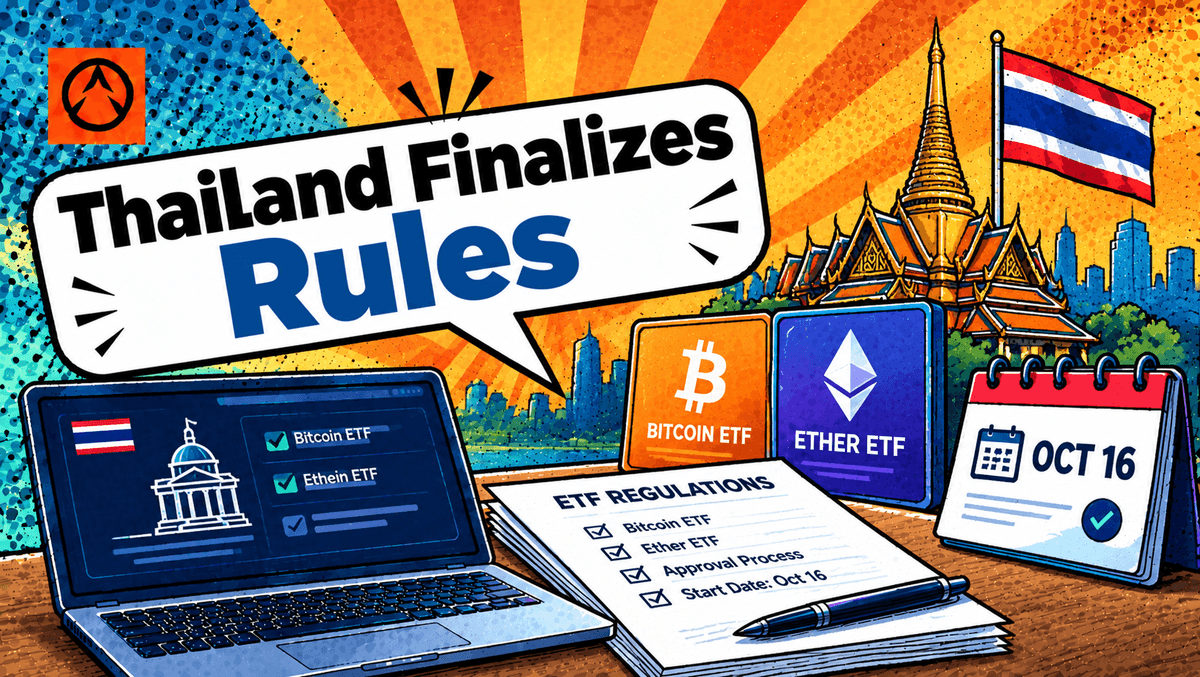
Thailand’s Securities and Exchange Commission (SEC) has finalized rules for cryptocurrency exchange-traded funds (ETFs), paving the way for locally listed funds tracking Bitcoin (BTC) and Ether (ETH). The regulations take effect on October 16, 2026, establishing a framework for fund management, digital asset custody and investor protection.
The SEC announced the framework on October 8 after consultations held earlier this year. The rules cover 11 regulatory notifications and initially limit eligible crypto assets to Bitcoin and Ether.
Bitcoin and Ether lead Thailand’s first crypto ETFs
Under the new framework, crypto ETFs must operate as passive investment vehicles designed to track the price of a single cryptocurrency. Each fund must maintain average net exposure of at least 80% of its net asset value to that asset over each accounting year.
For now, Bitcoin and Ether are the only eligible assets. The SEC said future eligibility decisions will consider factors including liquidity, market acceptance, blockchain network security and investor protection.
The funds must list and trade exclusively on the Stock Exchange of Thailand (SET). This gives investors a regulated securities-market route to crypto price exposure without requiring them to buy and hold the underlying assets directly.
The move also adds to the wider development of crypto investment products through traditional financial markets. In the United States, spot Bitcoin ETFs attracted $6.3 billion in net inflows during the third quarter of 2026, although their full-year flows remained close to flat after earlier withdrawals.
Related: Bitcoin ETFs Took $6.3B in Q3, but 2026 Is Near Flat
SEC sets custody and investor protection requirements
The Thai SEC has introduced requirements for asset managers seeking to establish crypto ETFs. Firms must demonstrate that they have suitable personnel, operating systems and service-provider arrangements to manage the products securely and efficiently.
Fund assets must be safeguarded by digital asset custodians regulated by the SEC. Where custody is delegated, the underlying digital asset custody must still be performed by a licensed custodian. The regulator has left open the possibility of permitting qualified foreign custodians when necessary and appropriate.
Investor protection measures will also apply. Securities firms must explain the products’ characteristics and risks, and investors must acknowledge that they understand those risks before trading. Firms are also expected to emphasize appropriate asset allocation and warn against excessive concentration in digital assets.
Brokers will not be permitted to provide margin loans for purchases of these crypto ETFs, limiting the use of borrowed money to amplify exposure through the products.
Foreign crypto ETF access remains restricted
Thailand’s framework does not give retail investors unrestricted access to overseas crypto ETFs through local securities firms. During the initial phase, firms will be restricted from facilitating investments in foreign crypto ETFs for clients who are neither institutional investors nor ultra-high-net-worth individuals.
The rules also prohibit alternative products linked to foreign crypto ETFs, such as depositary receipts referencing those funds, during the initial phase.
At the same time, Thai mutual funds and private funds will be allowed to invest in locally established crypto ETFs, subject to existing investment limits. This could provide domestic funds with another regulated route to gain exposure to Bitcoin and Ether.
October 16 marks the regulatory start
The new rules establish the conditions under which Thailand’s crypto ETFs can be created and traded, but October 16 is the framework’s effective date, not a confirmed first trading date for individual funds.
Asset managers must still meet the applicable requirements before their products can reach investors. The SEC’s announcement did not name approved issuers, fund tickers, fees or individual listing dates.
The framework gives Thailand a defined regulatory route for Bitcoin and Ether investment products, while keeping the initial offering narrow and subject to local custody and investor protection rules. The next milestone will be the progress of asset managers toward launching funds under the finalized requirements.

Saloni Rathi
Saloni Rathi has been part of Altcoin Buzz for over five years, working across content and marketing within the crypto and Web3 space. Her work focuses on creating clear, engaging and accessible content that helps readers understand complex cryptocurrency and blockchain topics. With a strong interest in storytelling and audience engagement, Saloni brings together research, creativity and marketing insight to turn complex ideas into simple and relatable stories. She believes great content starts with curiosity, creates clarity, and ultimately builds meaningful connections with readers.
More from SaloniNext up
NVIDIA Posts 103% Revenue Growth as AI Crypto Projects Watch GPU Demand
NVIDIA's Q3 revenue climbed 103% year over year to $115.8 billion, with its Data Center business leading growth. The results could renew attention on decentralized GPU networks and AI-focused crypto projects.
 TAORENDER
Related
More in Crypto NewsRelated
Crypto News Today: Russia's Crypto Shift, Institutional ETF Moves and Trezor Data Breach
 BTC

Crypto Derivatives Get US Approval as Backpack, tZERO Win Licences

Coldcard CEO Says 0.17% of Users Were Affected as Bitcoin Theft Tops $100M
BTC