AltcoinBuzzAltcoinBuzz
Subscribe
  • Crypto News
  • Crypto Research
  • Technical Analysis
AltcoinBuzzAltcoinBuzz

An independent digital media outlet delivering crypto research, news, and technical analysis to a community of 600,000+ users.

Follow us on:

Discover

  • Crypto Research
  • Crypto News
  • Technical Analysis
  • Key Opinions
  • Upcoming Launches

Categories

  • Bitcoin BTC
  • RWA
  • Technology
  • Altcoins
  • Regulation

Company

  • Affiliates
  • Partners & Sponsors
  • Careers
  • Contact
  • Terms of Use
  • Subscription Terms
  • About the ALTCOIN BUZZ
  • Privacy Policy
  • Contact ALTCOIN BUZZ
  • Advertise with us

Copyright 2026 ALTCOIN BUZZ. All rights reserved.Something is buzzzzzzzing.
HomeCrypto ResearchThree Hidden Flaws in Uniswap’s StablePair Hook Could Hit LP Returns
Crypto ResearchStablecoinsDeFi

Three Hidden Flaws in Uniswap’s StablePair Hook Could Hit LP Returns

StablePair uses a fixed reference price and cached data that can leave LPs exposed when a stablecoin weakens. The available data does not prove better returns.
SSaloni Rathi•Oct 1, 2026
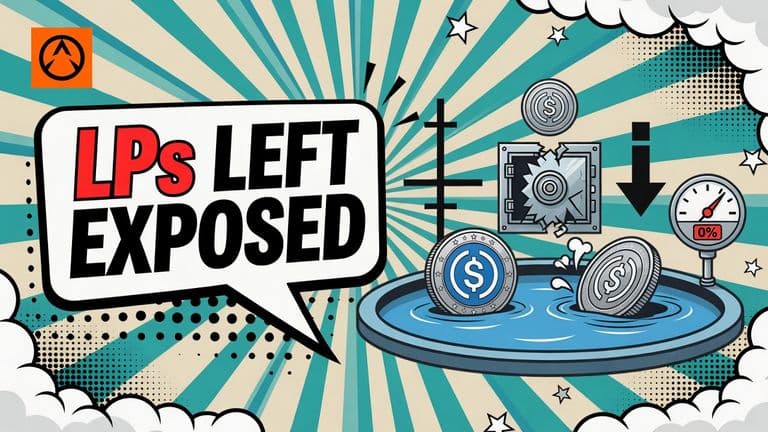
A comic cover shows a Uniswap stablecoin pool with USDC and a sinking stablecoin, a fixed reference marker, and an LP position exposed as the fee gauge reaches zero.
MentionedUSDC

The concern is not that StablePair can block withdrawals. It is that its fee design can stop charging LPs exactly when a weakening stablecoin changes the inventory they hold.

Uniswap Labs launched two Ethereum mainnet pools using the hook, USDC/USDT and USDC/USDG, on Sept. 10, 2026. The pool is new. The inventory issue is hypothetical, not a report of a current depeg, exploit or realized loss in either pool.

The Benchmark Does Not Follow the Market

StablePair does not consult an external market-price feed when it calculates its dynamic fee. Instead, it compares the pool's own price with a reference rate stored in the hook's configuration.

For USDC/USDT, that reference is exactly 1:1. It was fixed when the pool was created. The USDC/USDG pool also uses a reference, but its live configuration was not checked for this review.

That creates the first problem for you as an LP. The hook is classifying trades against a fixed benchmark, not the current relative value of the two assets outside the pool. If one stablecoin starts trading below $1, the reference does not automatically move with it.

Uniswap says the design captures most rebalancing profit as fee revenue. That may work when the imbalance is temporary and corrective trades arrive quickly. The harder case is price discovery, where the weaker asset is losing value rather than merely sitting outside its peg.

Zero Fees Can Increase LP Exposure

StablePair charges a fee based on the distance between the AMM price and the edge of its band. The two sides of the fee always add up to the width of that band.

Swaps that move the pool price farther from the reference pay no LP fee. Uniswap's stated reason is that they already give LPs a favorable price and a fee would suppress flow.

That assumption breaks down when a trader sells a weakening stablecoin for a stronger one. The trade removes the stronger asset from the pool and leaves active LP positions holding more of the weaker asset. Because it pays zero LP fee, the trade also produces no fee income to offset the added exposure.

The source article uses a simple example: an LP holding 10,000 hypothetical coins sees their external value fall from $1 to $0.90 each. Inventory drops from $10,000 to $9,000 before fees, a $1,000 loss.

That example does not describe either live pool. It shows the mechanism an LP is taking on when a pool asset weakens.

Block Caching Can Misprice Direction

The hook calculates fees from the AMM price at the start of each block. The first swap caches that price for later trades in the same block, so quotes change between blocks rather than during one.

Block caching removed a same-block advantage from splitting corrective swaps. It did not eliminate stale-price risk.

If the live price crosses the fixed reference during the block, later trades can be classified in the wrong direction. A swap that should enter one fee side may use the other side's cached classification until the next block.

The effect depends on the pool's band, fee decay rate and fee floor. Those are set separately for each pool and chain. The live values for the USDC/USDT and USDC/USDG pools were not checked, so the size of any pricing error is unconfirmed.

Corrective trades follow a Dutch auction. The fee starts at the far edge of the band, so the first arbitrageur receives no benefit from the mispricing. It then decays block by block toward a floor.

Governance Can Change the Benchmark

The hook's implementation is upgradeable. Under Uniswap's documented role model, governance controls live fee configurations, implementation upgrades and role administration.

That means the reference and other fee parameters can change without creating a new pool address. Integrators are directed to read the hook's live configuration because those values may differ from an earlier snapshot.

There are limits. Hook permissions are encoded in its address and cannot expand through an upgrade. The hook has no remove-liquidity callback, so an upgrade cannot block withdrawals. It also cannot return custom accounting deltas that would let it alter swap amounts and take an extra cut.

OpenZeppelin reviewed the core fee mechanism of a non-upgradeable predecessor from Feb. 9 to 13, 2026. Uniswap says block caching resolved the splitting issue. The audit did not cover the later upgradeability and role model, and the report itself was not checked for this review.

Volume Does Not Prove Better LP Returns

On Sept. 30, screenshots from the Uniswap interface showed about $6.1 million in TVL and $117.9 million in 24-hour volume for the StablePair USDC/USDT pool. They were not independently checked against on-chain data.

By comparison, a screenshot of the Ethereum USDC/USDT v3 pool with a 0.01% fee showed about $34.2 million in TVL, $15 million in volume and $1,100 in daily fees. The snapshots were taken minutes apart, the pools use different rules and liquidity conditions, and the StablePair panel did not show an absolute fee total or realized position-level return.

The numbers cannot establish that StablePair LPs earned more. A proper comparison would need the same period, active liquidity ranges, fee income and inventory valuation.

For an LP, the practical risk checks are narrower than a claim of higher returns. Read the live reference and fee parameters from the hook, track which asset your position accumulates during one-sided selling, and compare fee income with any change in the value of that inventory. If the pool asset is weakening, zero-fee trades do not by themselves mean the LP is protected.

Neither reviewed source offers a formal mitigation for the inventory case. The available control is informed positioning: withdrawals remain available, and the hook's address fixes its permissions, but neither fact changes the assets an LP may hold when the market moves away from the pool's reference.

The information discussed by Altcoin Buzz is not financial advice. This is for educational, entertainment, and informational purposes only. Any information or strategies are thoughts and opinions relevant to the accepted levels of risk tolerance of the writer/reviewers and their risk tolerance may be different than yours. We are not responsible for any losses that you may incur as a result of any investments directly or indirectly related to the information provided. Bitcoin and other cryptocurrencies are high-risk investments so please do your due diligence.

Copyright Altcoin Buzz Pte Ltd.

Related

A pop-art illustration shows an XRP coin, an XRPN Nasdaq listing badge, and connected treasury contributions inside a speech-bubble cover.
AltcoinsRegulation
Oct 1, 2026

Evernorth’s $1 Billion XRP Treasury Moves Closer to Nasdaq Listing

Evernorth plans an XRP treasury of at least 473 million coins, but most would come from contributions rather than cash purchases.

XRP
Pallavi Malviya Gupta
A pop-art SEC document sits beside an automated token buyback loop and a network control symbol divided between distributed nodes and one controlling party.
Regulation
Oct 1, 2026

SEC Says Automated Buybacks Aren’t Enough for Crypto Networks

The SEC’s revised buyback FAQ offers relief to functional networks without a central party, leaving many issuer-run programs outside its protection.
Shashwat Gupta
A comic-style illustration of Singapore’s skyline and regional map connected to institutional crypto trading infrastructure, exchange screens, flow arrows and stablecoin coins.
Altcoins
Oct 1, 2026

Singapore’s Crypto Economy Grew to $284 Billion in 2026

Singapore led its region in measured crypto activity as institutional platforms rose 94%. The data shows less about individual adoption.

Shashwat Gupta