Bitcoin Falls Below $77K as Zcash Leads Crypto Losses Amid Fed Rate Hike Bets
Bitcoin fell below $77,000 as Zcash plunged 12% and traders raised Fed rate-hike bets. Rising Treasury yields, oil prices and Friday's CPI now threaten BTC's recovery.

By Bikash DekaAuthor
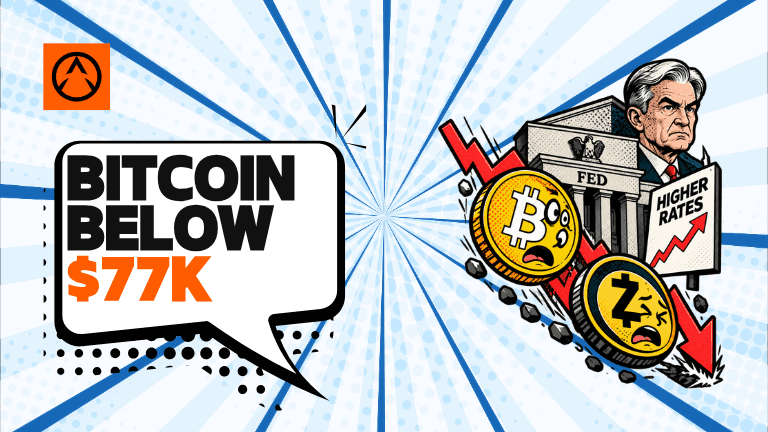
Bitcoin fell below $77,000 on Thursday as traders increased bets on a Federal Reserve rate hike following elevated U.S. producer inflation.
BTC dropped nearly 2% over 24 hours and more than 5% over the past week, extending the market's pullback as Treasury yields climbed and crude oil surged.
The broader crypto market suffered an even deeper decline. The CoinDesk 20 fell roughly 3%, while 95 of the CoinDesk 100 assets ended the session lower.
The sell-off came as markets continued repricing the outlook for the Federal Reserve's September 15-16 meeting.
Bitcoin Drops Below $77K as Rate Hike Bets Rise
Bitcoin's decline followed the latest U.S. PPI report, which showed producer prices rising 5.4% year over year in August.
The inflation reading reinforced expectations that the Federal Reserve could keep monetary policy tighter than previously anticipated. Interest-rate futures were pricing the probability of a September rate hike near 70%, up substantially from roughly a coin flip two weeks earlier.
Related: Bitcoin Price After August PPI: BTC Slips as Fed Rate-Hike Odds Jump. This report detailed how the PPI release pushed rate-hike expectations higher and sent Bitcoin toward the $77,000 area.
Bitcoin now faces a crucial technical test.
Bitget analyst Lewis Huang identified $76,270 as an important support level. With BTC trading less than $800 above that level, another wave of selling could put the August recovery structure under pressure.
Bitcoin has not traded below $76,270 since the rally began in August.
Zcash Leads the Crypto Market Lower
Zcash was among the biggest large-cap losers, falling roughly 12% to $1,134.
The decline erased part of ZEC's recent gains, although the privacy-focused cryptocurrency remains approximately 34% higher over the past week and nearly 145% higher over the past month.
The sharp reversal comes after an unusually strong rally that pushed Zcash above $1,000.
Related: Zcash shorts reached 72% as ZEC held above $1,100, highlighting the unusually crowded bearish positioning around the asset.
The latest decline shows the other side of that trade. After a major rally, a broad risk-off move can quickly trigger profit-taking and leveraged position unwinding.
Zcash's derivatives market has also become increasingly important. Altcoin perpetual futures open interest recently moved above Bitcoin's for the first time since December 2024, with Zcash contributing heavily to the increase in altcoin leverage.
HYPE, DOGE and XRP Also Face Heavy Selling
The weakness was not limited to Zcash.
Hyperliquid's HYPE dropped roughly 7% to below $79, extending its weekly decline to about 10%.
Dogecoin fell approximately 6% to $0.08, while XRP declined around 3% to $1.34 and was down nearly 7% over seven days.
Solana also slipped below $100, falling more than 3%.
Ether performed somewhat better, declining nearly 2% to around $2,445, leaving its weekly loss below 3%. BNB slipped slightly more than 1% to approximately $710.
TRON was the notable exception among major cryptocurrencies, holding around $0.34 and remaining more than 3% higher on the week.
The divergence shows that the sell-off is broad, but individual assets are experiencing very different levels of leverage and profit-taking.
Related: XRP, XLM, DOGE and NEAR Price Analysis for September 10: Can Altcoins Regain Momentum?
Oil and Treasury Yields Add to the Inflation Problem
The crypto sell-off is occurring alongside a sharp move across traditional markets.
Brent crude surged above $107 per barrel, gaining more than 6%, while West Texas Intermediate moved toward $102.
Higher energy prices create an additional inflation risk because rising fuel and transportation costs can feed through to the broader economy.
Treasury yields also climbed sharply. The 10-year yield approached 5%, while the two-year Treasury yield moved above 4.5%.
Higher yields create a difficult environment for Bitcoin.
When government bonds offer higher yields, investors have less incentive to seek risk through assets that generate no traditional income. Higher rates also increase the cost of leveraged positions, making speculative trades more vulnerable to forced liquidations.
The dollar index strengthened toward 99, while gold slipped toward $4,330.
U.S. equities also weakened, with the S&P 500 closing around 7,594 for its fourth consecutive decline.
The combination of higher oil prices, rising yields and a stronger dollar is therefore creating a broad macroeconomic headwind for crypto.
Bitcoin ETF Outflows Add More Pressure
Institutional flows are also showing signs of weakening.
U.S. spot Bitcoin ETFs recorded approximately $120 million in outflows on Wednesday, more than double the previous day's outflows.
That marks a notable shift from the strong institutional demand seen earlier in September.
Related: Spot Bitcoin ETFs Pull In $987 Million as Institutional Demand Recovers
The latest outflows do not necessarily signal a structural reversal, but they show that institutional demand is becoming more sensitive to the changing macro environment.
Interestingly, Ether, XRP and Solana funds still recorded inflows on the same day, suggesting that capital is not leaving the crypto investment-product market uniformly.
$76,270 Becomes Bitcoin's Critical Support
Bitcoin's immediate technical picture is now increasingly important.
The $76,270 level is the clearest downside reference because BTC has remained above it since the August rally began.
A successful defense could allow Bitcoin to stabilize and attempt another recovery toward $78,000 and eventually $80,000.
However, a decisive break below $76,270 would weaken the current recovery structure and could expose Bitcoin to deeper downside.
The macro backdrop makes that level particularly important. Higher Treasury yields, stronger oil prices, a firmer dollar and rising rate-hike expectations could increase selling pressure if Bitcoin fails to attract fresh spot demand.
CPI Becomes the Next Major Bitcoin Catalyst
The next major test is August consumer inflation.
The U.S. CPI report is scheduled for 8:30 a.m. ET on Friday, with markets expecting headline inflation of around 3.4% year over year and core inflation near 2.4%.
A softer CPI could reduce some of the pressure created by PPI and the stronger jobs report. If Treasury yields and the dollar decline alongside cooler consumer inflation, Bitcoin could attempt to reclaim $78,000 and $80,000.
A hotter CPI would produce the opposite setup.
If consumer inflation confirms that price pressures remain persistent, traders could increase bets on a September rate hike further. That would put additional pressure on Bitcoin and other risk assets.
The timing is critical because the Federal Reserve meets on September 15 - 16.
Bitcoin Faces a Critical Macro Test
Bitcoin's latest decline is more than a crypto-specific sell-off.
The combination of elevated producer inflation, surging oil prices, higher Treasury yields and rising Fed rate-hike expectations is creating a difficult environment for risk assets.
At the same time, Bitcoin's ETF flows have weakened after a strong start to September, while highly leveraged altcoins such as Zcash and HYPE are experiencing sharper corrections.
For BTC, $76,270 is now the level to watch.
Holding above it would keep the August recovery structure intact and give bulls an opportunity to rebuild momentum. A break below it, particularly if CPI comes in hot, could signal a deeper correction.
With the Federal Reserve meeting only days away, Friday's CPI report could determine whether Bitcoin stabilizes above support or extends its September decline.

Bikash Deka
Bikash Deka is a crypto and Web3 analyst and writer focused on making blockchain, cryptocurrency, and digital asset developments easier to understand. His work covers crypto markets, emerging blockchain projects, industry trends, and major developments across the digital asset ecosystem. With a background in Technology and Web3, Bikash combines analytical research with clear, beginner-friendly writing. He follows market movements, evaluates industry developments, and turns complex crypto topics into accessible insights for readers. At Altcoin Buzz, Bikash contributes research driven news and educational content designed to help readers better understand what is happening in the fast-moving world of cryptocurrency and blockchain.
More from BikashNext up
Bitcoin Core Speeds Up Fixes for AI found Bugs Drops
Bitcoin Core will backport and ship fixes for easily discoverable bugs as soon as possible, ending long embargoes for issues an LLM prompt can find.
 BTC
BTCRelated
More in Crypto NewsRelated
Electrum Bug Let Rogue Servers Steal Bitcoin via Fee Bumps
BTC
Bitcoin Drops Below $80K as Crypto Liquidations Top $834M
BTC ETH
ETH
Longs Take 83% of $333M Crypto Liquidations as Bitcoin Holds $81K
BTC SOL
SOL
Sui's Hashi Adds Anchorage Digital as $500M Bitcoin Launch Nears
BTC SUI
SUI