CFTC staff: wallets can offer perps without a broker license
CFTC Market Participants Division Staff Letter 26-25 lets wallet software developers route regulated derivatives trading through registered venues without registering as a broker, extending a position first given to Phantom in March.

By Anmol BillaSenior Analyst
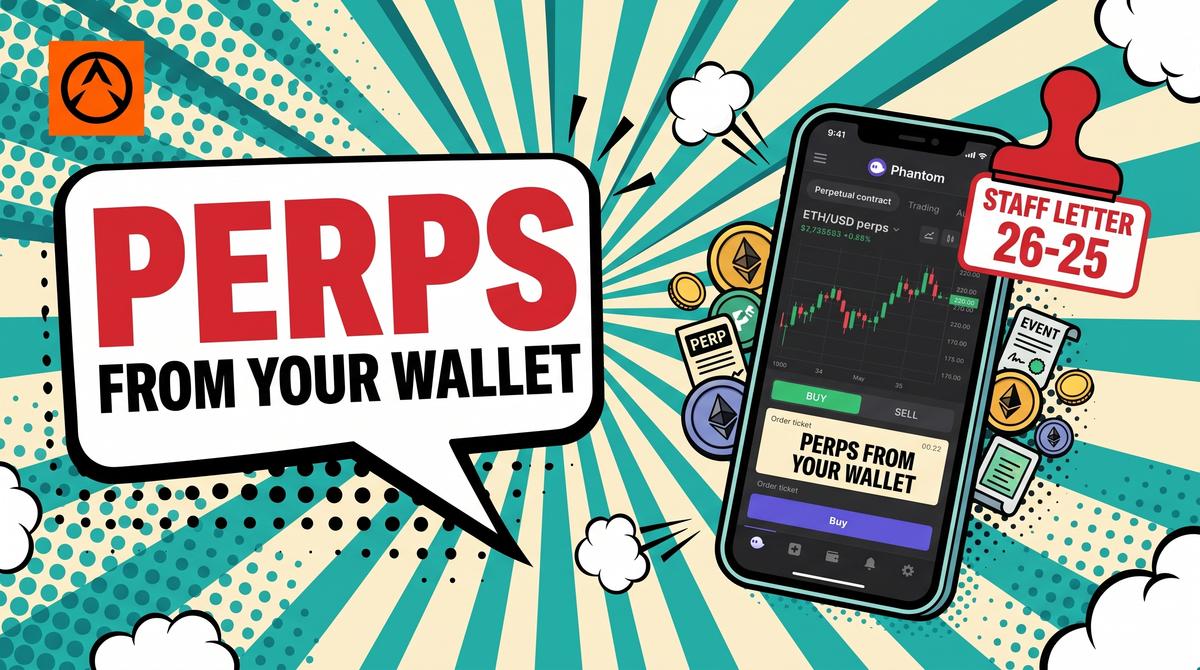
The CFTC's Market Participants Division told wallet software developers in Staff Letter 26-25 that they can build regulated derivatives trading into self-custodial wallets without registering as a broker. The position was previously granted only to Phantom Technologies, the company behind the Phantom crypto wallet, in Letter 26-09 in March, before the division heard from "other similarly situated providers of passive software" seeking the same relief.
What changes for you: if you trade from your self-custodial wallet, your wallet could soon show regulated derivatives, perpetual contracts and event contracts, alongside swaps and bridges. Orders route directly to a registered exchange, futures commission merchant, a firm that handles customer futures trades, or introducing broker, a firm that passes orders along. Your margin sits with the venue's clearinghouse or a clearing member, never with the wallet provider, and the wallet has to "clearly and conspicuously" flag when you are about to trade a regulated product.
What the wallet can do
The covered products are "event contracts, perpetual contracts, and other Commission-regulated derivatives," distributed as front-end software that lets users send orders directly to a registered venue. The provider can take a share of the registered venue's or broker's revenue, charge users a per-transaction fee, market specific venues and embed the software inside its own wallet. The provider is not allowed to generate express buy or sell signals or exercise discretion over routing, which keeps the wallet in a "passive software" lane rather than the registered-firm lane.
Who carries the risk
The seventh condition reaches the venues and brokers themselves: the provider and each registered venue or broker it works with must sign an undertaking making them "jointly and severally liable" for the provider's violations in the covered activities it conducts with that venue. That undertaking also includes consent to CFTC jurisdiction to investigate and bring enforcement actions against the venue or broker. Providers also have to file a notice accepting the conditions, give users conflict-of-interest disclosures and, unless the venue already owes one, a risk disclosure statement, and follow National Futures Association marketing rules as if they were registered.
The limits on the letter
The position is the division's alone, "not binding on the Commission," and lasts only until a CFTC rule or guidance on when software developers must register takes effect. A provider tied to a state or tribal government must add a waiver of sovereign immunity, "limited or otherwise," if one is needed to make the consent enforceable. The relief is not limited to crypto software, so the same template could apply to a stock-trading app that wants to route orders to a futures venue.
What to watch next
The letter was issued the same day the SEC granted a five-year innovation exemption for tokenized stock trading, and two days after the Senate blocked the Clarity Act, though the CFTC letter does not mention the bill. The position is the division's, not the Commission's, and lapses when the CFTC writes a rule or guidance on when software developers must register. Whether wallet providers other than Phantom move to rely on the letter is the next thing to look for.

Anmol Billa
Anmol Billa is a Senior Analyst at Altcoin Buzz, with over five years of experience working across cryptocurrency markets and the broader digital asset industry. His work focuses on technical analysis, market research, investment insights, and evaluating emerging opportunities within the crypto ecosystem. At Altcoin Buzz, Anmol contributes to technical market analysis, research-driven insights, pitch decks, and funding-related initiatives. His experience combines analytical thinking with a practical understanding of crypto markets, helping translate market trends and emerging projects into clear, actionable insights for readers and industry stakeholders.
More from AnmolNext up

Sui Ecosystem Faces Another Exit as Suiet Ends Wallet Services
Suiet, a self-custodial Sui wallet, will stop development and end API services after November 14, 2026, as Sui's value locked falls to $411.4 million.
 SUI
Related
More in Crypto NewsRelated
Crypto Market Today: Bitcoin Near $65K as DOJ Targets $1.2B in Stolen Binance Crypto
 XRP

JPMorgan's Crypto-Linked Holdings Near $1B as Strategy Stake Jumps 36%
 BTCCOIN

Bitcoin Wallet Named in $260B Lawsuit Moves 75 BTC After 15 Years
BTC