AltcoinBuzzAltcoinBuzz
Subscribe
  • Crypto News
  • Crypto Research
  • Technical Analysis
AltcoinBuzzAltcoinBuzz

An independent digital media outlet delivering crypto research, news, and technical analysis to a community of 600,000+ users.

Follow us on:

Discover

  • Crypto Research
  • Crypto News
  • Technical Analysis
  • Key Opinions
  • Upcoming Launches

Categories

  • Bitcoin BTC
  • RWA
  • Technology
  • Altcoins
  • Regulation

Company

  • Affiliates
  • Partners & Sponsors
  • Careers
  • Contact
  • Terms of Use
  • Subscription Terms
  • About the ALTCOIN BUZZ
  • Privacy Policy
  • Contact ALTCOIN BUZZ
  • Advertise with us

Copyright 2026 ALTCOIN BUZZ. All rights reserved.Something is buzzzzzzzing.
HomeCrypto NewsClarity Act Fails After a Last-Minute Ethics Deal Is Killed
Crypto NewsRegulation

Clarity Act Fails After a Last-Minute Ethics Deal Is Killed

A procedural vote failed, but negotiations reached the final yard. Here is what broke the Clarity Act and what could revive it.
PPallavi•Sep 27, 2026
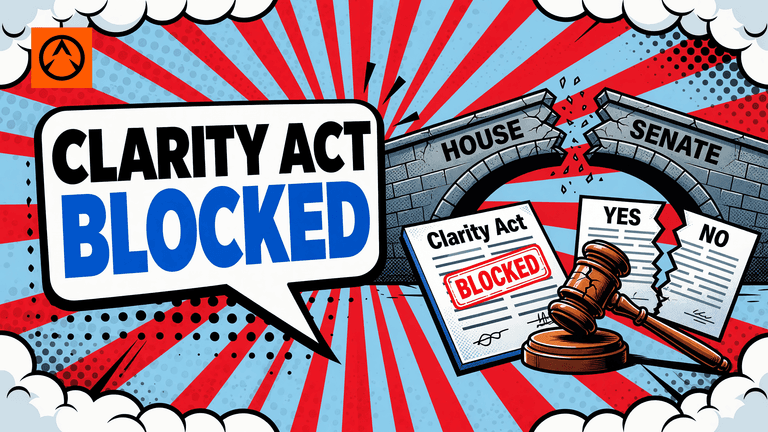
Clarity Act Blocked

Months of work on the Clarity Act reached the final yard of the Senate, then the negotiation stopped. The bill failed a key procedural vote in September 2026, leaving its future in limbo.

The fault line was not simply crypto policy. It was a contest over ethics, political power and how much stability the industry could win before the election.

What the Clarity Act was meant to do

The bill aimed to define how the Securities and Exchange Commission and Commodity Futures Trading Commission would divide oversight of the roughly $3 trillion crypto sector. That sounds procedural, but the answer would shape which rules applied to tokens, trading platforms and other digital assets.

The House had already passed its version by 294 votes to 134 in July 2025, with 78 Democrats supporting it. The Senate largely set it aside and worked on its own bill, originally called the Responsible Financial Innovation Act. It later adopted the Clarity Act name.

That choice made the work harder, according to Wintermute's Ron Hammond.

“Clarity's chances really faced an uphill battle when it came to the Senate decision not to take up the Clarity Act that passed the House as-is and [instead] just worked on their own,” he said.

CoinDesk's account of the collapse draws on interviews with more than a dozen industry participants and legislative aides over 10 days, some of whom were anonymous.

Stablecoin yield opened a long fight

One issue had blocked progress since January. Coinbase CEO Brian Armstrong publicly withdrew support for the Senate Banking Committee's bill over its treatment of stablecoin yield and rewards. That began a months-long dispute between the crypto and banking industries.

The argument did not appear from nowhere. A July 2025 Senate Banking Committee discussion draft had asked how legislation should address interest or yield-bearing digital assets, including stablecoins.

A source used that earlier question to push back on the idea that the banking lobby alone had caused the delay. But the choice between stablecoin rewards and bank deposits was already on the table. It became another fault line as lawmakers tried to finish the bill.

Ethics moved to the centre

Sen. Kirsten Gillibrand said in May that the bill would not advance without an ethics provision. Sen. Angela Alsobrooks, who had supported it in committee, said she wanted more work before backing further advancement.

Those demands followed President Donald Trump's June financial disclosure, which showed $1.4 billion from crypto ventures during his first year in office. That was more than half of the $2.2 billion total reported for 2025. His family's crypto dealings, including World Liberty Financial, the TRUMP memecoin and American Bitcoin, added to Democrats' concerns.

The pressure was already familiar. In May 2025, Sen. Ruben Gallego and eight other Democrats threatened to oppose the GENIUS Act over Trump's crypto profits. They ultimately voted for it after marginal changes.

White House and Senate Republican ethics proposals drew Democratic counteroffers. Tillis and Gallego also offered a bipartisan alternative. None produced agreement before the floor vote.

The process itself caused friction. One source said Republican staffers wrote drafts without including Democratic staffers through the usual joint process. Without a clear Republican agreement, an item had not been conceded, which left Democrats more negotiating leverage.

A later ethics proposal carried only Republican signatures. One source called that odd for a bill intended as a bipartisan effort.

The final negotiation ended

As the procedural vote began on Sept. 15, Sen. Thom Tillis led a last attempt to allow the full Senate to vote on the Tillis-Gallego ethics proposal as an amendment. A Democratic aide said the party was at the “one-yard Line” when the negotiation was shut down.

Several people told CoinDesk that a staffer for Senate Banking Committee Chairman Tim Scott ended the talks. Sens. Gallego and Chuck Schumer said a bipartisan agreement was taking shape before it was killed.

The political clock had been tight throughout. Ava Labs' Charley Cooper described a floor vote less than two months before election day as a difficult test in a heated, divided midterm. The House was also due to leave shortly after the Senate returned, so even a Senate victory would not have brought an immediate House vote.

The next concrete milestone

Sen. Bill Hagerty said the closer negotiations moved toward Nov. 3, the less chance of passage. He also said the Senate could take up the legislation again after the election.

That gives lawmakers a narrow, concrete goal: revive the bill before the year ends. A new Congress is sworn in next January, and its legislative process would have to begin again.

SEC Chair Paul Atkins has said a market structure bill remains necessary because the agencies are falling back on guidance where Congress has not granted missing authorities. One industry participant expects Democrats to prepare their own proposal, even if it never passes, to give the party a starting point.

The bill was meant to bring regulatory order. In the end, the negotiations needed order of their own, shared by both parties. The central job now is to rebuild that agreement before another procedural clock runs out.

The information discussed by Altcoin Buzz is not financial advice. This is for educational, entertainment, and informational purposes only. Any information or strategies are thoughts and opinions relevant to the accepted levels of risk tolerance of the writer/reviewers and their risk tolerance may be different than yours. We are not responsible for any losses that you may incur as a result of any investments directly or indirectly related to the information provided. Bitcoin and other cryptocurrencies are high-risk investments so please do your due diligence.

Copyright Altcoin Buzz Pte Ltd.

Related

A bold Solana coin and rising arrow dominate a group of seven ETF cards, with a $188.21M badge marking reported weekly inflows.
Crypto News
Sep 27, 2026

Solana ETFs Post Their Biggest Week Since Launch

Seven US spot Solana ETFs took in a reported $188.21 million, with Bitwise’s BSOL attracting most of the capital.

SOL
Pallavi
A bold comic cover showing the SEC separating a functioning network from issuer-dependent promises while token buybacks continue in the background.
RegulationAltcoins
Sep 27, 2026

SEC Staff Says Token Buybacks Aren’t Essential if the Network Works

SEC staff say buybacks alone aren’t essential managerial efforts for a functional crypto network, but the guidance is not a binding SEC position.

Shashwat Gupta
A tokenized stock breaches a volume limit and is suspended from trading while its traditional stock counterpart remains active.
RegulationRWA
Sep 27, 2026

Tokenized Stocks Can Face Three-Month Pauses After Volume Breaches

Repeated volume breaches can pause one tokenized stock across affiliated exchanges for three months, even while investors retain their economic rights.

Bikash Deka