AltcoinBuzzAltcoinBuzz
Subscribe
  • Crypto News
  • Crypto Research
  • Technical Analysis
AltcoinBuzzAltcoinBuzz

An independent digital media outlet delivering crypto research, news, and technical analysis to a community of 600,000+ users.

Follow us on:

Discover

  • Crypto Research
  • Crypto News
  • Technical Analysis
  • Key Opinions
  • Upcoming Launches

Categories

  • Bitcoin BTC
  • RWA
  • Technology
  • Altcoins
  • Regulation

Company

  • Affiliates
  • Partners & Sponsors
  • Careers
  • Contact
  • Terms of Use
  • Subscription Terms
  • About the ALTCOIN BUZZ
  • Privacy Policy
  • Contact ALTCOIN BUZZ
  • Advertise with us

Copyright 2026 ALTCOIN BUZZ. All rights reserved.Something is buzzzzzzzing.
HomeCrypto NewsGMX Builds Traction in the Perpetual DEX Market With $561B in Trading Volume
Crypto NewsDeFi

GMX Builds Traction in the Perpetual DEX Market With $561B in Trading Volume

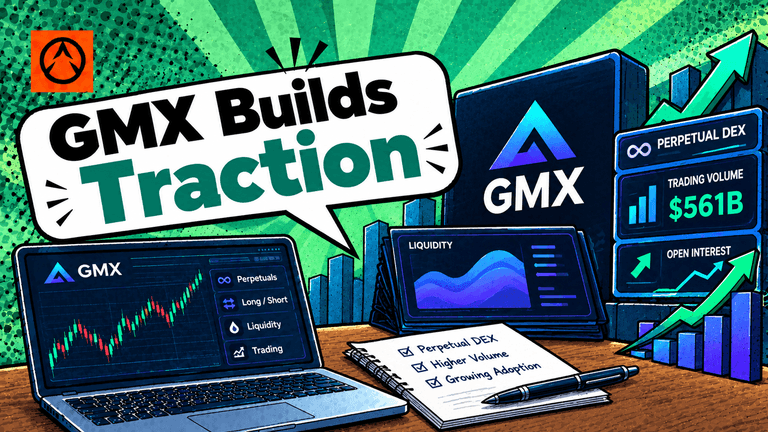
GMX has built a significant presence in decentralized derivatives, reporting $561 billion in total trading volume while expanding leveraged markets beyond crypto.
AAnmol Billa•Oct 9, 2026
GMX Builds Traction in Perpetual Trading
MentionedGMX$8.31+0.17%

GMX has established itself as a major player in decentralized perpetual trading, allowing users to open leveraged positions directly through blockchain-based markets. The platform operates without a traditional broker or centralized exchange account, letting traders use supported crypto wallets to access its markets.

GMX's official website reports more than 785,000 traders and $561 billion in total trading volume. It also lists around $270 million in open interest, which measures the value of positions that remain open. These are platform-displayed figures and may change over time.

The platform supports more than cryptocurrency trading. Its markets also cover assets such as gold, silver, energy products and selected U.S. equities, giving traders access to several asset classes through one decentralized interface.

How GMX Perpetual Trading Works

GMX is a decentralized exchange, or DEX, that allows users to trade perpetual futures. These are contracts that let traders speculate on an asset's price without a fixed expiration date.

Traders can open long positions when they expect prices to rise or short positions when they expect prices to fall. They can also use leverage to control a position larger than their initial margin.

GMX advertises leverage of up to 100x on supported markets, although the maximum depends on the market and its risk settings. Higher leverage also increases the risk of liquidation, when a position is closed because its collateral can no longer support the trade.

Unlike a conventional exchange order book, GMX uses liquidity pools to support trades. Its GMX Market (GM) and GMX Liquidity Vault (GLV) pools provide the liquidity used for positions and swaps.

The protocol also uses Chainlink price feeds to determine market prices and support trade execution. This allows it to operate without relying on a traditional centralized exchange's order book.

GMX Expands Beyond Crypto Markets

GMX has broadened its offering beyond major cryptocurrencies. Its platform lists markets linked to gold, silver, oil, natural gas and selected U.S. stocks and exchange-traded funds.

The expansion gives traders more ways to take leveraged positions through a self-custody wallet. GMX lists support across networks including Arbitrum, Avalanche, MegaETH and Solana, while its multichain account features support deposits from additional networks.

This approach reflects a wider trend in decentralized finance: bringing trading products traditionally associated with centralized exchanges onto blockchain-based platforms.

GMX's growth also fits into the broader expansion of on-chain derivatives. In August, Arbitrum's perpetual trading market recorded $1.48 billion in 24-hour volume, with GMX among the protocols contributing to the network's derivatives activity. The figure covered the wider Arbitrum market, not GMX alone.

Liquidity Providers Also Play a Role

GMX relies on liquidity providers to support its trading markets. Users can deposit eligible assets into GM or GLV pools and receive exposure to the fees generated by trading activity.

According to GMX's documentation, liquidity providers receive 63% of fees generated by trading, liquidations, borrowing and swaps on Arbitrum and Avalanche. The allocation can differ across products and networks.

This model connects trading demand with liquidity provision. More trading can generate additional fees, although liquidity providers still face risks from market exposure, trader profits and losses, and smart-contract vulnerabilities.

Risks Remain Despite GMX's Traction

GMX's decentralized structure removes the need for a traditional broker, but it does not eliminate trading risk.

Leveraged positions can be liquidated quickly when prices move against a trader. Fees, borrowing costs and price impact can also affect returns. In addition, users face smart-contract risks and the possibility that liquidity conditions may change.

GMX also has a security history that traders should consider. In July 2025, an exploit targeting its V1 GLP pool resulted in losses reported at roughly $40 million to $42 million. GMX said the incident affected V1, while its V2 markets were not affected. The incident highlights why protocol version and security updates matter when using decentralized trading platforms.

What GMX's Growth Means for DeFi

GMX's reported trading volume and broad market offering show how decentralized exchanges are developing beyond simple token swaps. Traders can access leveraged exposure, while liquidity providers can earn a share of protocol fees.

The platform's next challenge is maintaining liquidity, managing risk and competing with other perpetual DEXs as on-chain derivatives markets expand.

GMX's scale gives it a meaningful position in the sector, but trading volume alone does not guarantee future growth or profitability. For users, the key factors remain market liquidity, execution costs, security and the risks associated with leverage.

The information discussed by Altcoin Buzz is not financial advice. This is for educational, entertainment, and informational purposes only. Any information or strategies are thoughts and opinions relevant to the accepted levels of risk tolerance of the writer/reviewers and their risk tolerance may be different than yours. We are not responsible for any losses that you may incur as a result of any investments directly or indirectly related to the information provided. Bitcoin and other cryptocurrencies are high-risk investments so please do your due diligence.

Copyright Altcoin Buzz Pte Ltd.

Related

XRP Ledger adds permission delegation controls for banks, stablecoins and tokenized funds
Altcoins
Oct 9, 2026

XRP Ledger Adds New Controls for Banks, Stablecoins and Tokenized Funds

The XRP Ledger has activated PermissionDelegationV1_1, allowing financial institutions to delegate specific account tasks while keeping primary signing keys under tighter control.

XRP
Shitij Gupta
sDWF Labs-linked firms sue BitGo for $141 million over alleged early sales of locked crypto tokens
DeFi
Oct 9, 2026

DWF Labs Affiliates Sue BitGo for $141M Over Alleged Early Token Sales

DWF Labs-linked firms DWF Maas and Falcon Digital are suing BitGo for $141 million, alleging it sold Falcon Finance and ESPORTS tokens before contractual lock-ups expired.

FF
Bikash Deka
Sui Introduces Agent Pass
Altcoins
Oct 9, 2026

Sui Introduces Agent Pass to Set Spending Limits for AI Agents

Sui introduced Agent Pass at Basecamp 2026 to help developers control AI agent spending, adding to its wider push toward safer autonomous payments.

SUI
Saloni Rathi