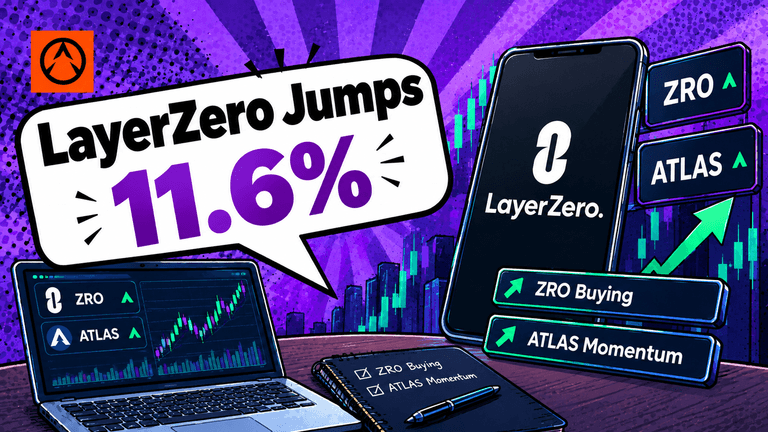
LayerZero’s ZRO token jumped 11.6% as fresh buying, ATLAS trading infrastructure, stablecoin integrations and ZRO buybacks strengthened the token’s market narrative.
 ZRO$1.81+10.90%
LayerZero’s ZRO token jumped 11.6% in 24 hours, trading around $1.76 in the latest market snapshot, as fresh buying activity collided with growing interest in the protocol’s expanding role in cross-chain infrastructure.
The move comes after a reported $500,000 OTC ZRO purchase from market maker Wintermute, while LayerZero’s upcoming ATLAS trading infrastructure and recent stablecoin partnerships are giving traders additional reasons to accumulate the token.
Trading activity has also picked up sharply. ZRO recorded about $186.7 million in 24-hour volume, while perpetual futures open interest stood near $247.1 million in the latest snapshot.

One of the clearest immediate catalysts is a reported $500,000 OTC purchase of ZRO from Wintermute by an unidentified wallet.
The latest market analysis identified the transaction as a major contributor to the current move. Because the purchase was made directly over the counter rather than through public exchange order books, it did not necessarily create the same visible market impact as an equivalent spot purchase executed across exchanges.
Still, the transaction has become part of the current accumulation narrative around ZRO.
The timing is notable because ZRO had already recovered sharply from its September lows. CoinGecko's historical data shows the token closing around $1.18 on September 21 before climbing to $1.65 by September 27.
The latest move therefore extends an existing rally rather than starting from a flat price base.
The bigger catalyst is LayerZero's ATLAS infrastructure.
LayerZero introduced ATLAS in August as a universal backend for trading venues, covering matching, clearing, settlement and risk infrastructure. The system is designed to support both open and institutional markets, while Zero acts as the underlying blockchain.
The important part for ZRO is the token's direct role in ATLAS economics.
Trading venues using ATLAS can stake ZRO to qualify for higher fee rebates. After the venue receives its rebate, LayerZero says 25% of the remaining economics goes to the market creator, while 75% is used to buy and burn ZRO.
That gives the token a potential connection to trading activity that goes beyond governance.
The ATLAS infrastructure is still part of LayerZero's upcoming expansion rather than an established source of large-scale revenue today. But expectations around that future utility are clearly part of the current market narrative. The latest analysis also identified anticipation around ATLAS and the Zero blockchain as secondary drivers of the current move.
LayerZero has also strengthened its position in the rapidly expanding stablecoin market.
On September 21, Anchorage Digital selected LayerZero as its interoperability partner for stablecoin issuance. The partnership covers stablecoins issued through Anchorage Digital Bank, including Tether's USAT, Western Union's USDPT, OSL Group's USDGO and Falcon Finance's fUSD.
LayerZero says the stablecoins will use its Omnichain Fungible Token standard to move across more than 170 blockchains. USAT became the first Anchorage-issued stablecoin to launch with LayerZero interoperability.
This matters for ZRO because it gives LayerZero another potential source of activity beyond traditional token bridging.
If regulated stablecoins increasingly need to operate across multiple networks, interoperability becomes part of the infrastructure required to distribute them. The Anchorage announcement therefore adds an institutional-use case to LayerZero's existing cross-chain narrative.
The token also has a direct link to Stargate activity.
LayerZero's pricing update introduced fees of up to two basis points on Stargate OFT transfers, capped at $250 per transfer. The company said excess revenue from those fees would be used for ZRO buybacks.
The separate LayerZero Labs Executor minimum fee was also raised to $0.25 per transaction from September 1. LayerZero said the changes were intended to better align infrastructure pricing with the cost of operating its services.
LayerZero's broader buyback system is not new. The project previously said Stargate revenue would be used to purchase ZRO on the open market, creating a connection between cross-chain activity and token demand.
That mechanism has become more relevant as traders assess whether future activity across LayerZero's products can offset scheduled token supply increases.
Another structural change is the ongoing transition from Stargate's STG token toward ZRO.
LayerZero said STG holders can continue converting their tokens to ZRO until December 15. The company is coordinating with exchanges, market makers and custodians during the transition.
At the same time, LayerZero plans to move all Stargate transactions to its Taxi delivery system from October 1, ending the Bus delivery method that batches transactions to reduce gas costs.
This further consolidates Stargate's role inside the LayerZero ecosystem and gives ZRO greater importance across products that were previously associated with STG.
The current rally is not happening only in the spot market.
The latest market snapshot shows roughly $247.1 million in ZRO perpetual open interest alongside $186.7 million in 24-hour trading volume.
That creates a significant derivatives component to the move. When open interest rises alongside price, traders are adding positions as the token moves higher. Those positions can amplify momentum, but they can also increase volatility if the market reverses.
Recent market data from Hyperliquid showed ZRO perpetual open interest of about $58.1 million on September 29, with positive funding and a 24-hour volume of roughly $11.6 million.
The derivatives activity therefore appears to be an important part of the current price action, rather than the move being driven exclusively by long-term spot accumulation.
There is also an important counterweight to the bullish narrative.
LayerZero has a continuing token unlock schedule. The next scheduled release is October 20, when about 31.3 million ZRO tokens are expected to unlock, equivalent to roughly 3.1% of total supply and about 4.2% of the current market capitalization according to Tokenomics.com data verified against LayerZero's tokenomics information.
That means the current rally is taking place ahead of another meaningful supply event.
The market will therefore be watching whether growing activity across ATLAS, Stargate and LayerZero's stablecoin infrastructure can create enough token demand to absorb additional supply.
The latest 11.6% move appears to be the result of several developments reinforcing each other.
The immediate trigger is a reported $500,000 OTC ZRO purchase, while the broader narrative is being driven by ATLAS, where ZRO is used for staking and receives value through the platform's buy-and-burn economics. LayerZero's recent Anchorage stablecoin partnership adds another institutional use case, while Stargate fees are already being directed toward ZRO buybacks.
At the same time, elevated derivatives activity is amplifying the price move.
ZRO has also climbed significantly from its September lows, rising from a September 21 close near $1.18 to around $1.76 in the latest snapshot.
The key distinction is that some of these catalysts are current sources of activity, while others are future expectations. ATLAS and Zero's broader rollout could create new utility for ZRO, but the market is currently pricing in part of that potential before the full system is live.
For now, ZRO's rally is being supported by a combination of fresh buying, expanding token utility, stablecoin adoption and leverage-driven momentum. The October unlock will provide the next test of whether demand can keep pace with new supply.
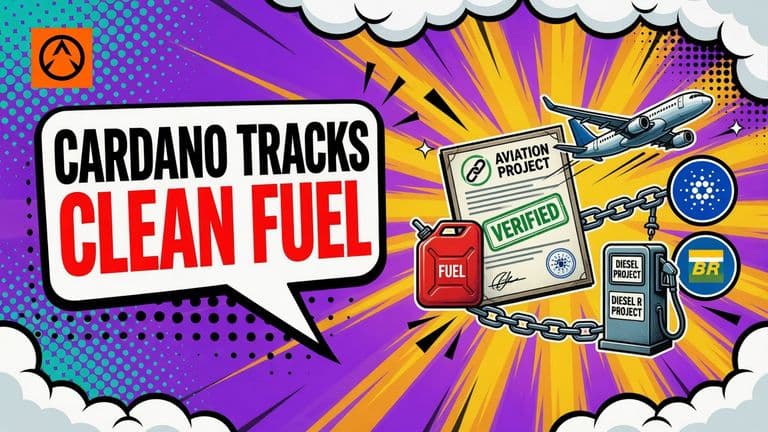
Brazil’s state-controlled oil company Petrobras is testing Cardano in two research projects focused on cleaner fuel.
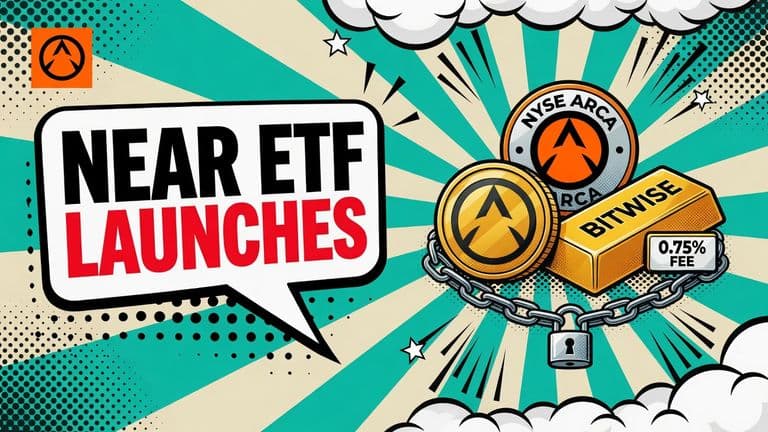
Bitwise’s NEAR ETF began trading on NYSE Arca. Its first flow data will show whether US demand extends beyond NEAR’s rally.
 NEAR
NEAR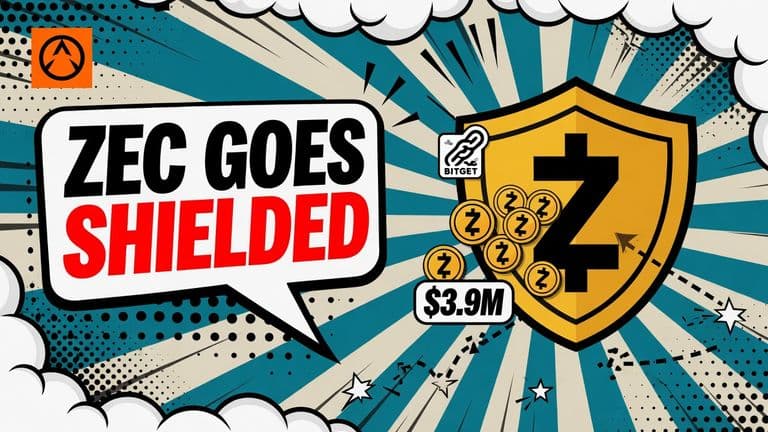
Wallets linked to the Bitget hack sent 2,746 ZEC into Zcash’s Ironwood pool, obscuring the next step for investigators.


