Coins.ph Says BSP Licence Intact as Peso Cash-Ins Stay Blocked
Coins.ph says users' funds are safe, it still operates as a BSP-licensed institution and services return "soon", as incoming peso transfers stay blocked.

By Anmol BillaSenior Analyst
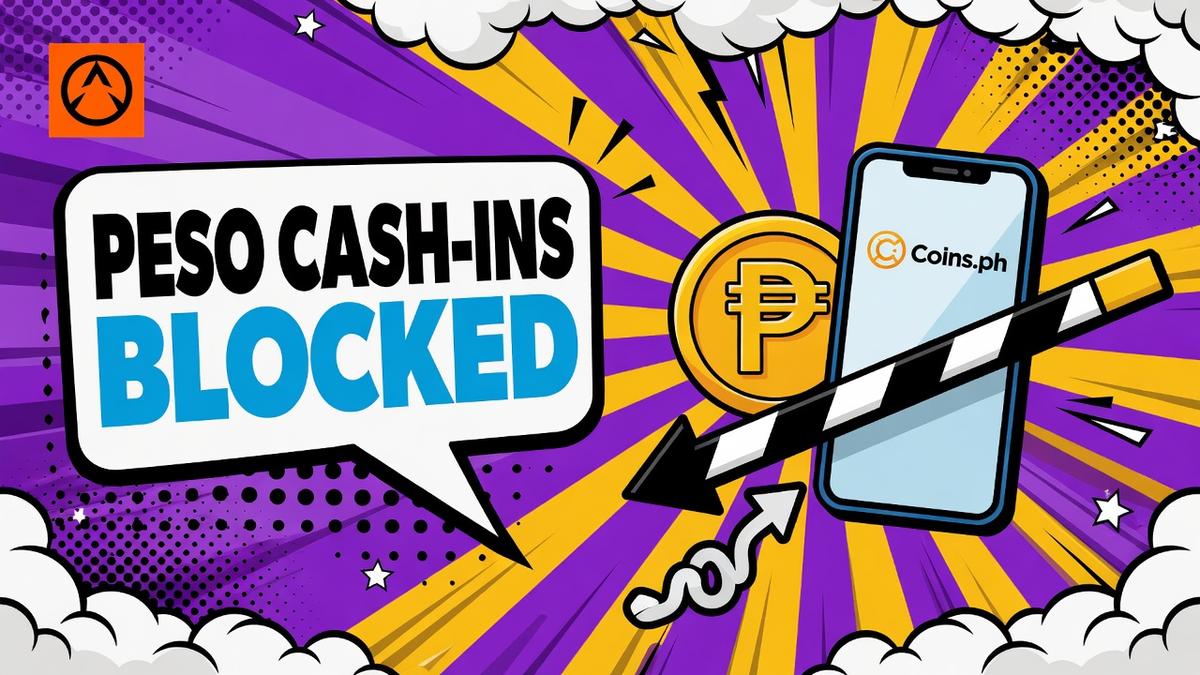
Updated 15 October 2026: Coins.ph has published its own statement confirming it still operates as a BSP-licensed institution and setting out its controls against offshore gambling operators, while peso cash-ins stay blocked.
The Bangko Sentral ng Pilipinas has blocked incoming peso transfers to the wallet arm behind Coins.ph, and the exchange has now answered on its own blog. A statement published on 14 October says users' funds are safe, that Coins.ph continues to operate as a BSP-licensed institution, and that it expects to restore the affected services "soon".
For anyone holding on the platform, nothing in that statement frees up a peso. Accounts are not frozen, and crypto trading still works. What has stopped is money coming in: pesos sent from an external bank account or another e-wallet no longer reach a Coins.ph wallet, so new trades have to be funded from balances already sitting on the exchange.
That is a large user base to inconvenience. Coins.ph says it has over 18 million registered accounts, processes roughly $50 million in 24-hour spot trading volume, and controls an estimated 75% to 80% of the country's peso-to-stablecoin liquidity.
What Coins.ph's Statement Actually Says
The statement is short, and its central sentence is this:
"Our users' funds are safe; we continue to operate as a BSP licensed institution. We expect to fully restore affected services soon and will share updates through our official channels."
It does not name which services are affected, and it gives no calendar date for their return.
The rest of it addresses the gambling reports directly. Coins.ph says it is aware of "recent news reports about our operations, including claims about offshore gaming transactions and our engagement with the Bangko Sentral ng Pilipinas (BSP)," and that it is "committed to serving only legitimate, compliant businesses and maintains strict controls to keep offshore gaming and gambling operators off our platform." The statement also says the company holds itself to the requirements and standards of the BSP, the Anti-Money Laundering Council and other regulators.
What the BSP Actually Ordered
The action on Coins.ph is a partial suspension, not a shutdown. The central bank suspended DCPay Philippines Inc., the electronic money issuer behind the exchange's peso wallet, from accepting incoming credit transfers cleared through InstaPay and PESONet, under Monetary Board Resolution No. 839.
Coins.ph put the same thing to users in an advisory published on 1 October:
"The Bangko Sentral ng Pilipinas (BSP) has directed Coins.ph to introduce enhancements to our internal controls. During this time, PHP cash-in via InstaPay and PESONet and QRPH collection services are temporarily unavailable."
The advisory says existing customers keep access to cash-outs, QRPh payments, bill payments and crypto trading, and that customer funds remain safe in accordance with BSP requirements. It adds that Coins.ph is working with the central bank to complete all requirements "within the timelines it has set," and will post updates on that page as services are restored.
Two weeks on, the freeze has not been lifted. Coins.ph's status page still lists InstaPay Cash In and PESONet Cash In as under maintenance, under an incident opened on 29 September at 13:00 GMT+08:00, while cash-outs on both rails show as operational. Nothing blocked money going out: DCPay kept its status as an originating institution, and in-store QRPh merchant payments were never affected.
The Gambling Allegation Coins.ph Denies
People with knowledge of the situation said the alleged infractions involve serving offshore gambling firms. The same people said several gambling operators moved onto the exchange after the central bank ordered supervised institutions in 2025 to cut in-app access to gambling sites, which also gave those firms a way to hold crypto and stablecoins for paying offshore partners.
Coins.ph denies it. "Coins.ph firmly denies any claim that it knowingly serves offshore gaming or gambling operators," the company said. A spokesperson said the exchange does not accept or permit offshore gambling operators and screens customers and transactions in line with BSP rules, but did not directly confirm or deny whether any such transactions occurred.
The central bank has not publicly linked its 2025 gambling directive to the restrictions on Coins.ph, and it has not commented on them.
Why the Licence Question Is Still Open
People familiar with the situation said the infractions are serious enough for Coins.ph to lose its licence to operate. No published document shows a revocation is being decided, and the BSP has not said the licence is at risk. The company's assurance that it still holds one is just that: its own.
The corporate structure matters here. Coins.ph runs through two separate BSP-regulated entities. DCPay holds an electronic money issuer licence and is the one under suspension. Betur Inc. holds a virtual asset service provider licence and powers crypto trading and custody. Betur's licence has not been suspended, and crypto trading continues to work. The fiat rails that fund it are the part that is down.
The resolution behind all this is another gap. Monetary Board Resolution No. 839 has not been published publicly, so its number and its terms come from local news reports rather than from the central bank's own document.
Several senior compliance staff, including the chief compliance officer, left the company this year. No link between those departures and the central bank's action has been established.
Until the cash-in rails reopen, Coins.ph users can sell, withdraw and pay, but they cannot top up with fresh pesos. The next signal is whether the BSP lifts the restriction on DCPay, or widens it to Betur's VASP licence.

Anmol Billa
Anmol Billa is a Senior Analyst at Altcoin Buzz, with over five years of experience working across cryptocurrency markets and the broader digital asset industry. His work focuses on technical analysis, market research, investment insights, and evaluating emerging opportunities within the crypto ecosystem. At Altcoin Buzz, Anmol contributes to technical market analysis, research-driven insights, pitch decks, and funding-related initiatives. His experience combines analytical thinking with a practical understanding of crypto markets, helping translate market trends and emerging projects into clear, actionable insights for readers and industry stakeholders.
More from AnmolNext up

NEAR Protocol Cuts Token Inflation to 1.6% as Intents Volume Surpasses $37B
NEAR Protocol has ratified a proposal to reduce maximum annual token issuance from 2.5% to 1.6% over 24 months. The decision comes as NEAR Intents surpasses $37 billion in cumulative volume and the network attracts more than 2,400 hackathon submissions.
 NEAR
Related
More in Crypto NewsRelated
Binance Heist and DeFi Exploits Put Crypto Security Under Pressure
Crypto Market Today: Bitcoin Near $65K as DOJ Targets $1.2B in Stolen Binance Crypto
 XRP
JPMorgan's Crypto-Linked Holdings Near $1B as Strategy Stake Jumps 36%
 BTCCOIN
Bitcoin Wallet Named in $260B Lawsuit Moves 75 BTC After 15 Years
BTC