AltcoinBuzzAltcoinBuzz
Subscribe
  • Crypto News
  • Crypto Research
  • Technical Analysis
AltcoinBuzzAltcoinBuzz

An independent digital media outlet delivering crypto research, news, and technical analysis to a community of 600,000+ users.

Follow us on:

Discover

  • Crypto Research
  • Crypto News
  • Technical Analysis
  • Key Opinions
  • Upcoming Launches

Categories

  • Bitcoin BTC
  • RWA
  • Technology
  • Altcoins
  • Regulation

Company

  • Affiliates
  • Partners & Sponsors
  • Careers
  • Contact
  • Terms of Use
  • Subscription Terms
  • About the ALTCOIN BUZZ
  • Privacy Policy
  • Contact ALTCOIN BUZZ
  • Advertise with us

Copyright 2026 ALTCOIN BUZZ. All rights reserved.Something is buzzzzzzzing.
HomeCrypto ResearchSEC Staff Releases New FAQs on Crypto Assets
Crypto ResearchRegulation

SEC Staff Releases New FAQs on Crypto Assets

SEC staff FAQs explain how token classification, staking receipts and buybacks are treated, but they cannot create new legal obligations.
SShashwat Gupta•Oct 1, 2026
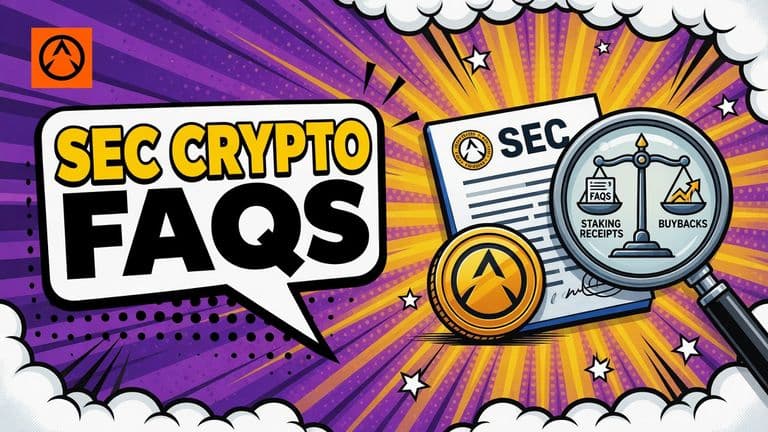
A pop-art illustration shows an SEC document beside a crypto token and regulatory symbols, representing the SEC staff’s nonbinding crypto asset FAQs.

The SEC's crypto FAQs give project teams a clearer picture of how staff think about token classification, staking receipts and buybacks. They don't give anyone new legal protection. The Division of Corporation Finance's page says its answers are staff views, haven't been approved or disapproved by the Commission, and have no legal force or effect.

That distinction matters. Projects can use the FAQs to understand staff reasoning, but the answers don't amend applicable law or create new obligations.

Functionality Doesn't Test an Issuer's Promises

One FAQ examines how an issuer's definition of a functional or decentralized network relates to the SEC's classification framework. The answer draws a useful line. An issuer may set its own thresholds for fulfilling its representations or promises. Those thresholds don't decide how the SEC classifies the crypto asset.

So, if a project says its network will reach a particular level of decentralization, its chosen benchmark may answer whether the project met its own promise. It doesn't automatically set the standard for classifying the token.

The FAQs are divided into questions about classification under Section III of the March 17 Interpretive Release and crypto assets subject to an investment contract under Section IV.

A Staking Receipt Comes With a Strict Test

The staking-receipt answer offers perhaps the clearest practical example. The staff says a receipt differs from other financial instruments because it doesn't transfer ownership or control of the deposited asset to the issuer. The issuer can't transfer, lend, pledge, rehypothecate or otherwise use that asset for itself or third-party claims.

A receipt also doesn't change the rights, obligations or benefits attached to the deposited asset, or give its holder additional financial incentives.

Under the staff's example, a staking receipt token for a digital commodity that isn't subject to an investment contract is a digital tool. It serves a practical function by evidencing ownership of the underlying commodity.

The token isn't the reward itself. A footnote says it doesn't create or guarantee staking rewards, generate them, or set their amount.

The classification can change with the arrangement. The staff also says a staking receipt token may be a digital commodity when a protocol-based liquid staking provider issues it and links it to the programmatic operation of a functional crypto system.

Promises Depend on the System

The FAQs say marketing a system's current utility, or describing possible future features with indefinite aspirations and no pitch for profit, generally won't by itself create “essential managerial efforts.”

But there's no bright-line rule for every kind of promotion. Whether marketing communications amount to representations or promises depends on the facts and circumstances.

The staff also says a non-security token doesn't break away from its investment contract if another party assumes the issuer's promises to undertake essential managerial efforts, either through an agreement or by operation of law.

Once a crypto system is functional, work to secure, maintain, improve or enhance it, or to facilitate network effects, generally doesn't count as essential managerial efforts. Promises to continue that work therefore don't satisfy that part of the Howey test, according to the FAQ.

This answer draws from an August 18 SEC proposing release rather than introducing a new staff policy.

The treatment changes if a functional system has no central party. The staff says issuer statements about such a system generally won't create a new investment contract, because no person controls the system in a way that could determine its success or failure.

The Buyback Answer Has a Narrowing Edit

Buybacks show why those conditions matter. The FAQ says an announcement of a non-security token buyback doesn't constitute essential managerial efforts when the system is functional and has no central party.

On a non-functional system, the answer can be different. A buyback could qualify as a promise of essential managerial efforts if the issuer presents it as creating yield or return for token holders.

The SEC marked this answer as updated on September 28, 2026, adding “and has no central party” to the first sentence. That condition now sits at the centre of the safe answer. The page also does not equate a secondary-market trading platform with a promoter. A platform would qualify only if it met the definition of “promoter” under Securities Act Rule 405.

The FAQs answer several practical questions about the staff's current reading of the framework. They leave one larger question intact: whether those answers will become part of the Commission's formal position. As things stand, the page says they have no legal force or effect.

The information discussed by Altcoin Buzz is not financial advice. This is for educational, entertainment, and informational purposes only. Any information or strategies are thoughts and opinions relevant to the accepted levels of risk tolerance of the writer/reviewers and their risk tolerance may be different than yours. We are not responsible for any losses that you may incur as a result of any investments directly or indirectly related to the information provided. Bitcoin and other cryptocurrencies are high-risk investments so please do your due diligence.

Copyright Altcoin Buzz Pte Ltd.

Related

A pop-art illustration shows stablecoin coins sending value into a growing stack of US Treasury bills.
StablecoinsRWA
Oct 1, 2026

Stablecoins Become a Bigger Buyer of Short-Term Treasuries

An SF Fed study finds stablecoin issuers have added $200 billion in Treasuries, changing who supports the dollar debt market.
USDC
Pallavi Malviya Gupta
A pop-art illustration shows an XRP coin, an XRPN Nasdaq listing badge, and connected treasury contributions inside a speech-bubble cover.
AltcoinsRegulation
Oct 1, 2026

Evernorth’s $1 Billion XRP Treasury Moves Closer to Nasdaq Listing

Evernorth plans an XRP treasury of at least 473 million coins, but most would come from contributions rather than cash purchases.
XRP
Pallavi Malviya Gupta
A pop-art SEC document sits beside an automated token buyback loop and a network control symbol divided between distributed nodes and one controlling party.
Regulation
Oct 1, 2026

SEC Says Automated Buybacks Aren’t Enough for Crypto Networks

The SEC’s revised buyback FAQ offers relief to functional networks without a central party, leaving many issuer-run programs outside its protection.

Shashwat Gupta