AltcoinBuzzAltcoinBuzz
Subscribe
  • Crypto News
  • Crypto Research
  • Technical Analysis
AltcoinBuzzAltcoinBuzz

An independent digital media outlet delivering crypto research, news, and technical analysis to a community of 600,000+ users.

Follow us on:

Discover

  • Crypto Research
  • Crypto News
  • Technical Analysis
  • Key Opinions
  • Upcoming Launches

Categories

  • Bitcoin BTC
  • RWA
  • Technology
  • Altcoins
  • Regulation

Company

  • Affiliates
  • Partners & Sponsors
  • Careers
  • Contact
  • Terms of Use
  • Subscription Terms
  • About the ALTCOIN BUZZ
  • Privacy Policy
  • Contact ALTCOIN BUZZ
  • Advertise with us

Copyright 2026 ALTCOIN BUZZ. All rights reserved.Something is buzzzzzzzing.
HomeCrypto NewsXRP Ledger Opens Vote on New Lending Upgrade with Vaults and Interest Rules
Crypto NewsDeFiTechnology

XRP Ledger Opens Vote on New Lending Upgrade with Vaults and Interest Rules

XRPL validators are voting on lending changes that add closed-ended vaults, cash accounting and new restrictions for loan brokers.
AAnmol Billa•Oct 1, 2026
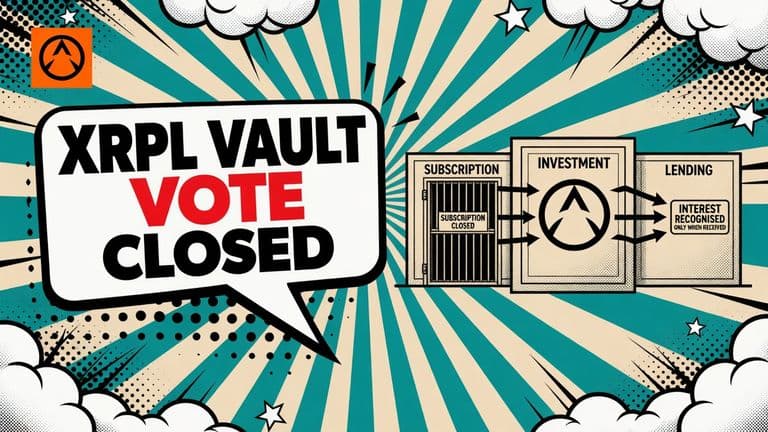
A pop-art illustration of an XRPL lending vault divided into subscription, investment, and redemption stages, with a closed subscription gate and interest recognised when payment arrives.
MentionedXRP$1.49-1.18%

The XRP Ledger Lending Protocol amendment is now open for validator voting. If approved, LendingProtocolV1_1 will add closed-ended lending vaults and change when interest counts as income, but it will not put lending on XRPL mainnet by itself.

For an XRP holder, the practical change is a stricter lending structure. Once a closed-ended vault closes its subscription window, new shares cannot be issued. Loans would then operate within defined investment and redemption periods, rather than accepting and releasing assets at any time.

What The Amendment Changes

The XRPL amendment record identifies LendingProtocolV1_1 as an extension of the LendingProtocol and SingleAssetVault amendments. It introduces a closed-ended vault model and cash-basis accounting.

A closed-ended vault has three stages:

  • Subscription, when assets can enter the vault
  • Investment, when loans can be originated
  • Redemption, when assets can be withdrawn

The XRPL documentation says existing open-ended vaults allow users to enter and exit at any time. That flexibility can affect how gains are distributed among participants.

The proposed closed-ended structure removes entry after the subscription period closes. No new shares can be minted during the investment or redemption stages. The point is to fix the vault's membership before its lending period begins.

The amendment also changes the treatment of new loan brokers. Once LendingProtocolV1_1 is enabled, new brokers can only be created against closed-ended vaults.

Interest Would Count When Paid

Cash-basis accounting would stop a vault from recording scheduled future interest immediately. Under the proposal, interest becomes income only when the borrower actually makes a payment.

That replaces the instant-recognition model used under the existing design, which recognised all scheduled interest when a loan was originated. The XRPL documentation describes the change as shifting recognition from origination to actual payment.

For a vault, the practical effect is narrower reported assets. AssetsTotal would reflect interest received rather than interest expected in the future. The change does not cancel the loan or the agreed repayment schedule. It changes when the vault recognises the return as income.

Three Amendments Are Still Needed

LendingProtocolV1_1 cannot activate XRPL lending on its own. The XRPL Lending Protocol documentation describes lending as a DeFi primitive for fixed-term, uncollateralized loans funded from a Single Asset Vault.

The broader system is described in three parts:

  • LendingProtocol, the base engine for loan brokers, origination, repayment and default handling
  • SingleAssetVault, which supplies pooled assets for loans
  • LendingProtocolV1_1, which adds closed-ended vaults and changes interest accounting

The amendments cover different parts of the lending system. LendingProtocolV1_1 must activate before LendingProtocol and SingleAssetVault can proceed. All three must be approved before lending launches on XRPL mainnet.

There is no confirmed launch date in the amendment record. The vote also does not establish how much DeFi activity the final protocol will attract.

What Validators Still Have To Prove

An XRPL amendment needs support from more than 80% of trusted validators for two weeks. If support falls below that threshold, the two-week period restarts, according to the XRPL network rules.

Validators check amendment status at every flag ledger, usually around 15 minutes apart. A majority is counted every 256th ledger.

The current support level for LendingProtocolV1_1 was not available in the materials reviewed, so the amendment's distance from activation remains unclear. No target activation date has been confirmed.

There is also an operational consequence for validator software. Servers running older xrpld releases without the amendment code become amendment blocked. They cannot validate ledgers, process transactions, join consensus or vote on future amendments until they run compatible software.

What It Means For XRPL DeFi

The proposal is not adding collateral or automatic liquidation. The current design focuses on fixed-term, uncollateralized credit origination and has no automated on-chain collateral or liquidation management.

Loan brokers can provide first-loss capital to cover missed payments. If the available cover falls below the required minimum, the broker cannot issue new loans or collect fees.

That makes the amendments a proposal for lending infrastructure, not proof of demand. Closed-ended vaults could give lenders a defined timetable, while cash accounting would make reported income less dependent on future payments. Whether that produces meaningful XRPL DeFi activity depends on validator approval and the other two amendments clearing the same governance process.

The information discussed by Altcoin Buzz is not financial advice. This is for educational, entertainment, and informational purposes only. Any information or strategies are thoughts and opinions relevant to the accepted levels of risk tolerance of the writer/reviewers and their risk tolerance may be different than yours. We are not responsible for any losses that you may incur as a result of any investments directly or indirectly related to the information provided. Bitcoin and other cryptocurrencies are high-risk investments so please do your due diligence.

Copyright Altcoin Buzz Pte Ltd.

Related

A pop-art cover shows the NEAR mark on a large coin beside a Bitwise ETF badge, rising coins, an upward arrow, and a $35.5M inflows badge.
Altcoins
Oct 1, 2026

NEAR Jumps 11% After First US ETF Launch Draws $35M in Inflows

Bitwise's US spot NEAR ETF drew $35.5 million on day one. The launch followed a rally while leverage declined.

NEAR
Shashwat Gupta
A comic cover shows OUSD connected across Ethereum, Solana, Base and Tempo, with uneven liquidity pools and a question mark highlighting the uncertainty.
StablecoinsEthereum ETH
Oct 1, 2026

Open Standard Launches OUSD Across Four Chains, but Liquidity Is Unclear

Open Standard launched OUSD on Ethereum, Solana, Base and Tempo on 30 September 2026, giving the dollar stablecoin a four-chain start.

Anmol Billa
A comic cover shows the USDAU stablecoin connected through a business minting and redemption account to six named blockchain marks.
StablecoinsRegulation
Oct 1, 2026

European Stablecoin Issuer AllUnity Launches USDAU Across Six Blockchains

AllUnity's USD-pegged USDAU targets European businesses with regulated issuance, 1:1 redemption and support across six blockchains.

Pallavi Malviya Gupta