AltcoinBuzzAltcoinBuzz
Subscribe
  • Crypto News
  • Crypto Research
  • Technical Analysis
AltcoinBuzzAltcoinBuzz

An independent digital media outlet delivering crypto research, news, and technical analysis to a community of 600,000+ users.

Follow us on:

Discover

  • Crypto Research
  • Crypto News
  • Technical Analysis
  • Key Opinions
  • Upcoming Launches

Categories

  • Bitcoin BTC
  • RWA
  • Technology
  • Altcoins
  • Regulation

Company

  • Affiliates
  • Partners & Sponsors
  • Careers
  • Contact
  • Terms of Use
  • Subscription Terms
  • About the ALTCOIN BUZZ
  • Privacy Policy
  • Contact ALTCOIN BUZZ
  • Advertise with us

Copyright 2026 ALTCOIN BUZZ. All rights reserved.Something is buzzzzzzzing.
HomeCrypto NewsZcash Developers Push Back on ‘Mathocalypse’ Panic with Emergency Recovery Plan
Crypto NewsAltcoinsPrivacy

Zcash Developers Push Back on ‘Mathocalypse’ Panic with Emergency Recovery Plan

Zcash developers are pushing back against Mathocalypse fears, outlining a proposed rapid token-holder vote and miner coordination to respond to potential cryptographic threats.
BBikash Deka•Oct 9, 2026
Zcash Developers Address Mathocalypse Fears
MentionedZEC$1,228.87-0.72%

Zcash developers and ecosystem leaders are pushing back against fears that rapid advances in artificial intelligence could threaten the cryptography protecting digital assets.

The debate, described as the “Mathocalypse,” has raised concerns that increasingly powerful AI systems could discover ways to break mathematical protections used by cryptocurrencies and other internet services.

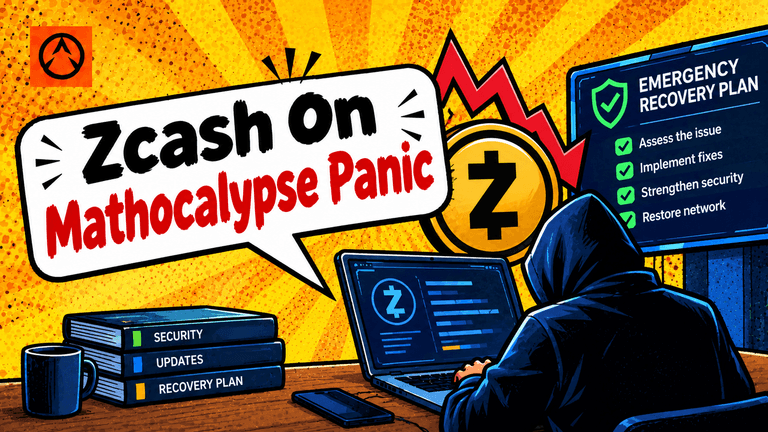
Zcash's response focuses on preparation rather than panic. The proposed recovery approach includes a 24-hour token-holder vote and coordination with miners to temporarily freeze vulnerable operations if a serious threat emerges.

The discussion comes as crypto developers face growing pressure to prepare for new security risks without disrupting networks unnecessarily.

What Is the Mathocalypse?

The Mathocalypse debate gained attention after new AI research results renewed questions about how quickly machines might advance mathematical research.

Computer scientist Scott Aaronson raised concerns about AI systems potentially making progress against important cryptographic problems. Ethereum researcher Justin Drake also urged crypto users to prepare for a possible threat to existing cryptography.

However, there is no publicly verified evidence that these AI advances have broken the cryptographic systems protecting major cryptocurrencies. The concern is that future breakthroughs could weaken assumptions that current security systems depend on. 

Cryptography protects digital signatures, wallet access and transaction authorization. If an attacker could derive a wallet's private key from its public information, the attacker might be able to spend its funds.

That is why developers are discussing contingency plans before a confirmed attack occurs.

Zcash's Proposed Emergency Response

The recovery plan described by Zcash leaders centers on two actions: rapid token-holder coordination and cooperation among miners.

The proposed 24-hour token-holder vote would provide a way to gather community input quickly if a serious cryptographic threat required an emergency response.

Miner coordination would address the network's immediate operation. If a vulnerable component needed to be disabled, miners and other network participants could coordinate to stop processing affected transactions while developers prepared a fix.

Such a response would be a major intervention. It could temporarily limit some network functions, but it might also reduce the opportunity for attackers to exploit a confirmed vulnerability.

The exact procedures, voting thresholds and implementation details should be confirmed against the original proposal before being treated as finalized network policy.

Zcash Has Already Coordinated an Emergency Fix

Zcash has a real example of how this type of response can work.

In May 2026, security researcher Taylor Hornby discovered a critical vulnerability in the network's Orchard shielded transaction system. The flaw could potentially have allowed counterfeit ZEC to be created without detection.

Zcash Open Development Lab (ZODL), the Zcash Foundation, miners, exchanges and infrastructure operators coordinated an emergency response. The network temporarily stopped processing Orchard-related transactions while developers prepared and deployed a fix.

The emergency soft fork activated on June 2, followed by a hard-fork upgrade on June 3 that restored Orchard functionality using the corrected circuit. Developers reported no evidence that the vulnerability had been exploited or that unauthorized ZEC had been created.

The incident demonstrates why emergency plans require cooperation across the ecosystem. Developers can write a fix, but independent network participants must also adopt the changes when a vulnerability requires a consensus-level update.

Why a Rapid Response Matters

A cryptographic vulnerability can be different from an ordinary software bug.

A typical application bug may affect a limited feature and can sometimes be fixed through a routine software update. A flaw in a blockchain's cryptographic rules may threaten transaction validity, wallet security or the network's supply accounting.

Developers may therefore need to balance two risks: acting too slowly and giving attackers more time, or acting too quickly and disrupting legitimate users.

A token-holder vote could help establish community support for an emergency response, while miner and node-operator coordination could help implement temporary safeguards.

However, a vote alone cannot repair cryptography. Developers still need to identify the weakness, design a technically sound fix, test it and coordinate its deployment.

Zcash's Next Upgrade Adds More Security Context

Zcash is also preparing its NU7 network upgrade, which is currently active on testnet but has not yet activated on mainnet.

The planned upgrade includes faster 25-second block times, changes to the network's sustainability mechanism and the disabling of transactions associated with the older Sprout privacy system. Its mainnet timing remains subject to final implementation and activation decisions. Zcash Community Forum

NU7 is a separate development from the Mathocalypse response. Still, both discussions highlight the importance of testing, coordination and clear decisions when changes affect a blockchain's core rules.

What Happens Next?

The central question is whether Zcash and other cryptocurrency networks can prepare for potential cryptographic threats before those threats become practical attacks.

For Zcash, the proposed emergency process would offer a framework for rapid community decisions and coordinated action if a serious vulnerability emerges.

The plan should not be mistaken for proof that Zcash's current cryptography has failed. Instead, it reflects the need to prepare for a changing security environment as AI research advances.

For now, the Mathocalypse remains a warning about a possible future risk, not evidence of a confirmed cryptographic break. The priority for Zcash developers is to preserve that distinction while ensuring the network can respond quickly if the threat becomes real.

The information discussed by Altcoin Buzz is not financial advice. This is for educational, entertainment, and informational purposes only. Any information or strategies are thoughts and opinions relevant to the accepted levels of risk tolerance of the writer/reviewers and their risk tolerance may be different than yours. We are not responsible for any losses that you may incur as a result of any investments directly or indirectly related to the information provided. Bitcoin and other cryptocurrencies are high-risk investments so please do your due diligence.

Copyright Altcoin Buzz Pte Ltd.

Related

GMX Builds Traction in Perpetual Trading
DeFi
Oct 9, 2026

GMX Builds Traction in the Perpetual DEX Market With $561B in Trading Volume

GMX has built a significant presence in decentralized derivatives, reporting $561 billion in total trading volume while expanding leveraged markets beyond crypto.

GMX
Anmol Billa
sDWF Labs-linked firms sue BitGo for $141 million over alleged early sales of locked crypto tokens
DeFi
Oct 9, 2026

DWF Labs Affiliates Sue BitGo for $141M Over Alleged Early Token Sales

DWF Labs-linked firms DWF Maas and Falcon Digital are suing BitGo for $141 million, alleging it sold Falcon Finance and ESPORTS tokens before contractual lock-ups expired.
FF
Bikash Deka
Sui Introduces Agent Pass
Altcoins
Oct 9, 2026

Sui Introduces Agent Pass to Set Spending Limits for AI Agents

Sui introduced Agent Pass at Basecamp 2026 to help developers control AI agent spending, adding to its wider push toward safer autonomous payments.

SUI
Saloni Rathi