AltcoinBuzzAltcoinBuzz
Subscribe
  • Crypto News
  • Crypto Research
  • Technical Analysis
AltcoinBuzzAltcoinBuzz

An independent digital media outlet delivering crypto research, news, and technical analysis to a community of 600,000+ users.

Follow us on:

Discover

  • Crypto Research
  • Crypto News
  • Technical Analysis
  • Key Opinions
  • Upcoming Launches

Categories

  • Bitcoin BTC
  • RWA
  • Technology
  • Altcoins
  • Regulation

Company

  • Affiliates
  • Partners & Sponsors
  • Careers
  • Contact
  • Terms of Use
  • Subscription Terms
  • About the ALTCOIN BUZZ
  • Privacy Policy
  • Contact ALTCOIN BUZZ
  • Advertise with us

Copyright 2026 ALTCOIN BUZZ. All rights reserved.Something is buzzzzzzzing.
HomeCrypto NewsBitGo Offers Banks Turnkey Stablecoin Issuance Under GENIUS Act
Crypto NewsStablecoinsRegulation

BitGo Offers Banks Turnkey Stablecoin Issuance Under GENIUS Act

BitGo's Stablecoin-as-a-Service bundles custody, reserve management and minting for issuers, and the company is pitching it as built to follow the GENIUS Act.
AAnmol Billa•Oct 14, 2026
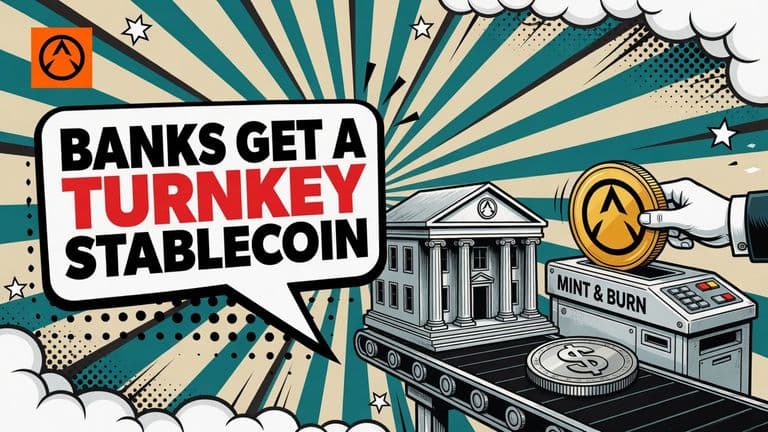
A comic-style bank building hands a large BitGo-stamped coin into a mint-and-burn console held by a suited arm, with a plain dollar coin on a conveyor below.

BitGo is selling the machinery behind a stablecoin as a product.

The custodian's Stablecoin-as-a-Service page says it handles custody, reserve management, smart contract infrastructure and orchestration, while the issuer keeps governance, compliance and distribution strategy. That split is the offer: BitGo runs the operational parts, and the issuer keeps the parts that carry legal responsibility.

For someone holding stablecoins, the change is about who gets to issue one. A bank or fintech that wanted its own dollar token previously had to assemble custody, reserves, minting and redemption from several vendors, or build them in-house. BitGo is selling that as a single package and pitching it as built to follow the GENIUS Act.

What the Service Takes Off an Issuer's Hands

BitGo's own description of the split is blunt:

Stablecoin-as-a-service reduces operational complexity by handling custody, reserve management, smart contract infrastructure, and orchestration. Stablecoins supported by BitGo retain responsibility for governance, compliance, and distribution strategy.

The BitGo Mint side supplies distribution. Issuers get direct minting and redemption access to exchanges, market makers and institutional participants, and BitGo says that gives a new stablecoin an immediate audience of banks, exchanges, asset managers and fintechs. Mint launched as a feature inside the BitGo UI supporting USD1 and SoFiUSD, with more assets and issuers to follow, per the company's product release notes.

Issuers also get an Issuer Console, a portal showing real-time supply metrics, mint and redemption history, reserve composition and access controls, plus white-labelled onboarding and a white-labelled mint and burn web app.

Two details are worth holding onto. BitGo says reserves can be allocated to permitted investments to generate returns for the issuer, and that reserve attestations come from "top accounting firms" it does not name.

GENIUS Act Alignment Is a Claim, Not an Approval

BitGo's GENIUS Act page says attestation reports for reserves are public and produced by third-party accounting partners. On the product page, the compliance language is qualified:

BitGo's Stablecoin-as-a-service is designed to adhere with regulatory requirements outlined in the GENIUS Act. Issuers outside of the US remain responsible for meeting applicable legal requirements, while BitGo provides operational infrastructure.

"Designed to adhere" is BitGo's description of its own product. It is not a licence, an approval or a regulator's statement, and the page pushes non-US legal duties back onto the issuer.

The Page Does Not Name the Chains

Cross-chain issuance is listed as a feature, and the page refers only to "the most popular blockchains." No chain list appears. That matters for an issuer weighing providers, because a cross-chain capability is only as useful as the specific networks behind it. For scale, AllUnity launched its USDAU stablecoin across six blockchains and named them.

USD1 and SoFiUSD Are the Reference Cases

USD1 is the clearest example. BitGo says World Liberty Financial chose it as custodian and infrastructure provider for USD1, and that the token is 100% backed by short-term US government treasuries, US dollar deposits and other cash equivalents, redeemable 1:1 for the dollar. BitGo's reserve system uses automatic rebalancing and daily reconciliation.

SoFiUSD is the bank case. BitGo describes it as the first US dollar stablecoin issued by a nationally chartered and insured deposit bank on a permissionless public blockchain, with BitGo Bank & Trust as primary infrastructure provider and distribution partner. Both BitGo Bank & Trust and SoFi Bank, N.A. are OCC-regulated, per BitGo.

CEO Mike Belshe framed the product around that audience:

Our Stablecoin-as-a-Service offering was designed for forward-thinking institutions that require cutting-edge technology paired with BitGo's longstanding foundation of trust.

There is a third name in the line-up. BitGo was named issuer and custodian, through BitGo Bank & Trust National Association, for FYUSD, a dollar-pegged stablecoin built by New Frontier Labs for institutional investors in Asia.

A Launch, or a Relaunch

Reports dated 13 October 2026 describe a launch. BitGo's own 2025 year in review says the company "debuted its Stablecoin-as-a-Service offering in March," a turnkey solution running from reserve management to minting, and that the infrastructure served as the blueprint for USD1's April launch.

Both can be accurate if October is a repackaging or an expansion rather than a first outing. Nothing on BitGo's blog index dated 13 or 14 October announces the product, so whether this week's event is a launch or a relaunch is unresolved.

The observable things to watch are narrow: whether BitGo publishes the list of blockchains the service actually supports, and whether an issuer outside USD1, SoFiUSD and FYUSD signs up.

The information discussed by Altcoin Buzz is not financial advice. This is for educational, entertainment, and informational purposes only. Any information or strategies are thoughts and opinions relevant to the accepted levels of risk tolerance of the writer/reviewers and their risk tolerance may be different than yours. We are not responsible for any losses that you may incur as a result of any investments directly or indirectly related to the information provided. Bitcoin and other cryptocurrencies are high-risk investments so please do your due diligence.

Copyright Altcoin Buzz Pte Ltd.

Related

A comic-style illustration of two large coin faces, one carrying the Binance mark and one the QuickSwap mark, with a red cross-out stroke over the lower coin and a badge showing -6.69%.
AltcoinsDeFi
Oct 14, 2026

Binance to Delist EPIC and QUICK, Ending Spot Trading on October 28

Binance will remove all EPIC and QUICK spot pairs on October 28, with margin, futures, deposits and withdrawals closing on their own dates before then.

Anmol Billa
A hooded figure slips out through a jagged crack in a bank vault door while carrying a stack of data records, drawn as a bold comic illustration with a headline bubble reading SIXTEEN FIRMS HIT.
Regulation
Oct 14, 2026

GOPAX Operator Streami Among 16 Firms Hit in South Korea Hack

South Korea's FSC says 16 financial firms were hit around the Shinhan Bank breach, including GOPAX operator Streami.

Anmol Billa
A comic illustration of two executives shaking hands at a signed document, with an open vault behind them holding a gold crypto coin, a tokenized share and a key.
RWARegulation
Oct 14, 2026

Ripple and Meritz Securities Explore Custody for Korea's Markets

Ripple and Meritz Securities will explore bringing Ripple Custody and tokenization to Korea's capital markets, starting within current rules.

XRP
Pallavi Malviya Gupta