AltcoinBuzzAltcoinBuzz
Subscribe
  • Crypto News
  • Crypto Research
  • Technical Analysis
AltcoinBuzzAltcoinBuzz

An independent digital media outlet delivering crypto research, news, and technical analysis to a community of 600,000+ users.

Follow us on:

Discover

  • Crypto Research
  • Crypto News
  • Technical Analysis
  • Key Opinions
  • Upcoming Launches

Categories

  • Bitcoin BTC
  • RWA
  • Technology
  • Altcoins
  • Regulation

Company

  • Affiliates
  • Partners & Sponsors
  • Careers
  • Contact
  • Terms of Use
  • Subscription Terms
  • About the ALTCOIN BUZZ
  • Privacy Policy
  • Contact ALTCOIN BUZZ
  • Advertise with us

Copyright 2026 ALTCOIN BUZZ. All rights reserved.Something is buzzzzzzzing.
HomeCrypto NewsDrift Opens DFX Claims for Users Hit by $2.95M Exploit
Crypto NewsDeFiAltcoins

Drift Opens DFX Claims for Users Hit by $2.95M Exploit

Drift opened DFX claims for verified April exploit losses. The first redemption value is about 0.0104 USDT per token, backed by a 3.1 million USDT pool.
SSaloni Rathi•Oct 1, 2026
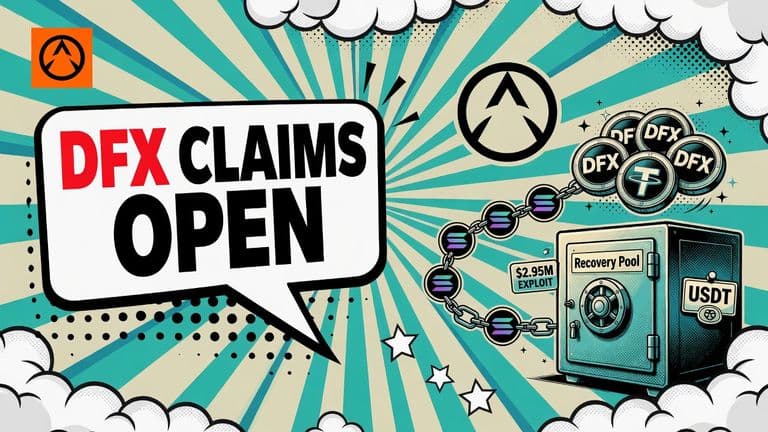
A pop-art cover shows Drift's DFX recovery token beside a partially funded USDT pool, symbolising claims opened for users affected by a $2.95 million exploit.
MentionedSOL$118.09-0.01%

Drift Foundation opened DFX claims on October 1, 2026, for users with verified losses from the April 1 exploit. The token began with a Recovery Pool holding about 3.1 million USDT against 299,500,810.998 DFX, putting the early redemption rate at about 0.0104 USDT per token.

That is not yet one cent of full value. You can redeem now, wait for the Recovery Pool to grow, sell DFX on a secondary market, or do nothing before the claim deadline. Each choice gives up something different.

Who Can Claim DFX

Your allocation was fixed in the loss snapshot taken for the April 1 incident. Eligibility depends on connecting the wallet that controlled your Drift account on that date. A different wallet will not show your allocation, even if it previously interacted with Drift.

To claim DFX, you must accept the token terms and have a small amount of SOL in the connected wallet for the network fee. Drift says claims and redemptions close at 00:00 UTC on January 1, 2028. Any DFX left unclaimed at that point will be permanently burned.

The Insurance Fund card is separate. It follows its own terms and does not provide DFX.

Why One DFX Does Not Equal One USDT Yet

DFX is a standard SPL token on Solana. It can be transferred and traded freely, including on Raydium, but the Drift announcement makes no representation about where or how it will trade.

The fixed supply is 299,500,810.998 DFX, set at one token per verified USDT of loss. There is no mint function, so more DFX cannot be created.

The initial gap comes from the size of the Recovery Pool. Drift reported a balance of about 3.1 million USDT at launch. Dividing that balance by outstanding supply gives an early redemption value of about 0.0104 USDT for every DFX.

The redemption rate is not fixed forever. It is calculated by dividing the Recovery Pool balance by outstanding DFX supply. As the pool receives more USDT, or holders redeem and reduce supply, the amount available per remaining DFX can rise.

Where The USDT Comes From

Drift says three funding streams feed the Recovery Pool.

  • Tether has committed up to 127.5 million USDT to support the relaunch and user recovery.
  • Strategic partners have committed up to another 20 million USDT.
  • Stolen funds recovered through freezes, the bounty or law enforcement are directed into the pool.

Protocol revenue adds smaller, recurring deposits. On Velocity, net trading fees are divided among the Insurance Fund, vAMM capital and Net Protocol Revenue. A tiered share of daily Net Protocol Revenue goes into the Recovery Pool:

  • 60% of the first 30,000 USDT
  • 70% of revenue from 30,000 to 100,000 USDT
  • 90% of revenue above 100,000 USDT

Each rate applies only within its band. Deposits stop once cumulative funding matches the total verified losses. Drift says each deposit is an on-chain transaction visible on its Recovery Dashboard.

The commitments do not equal confirmed assets already available to claimants. Drift described Tether's 127.5 million USDT as a matched deployment, but the announcement does not explain that mechanism. The Recovery Pool initially held only about 3.1 million USDT.

Your Options, And What Each One Gives Up

Redeeming converts DFX into USDT at the rate shown when the transaction goes through. Drift burns the DFX and pays the USDT in one transaction. Either both steps succeed or neither does. Once completed, the redemption is final.

Redemption does not reduce the value of the tokens left behind. The pool loses USDT and the supply loses DFX in the same proportion. If 10% of supply redeems, Drift says each remaining DFX receives about 11% more of every later pool deposit.

That makes early redemption a trade-off between certainty today and a larger claim on future funding later.

Selling DFX produces a different outcome. Its market price may differ from the 0.0104 USDT redemption rate, and you keep no DFX after the sale. The announcement does not promise a secondary market or set a target price.

Waiting leaves your full DFX allocation exposed to how quickly the pool grows. The Recovery Dashboard tracks the pool balance, outstanding supply and current redemption amount. Drift states that the pool only grows, the redemption amount never falls and supply only shrinks. It also describes the figures as illustrative mechanics, not a projection or promise.

The clearest number to watch is not the market price. It is the ratio of Recovery Pool USDT to outstanding DFX. That is the amount Drift says you can receive for each token if you redeem.

What Could Delay Full Recovery

The recovery schedule depends on more than the token design. Pool growth relies on protocol revenue, partner deployments and stolen funds that can actually be recovered.

Drift's announcement supports the funding structure, but it does not set a date for matching every verified loss. That leaves two gaps for claimants to watch: the pace of Velocity revenue and whether partner commitments become deployed funds.

So DFX does not restore the full USDT loss on day one. It gives verified users a fixed allocation, a live redemption rate and a claim on future Recovery Pool deposits. Redeeming locks in the current amount. Holding waits for that amount to rise, but also leaves the outcome tied to recovery funding that has not arrived yet.

The information discussed by Altcoin Buzz is not financial advice. This is for educational, entertainment, and informational purposes only. Any information or strategies are thoughts and opinions relevant to the accepted levels of risk tolerance of the writer/reviewers and their risk tolerance may be different than yours. We are not responsible for any losses that you may incur as a result of any investments directly or indirectly related to the information provided. Bitcoin and other cryptocurrencies are high-risk investments so please do your due diligence.

Copyright Altcoin Buzz Pte Ltd.

Related

An Ethereum upgrade block sits beside a crossed-out reward flame, while a validator reward coin fades inside the pop-art cover.
Ethereum ETHTechnology
Oct 1, 2026

Ethereum Drops Plan to Burn Staking Rewards in Hegotá Upgrade

Ethereum’s proposed staking reward burn, EIP-8363, has been withdrawn from consideration for the Hegotá upgrade.

ETH
Shashwat Gupta
A pop-art A7 payment network is hit by US sanctions while a separate proposed payment ban remains marked as pending.
Regulation
Oct 1, 2026

US Sanctions A7 Network and Proposes Sub-Agent Payment Ban

Treasury sanctioned the A7 Network as a transnational criminal group. FinCEN has separately proposed blocking funds tied to its Sub-Agents.

Shashwat Gupta
A pop-art crypto company is shown between connected New York and Wyoming oversight symbols, representing coordinated regulation.
Regulation
Oct 1, 2026

New York and Wyoming Regulators Coordinate Crypto Oversight

New York and Wyoming regulators will coordinate licensing reviews, examinations and potential enforcement involving digital asset businesses.

Shashwat Gupta