AltcoinBuzzAltcoinBuzz
Subscribe
  • Crypto News
  • Crypto Research
  • Technical Analysis
AltcoinBuzzAltcoinBuzz

An independent digital media outlet delivering crypto research, news, and technical analysis to a community of 600,000+ users.

Follow us on:

Discover

  • Crypto Research
  • Crypto News
  • Technical Analysis
  • Key Opinions
  • Upcoming Launches

Categories

  • Bitcoin BTC
  • RWA
  • Technology
  • Altcoins
  • Regulation

Company

  • Affiliates
  • Partners & Sponsors
  • Careers
  • Contact
  • Terms of Use
  • Subscription Terms
  • About the ALTCOIN BUZZ
  • Privacy Policy
  • Contact ALTCOIN BUZZ
  • Advertise with us

Copyright 2026 ALTCOIN BUZZ. All rights reserved.Something is buzzzzzzzing.
HomeCrypto NewsUS Sanctions A7 Network and Proposes Sub-Agent Payment Ban
Crypto NewsRegulation

US Sanctions A7 Network and Proposes Sub-Agent Payment Ban

Treasury sanctioned the A7 Network as a transnational criminal group. FinCEN has separately proposed blocking funds tied to its Sub-Agents.
SShashwat Gupta•Oct 1, 2026
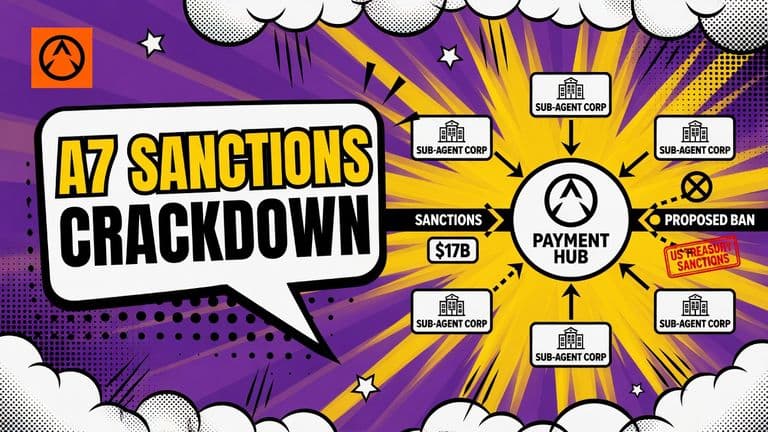
A pop-art A7 payment network is hit by US sanctions while a separate proposed payment ban remains marked as pending.

The US Treasury has sanctioned the A7 Network as a transnational criminal organization and separately proposed a ban on transmitting funds tied to its Sub-Agents. The two measures are at different stages: the sanctions are immediate, while FinCEN's payment restriction is still a proposal.

Treasury announced the action on October 1, 2026, under Operation Economic Outcast. It describes A7 as a shadow banking network with ties to Russia that Iran used to evade sanctions.

OFAC also sanctioned A7's leader, Ilan Mironovich Shor, whom Treasury describes as a sanctioned and convicted criminal fraudster. The action builds on the agency's August 14, 2025 designation of A7 LLC and Old Vector LLC.

How the A7 Network Moves Money

A7's Sub-Agents are companies based in third-country jurisdictions. They receive and send payments on the network's behalf, forming the core of what Treasury calls its laundering architecture.

FinCEN found that these Sub-Agents processed more than $17 billion between January 2025 and June 2026. That is a FinCEN investigation figure aggregated across the global network. It is separate from A7's own claim that it processed more than 7.5 trillion rubles, equivalent to $91.5 billion, as of January 2026.

Treasury compared that claimed figure with roughly 13 percent of Russia's 2025 foreign trade transactions. The comparison shows the scale A7 claimed to its customers. It does not independently verify the volume.

The network reportedly used several tools to disguise the source and purpose of payments:

  • Companies acting as Sub-Agents in third countries
  • Falsified trade documents and import-export records
  • Misleading descriptions of goods
  • Websites and bank accounts controlled by A7 staff
  • Custom-built VPNs that conceal staff locations

A7 staff could access the Sub-Agents' financial accounts and execute payments rapidly. The setup makes the companies look like ordinary commercial participants while Treasury says their activity routes money for sanctioned and illicit actors.

Why Iran and Other Risk Actors Matter

Treasury said the same Sub-Agents supported payments for Iran's central bank, the Islamic Revolutionary Guard Corps and Iran-backed terrorist organizations. It also linked the network to ransomware actors, restricted-goods procurement and transactions connected to North Korean hacks of cryptocurrency exchanges.

One Sub-Agent and its sister company received nearly $140 million from entities involved in Iranian sanctions evasion after dealing with Iran's shadow fleet. A separate Sub-Agent sent about $1.6 million to a company linked to sanctions evasion and weapons procurement.

The latest action also extends the government's treatment of A7A5, a blocked, ruble-backed token issued by Old Vector. Treasury says it created the token so network members could conduct international transactions and evade sanctions while generating revenue for sanctioned infrastructure providers.

The release does not list a blockchain, contract address or wallet for A7A5. It also names only a limited set of designated entities, including A7 LLC and Old Vector. No individual Sub-Agent wallet addresses appear in the announcement.

A Proposed Ban, Not Yet a Final Rule

FinCEN's separate proposal would prohibit transmittals of funds concerning transactions involving A7 Sub-Agents. This is a notice of proposed rulemaking, not a final rule.

The public comment period will close 30 days after the proposal is published in the Federal Register. Its practical effect will depend on the final rule. The Treasury announcement does not establish an effective date for the payment restriction.

FinCEN issued the proposal under section 9714(a) of the Combating Russian Money Laundering Act, but said it is not limited to Russian sanctions evasion. The scope reaches the broader role Treasury assigns to A7 Sub-Agents.

At the same time, FinCEN issued an alert with warning signs that financial institutions can use to identify A7 activity. It also said whistleblowers may qualify for rewards if their information leads to successful enforcement with monetary penalties exceeding $1,000,000.

The Crypto Connections

A7 has been linked to Nobitex, which Treasury describes as Iran's largest digital-asset exchange and which OFAC designated on June 2, 2026. Treasury also says A7 facilitated transactions connected to North Korean hacks of crypto exchanges.

Those links place A7 inside the financial infrastructure used around sanctioned and illicit activity. They do not make every transaction associated with A7A5 or Nobitex criminal merely because the entities have been sanctioned. They do explain why OFAC moved beyond designating several A7 companies in 2025 and targeted the broader network this time.

For crypto users, the immediate distinction is simple. The A7 Network sanctions are active. The proposed Sub-Agent payment ban is not yet a final restriction, and the announcement provides no contract or wallet details with which to assess a specific token holding.

The information discussed by Altcoin Buzz is not financial advice. This is for educational, entertainment, and informational purposes only. Any information or strategies are thoughts and opinions relevant to the accepted levels of risk tolerance of the writer/reviewers and their risk tolerance may be different than yours. We are not responsible for any losses that you may incur as a result of any investments directly or indirectly related to the information provided. Bitcoin and other cryptocurrencies are high-risk investments so please do your due diligence.

Copyright Altcoin Buzz Pte Ltd.

Related

An Ethereum upgrade block sits beside a crossed-out reward flame, while a validator reward coin fades inside the pop-art cover.
Ethereum ETHTechnology
Oct 1, 2026

Ethereum Drops Plan to Burn Staking Rewards in Hegotá Upgrade

Ethereum’s proposed staking reward burn, EIP-8363, has been withdrawn from consideration for the Hegotá upgrade.
ETH
Shashwat Gupta
A pop-art cover shows Drift's DFX recovery token beside a partially funded USDT pool, symbolising claims opened for users affected by a $2.95 million exploit.
DeFiAltcoins
Oct 1, 2026

Drift Opens DFX Claims for Users Hit by $2.95M Exploit

Drift opened DFX claims for verified April exploit losses. The first redemption value is about 0.0104 USDT per token, backed by a 3.1 million USDT pool.

SOL
Saloni Rathi
A pop-art crypto company is shown between connected New York and Wyoming oversight symbols, representing coordinated regulation.
Regulation
Oct 1, 2026

New York and Wyoming Regulators Coordinate Crypto Oversight

New York and Wyoming regulators will coordinate licensing reviews, examinations and potential enforcement involving digital asset businesses.

Shashwat Gupta