SBF's Supreme Court Appeal Puts $11 Billion Forfeiture on the Line
SBF's counsel asked the Supreme Court to review his conviction and $11 billion forfeiture. The legal question, the timeline, what it means for FTX creditors.

By Anmol BillaSenior Analyst
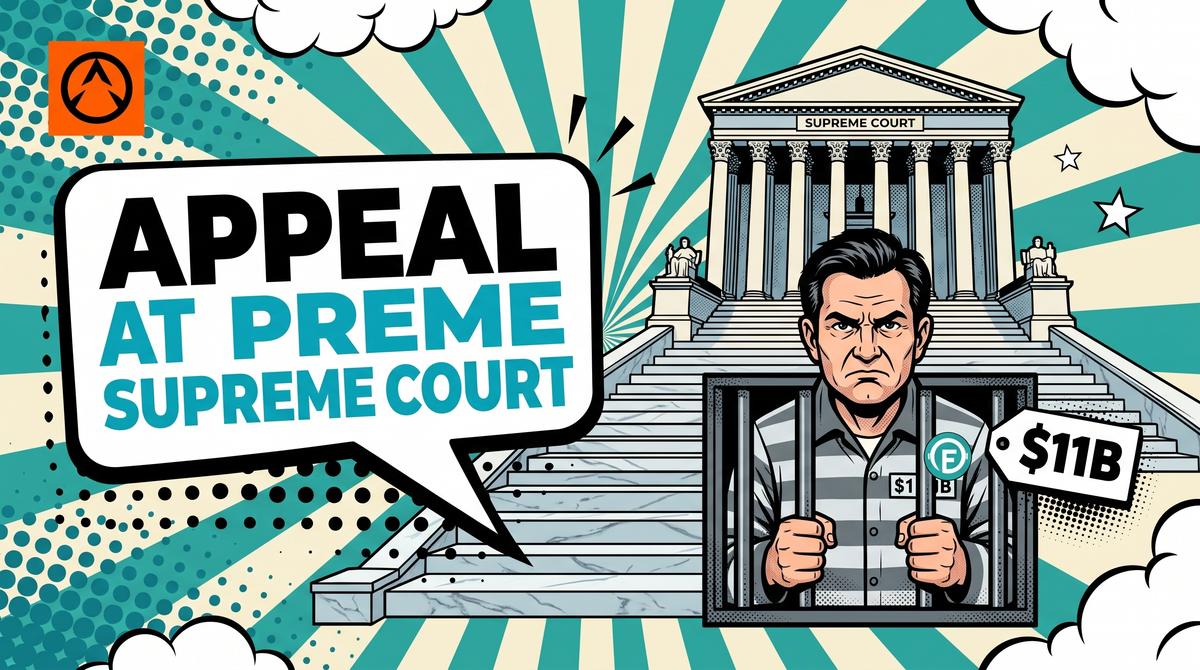
Jeffrey L. Fisher is counsel of record for Sam Bankman-Fried at the Supreme Court, and on September 10 he filed a petition asking the justices to review both the seven-count fraud conviction and the $11 billion forfeiture that came with it. The case is docketed as No. 26-349.
If you hold a claim in the FTX bankruptcy, little about your recovery turns on this. Creditor payments come from the estate's recovered assets under its confirmed Chapter 11 plan, a separate legal track from the criminal judgment, and the forfeiture is money owed to the government. What the petition does ask is whether the evidence rules at his trial and the size of that forfeiture were lawful.
The Two Questions the Petition Puts to the Court
The filing spends little time relitigating FTX's collapse and is specific about the law. The petition presents two questions.
- First, in a "fraudulent inducement" prosecution, where it does not matter whether victims lost money, when may the trial court admit evidence indicating whether they suffered such losses?
- Second, does the Eighth Amendment permit a forfeiture or other criminal fine that "destroys any future prospect of earning a livelihood"?
The petition argues "no customer lost money as a result of these actions" and that customers have now been repaid with substantial interest. It says the district court blocked him from showing that to the jury, and that the $11 billion forfeiture is punitive on top of 25 years in prison and his voluntary handover of assets to repay customers.
Fisher has described the sum as an $11 billion debt for the rest of Bankman-Fried's life, owed to the government, and unpayable from anything he earns after release.
Kousisis, Carpenter and the Fight Over Loss
Kousisis v. United States was decided 9-0 on May 22, 2025, in an opinion by Justice Amy Coney Barrett, docket 23-909. The court held that a defendant who induces a victim into a transaction under materially false pretenses may be convicted of federal fraud even if he did not seek to cause the victim economic loss.
The Second Circuit applied that reasoning in June, holding that FTX customers were defrauded as soon as their money was transferred to Alameda, regardless of how strongly Bankman-Fried believed he might later return it. The panel also said the trial court acted within its discretion in excluding evidence about the later value of FTX-related investments.
The petition points instead to United States v. Carpenter, a 2007 First Circuit decision in which the defendant intended customers to suffer no financial losses. Mark Bini, a former federal and state prosecutor now a partner at Reed Smith, has called that an uphill battle. The appeals court said the government's trial evidence was, conservatively stated, robust, and held that federal forfeiture law calculates the amount through proceeds obtained from criminal conduct, not solely through the victims' remaining losses.
What It Means for FTX Creditors
Not much, directly. The estate began its Fifth Distribution on July 31, 2026, about $900 million, with Class 5A Dotcom and 5B US customer claims each reaching 105% cumulative, Classes 6A and 6B each at 103% cumulative, and Class 7 convenience claims at 120%. A further $18 million went to eligible Preferred Equity Holders, taking total payments from the Preferred Shareholder Remission Fund Trust to $95 million.
Payouts were calculated from token prices at the time of the 2022 collapse, so customers who waited three years for repayment missed the gains in between.
The forfeiture sits on the other track. If the court trims it, the change lands on what Bankman-Fried owes the government, not on what creditors already received. Bini's read is that if the justices accept the forfeiture argument but reject the evidence argument, a reduced forfeiture is more likely than a new trial.
The Timeline Runs Into 2027
The government's response was due October 15 and the court extended it to November 16, 2026. Four of the nine justices must vote to hear a case, and filing the petition neither grants a new trial nor suspends the sentence. Bankman-Fried is serving 25 years and is expected to remain in prison until 2043. He is also seeking a pardon from President Donald Trump.
Fisher's expectation is a decision on whether to take the case in late 2026 or early 2027, and if review is granted, a ruling in the term ending June 2027 or the term after that. That is the defense's expectation, not a date on the docket.
For now the judgment stands. The Second Circuit issued its mandate in August 2026, returning jurisdiction to the district court and leaving the conviction and the forfeiture in effect.

Anmol Billa
Anmol Billa is a Senior Analyst at Altcoin Buzz, with over five years of experience working across cryptocurrency markets and the broader digital asset industry. His work focuses on technical analysis, market research, investment insights, and evaluating emerging opportunities within the crypto ecosystem. At Altcoin Buzz, Anmol contributes to technical market analysis, research-driven insights, pitch decks, and funding-related initiatives. His experience combines analytical thinking with a practical understanding of crypto markets, helping translate market trends and emerging projects into clear, actionable insights for readers and industry stakeholders.
More from AnmolNext up
US CPI, PPI and Fed Speeches: 5 Events That Could Move Crypto This Week
US inflation reports, five Federal Reserve speakers and Japan's producer-price data headline the economic calendar as crypto traders assess the outlook for December interest rates.
Related
More in Crypto NewsRelated
Forward Industries Expands Solana Treasury to 8.7 Million SOL as Per-Share Growth Slows
 SOL

Why Are Strategy and Metaplanet Leaving MSCI Indexes on Nov. 30?
Deutsche Bank Launches Crypto Custody for Institutions, Eyes Asia Expansion
Bitcoin Trades Near $73K as US CPI Increased to 0.4% in October from its expectations of 0.3%
 BTC