OffMarket Hides Who Placed a Polymarket Bet, Not the Bet
StarkWare's OffMarket lets traders take Polymarket positions from wallets unlinked to their account. The bet stays public, the person behind it does not.

By Shashwat GuptaFounder
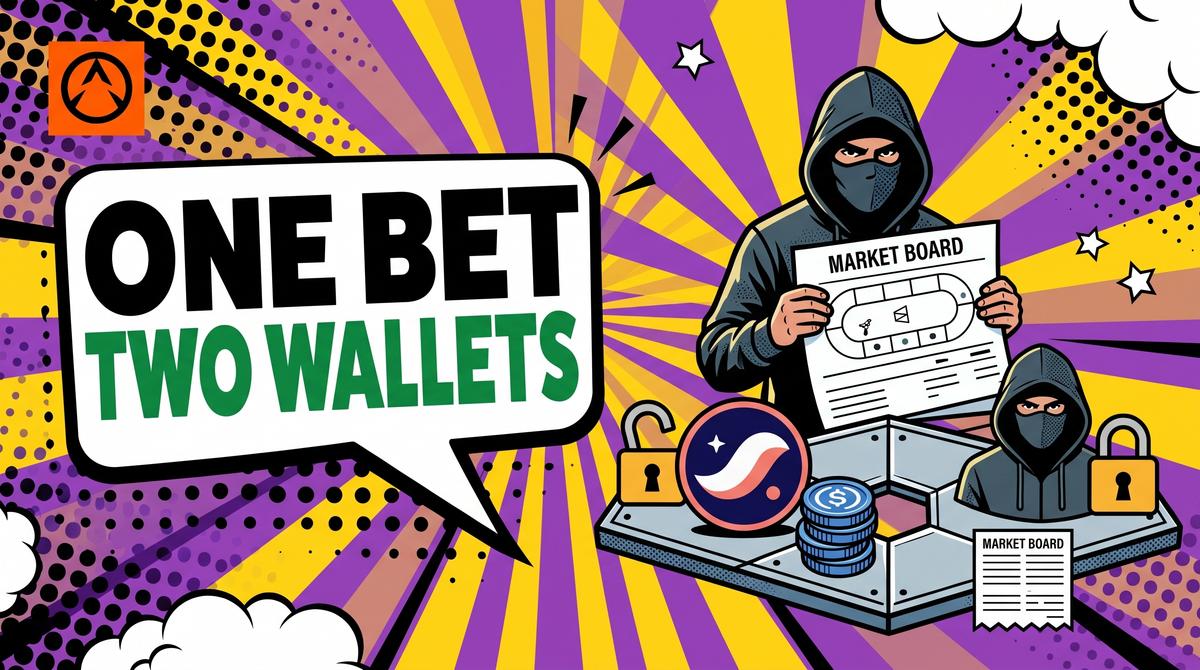
StarkWare's new trading app, OffMarket, does one narrow thing: it lets people trade Polymarket markets from wallets that are not publicly linked to the account placing the bet. The markets, the order book and the odds are Polymarket's. What changes is who the chain can connect a position to.
The limits matter as much as the promise. An on-chain observer can still see that USDC moved from the Starknet privacy pool to some Polygon address, that the address traded on Polymarket, and what it holds and won or lost. They cannot see which Starknet address funded it, or that several positions belong to the same person, as OffMarket's own description sets out.
One Wallet per Bet, Derived From a Signature
You sign in with Google or a crypto wallet, then deposit USDC. No Polymarket account is needed, because OffMarket derives a fresh trading wallet for each position and handles the Polymarket side for you.
For each bet it creates a Polygon wallet derived mathematically from your signature. You can always recover it, but it has no on-chain connection to your identity. That wallet places the order on Polymarket, holds the position, and collects the winnings.
The money moves in two stages. Deposits go into a smart contract on Starknet, where zero-knowledge proofs encode balance and activity into ciphertext that only your private viewing key can read. From there, Circle's CCTP, the standard USDC burn-and-mint bridge, burns the USDC on Starknet and mints it to the fresh Polygon wallet. The bridge carries no identifying information, and the process reverses when funds come back.
The Tradeoff: A Viewing Key in Escrow
OffMarket is non-custodial. Private keys are derived in your browser from a single signature and never transmitted anywhere, and the Starknet contract leaves no administrator able to reach the funds:
The contract is public and immutable. No administrator can access your funds or see your balance.
The compliance hook is deliberate. When a user shields USDC through STRK20, Starknet's native privacy framework, a viewing key is registered that is scoped to that user alone. If a legitimate legal request arrives, a designated third-party auditing entity can use the key to reconstruct that specific user's transaction history and nothing else. OffMarket describes the same arrangement, with an auditing entity holding the viewing key in escrow for compliance tracing.
STRK20 also charges a fixed fee per transaction rather than skimming a percentage of transaction value, closer to a gas fee than a toll.
What Stays Visible, and What That Costs
The unlink is not invisibility. OffMarket's site names exactly what stays public: the transfer from the Starknet pool to the Polygon wallet, that wallet's trading on Polymarket, and its positions and profit and loss. A fresh wallet still accumulates a public record, and every bet gets its own.
That design buys one thing in return, though. OffMarket routes orders into Polymarket's existing markets, order book and odds rather than building a smaller private book, so a shielded trade meets the same liquidity an unshielded one would.
The Audit Behind the Privacy Pool
The pool contracts have been reviewed. OpenZeppelin audited the starkware-libs/starknet-privacy repository at commit c5e2fb5, in a report dated June 23, 2026. It logged 11 findings: zero critical, zero high, two medium and five low. Both medium issues were resolved, along with one of the five low.
The audited design is a UTXO-based privacy protocol. Users deposit into a shared pool, transact privately, and withdraw without revealing a link between sender and recipient. In that design an auditor holds a private key that can decrypt viewing keys and withdrawal data, which gives visibility into activity without the ability to control or spend user funds.
Can You Trade on It Today?
The app is live at offmarket.cx, and the site describes signing in, depositing USDC and trading the same Polymarket prediction markets at the same odds. OffMarket says there is no OffMarket server, no database of user accounts and no custodied keys, and that you could recover your derived wallets directly if it shut down.
Two things its own pages do not settle: the exact date it opened to everyone, and which countries it serves. A per-account deposit cap reported at $1,000 is also unconfirmed by OffMarket's own description of the service.
What the product does confirm is a preference. It took Polymarket's order book as given and wrapped the privacy layer around it, so a trade placed off the record still lands in the same market as everyone else's.

Shashwat Gupta
Shashwat Gupta is an entrepreneur, CEO and co-founder of the online media portal, Altcoin Buzz. Shash has been a crypto enthusiast since 2015 and entered the emerging cryptocurrency space full time in early 2017. His business expertise and extensive knowledge in the crypto space have helped shape Altcoin Buzz to be what it is today.
More from ShashwatNext up
Pyth Adds Live NYSE Data From Five Exchanges as ARR Reaches $13.67 Million
Pyth Network has added real-time stock and ETF data from all five NYSE Group exchanges to its Data Marketplace. The move follows its Nasdaq distribution agreement and comes as October ARR reaches $13.67 million.
 PYTH
Related
More in Crypto NewsRelated
Why Did Zcash Fall Below $1,000 for the First Time Since September?
 ZEC
 UNI
Grayscale Pledges $1 Million to Zcash Ecosystem as ZEC and Its ETF Slide
ZEC
XRP Whales Move $900 Million to Binance as Price Crashes to $1.08
 XRP

Zcash (ZEC) Hashrate Hits Record High After NU7 Upgrade as Network Activity Surges
ZEC