White House crypto adviser Patrick Witt says he remains bullish on the CLARITY Act ahead of a planned September 15 Senate vote, despite renewed disputes over stablecoin rewards and Trump's crypto interests.
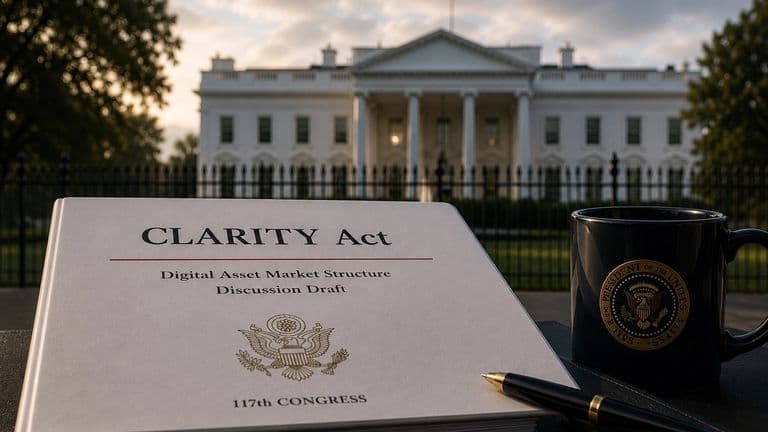
White House crypto adviser Patrick Witt said he remains “optimistic and bullish” on the CLARITY Act ahead of a planned September vote, even as disagreements over stablecoin rewards and President Donald Trump’s cryptocurrency-related conflicts of interest threaten to complicate negotiations.
Speaking Tuesday at the annual SALT conference in Wyoming, Witt said the White House expects to work with Democratic lawmakers during the August recess to resolve remaining disagreements before the Senate considers the legislation.
“We'll be sitting down with Democrats and really trying to hash out the areas where there are disagreements and get a solid vote on the 15th,” Witt said, adding that he is “truly optimistic and bullish” about the bill.
The Senate has scheduled a cloture vote for September 15, giving lawmakers several weeks to negotiate the remaining issues. Previous coverage has detailed the challenges the CLARITY Act faces ahead of the September vote, including disagreements among lawmakers over the legislation's broader regulatory framework.
The more than 600-page CLARITY Act is designed to establish a comprehensive federal regulatory framework for the cryptocurrency industry.
However, the legislation has faced repeated delays as lawmakers debate several contentious provisions.
One of the biggest disagreements has centered on stablecoin rewards, particularly whether platforms should be allowed to compensate users for holding stablecoins.
The issue has created tension between the cryptocurrency industry and traditional banking institutions, with both sides pushing for different approaches to how stablecoin based rewards should be regulated.
Earlier in the year, Democratic Sen. Angela Alsobrooks and Republican Sen. Thom Tillis reached a compromise intended to resolve the dispute.
Under the proposed framework, platforms would not be permitted to pay rewards simply because a user holds a stablecoin. However, rewards could still be provided in connection with transactions and payments.
That compromise appeared to settle one of the biggest obstacles facing the legislation.
It may not have been enough.
Senate Banking Committee Chair Tim Scott, a Republican from South Carolina, said Tuesday that the stablecoin issue has resurfaced.
Speaking on a separate panel at the Wyoming conference, Scott suggested lawmakers would need to revisit the matter before the September vote.
“We thought it [stablecoin issue] was all settled,” Scott said, arguing that the remaining disagreements have once again become a significant part of the negotiations.
The renewed debate creates another obstacle for lawmakers who had hoped to use the August recess to prepare the legislation for a vote.
For the crypto industry, the stablecoin provisions are particularly important because the rules could influence how platforms structure rewards, payments and other services around dollar-pegged digital assets.
For banks, the issue is closely tied to competition. Stablecoins increasingly overlap with traditional financial services, particularly payments and deposits, making the regulatory treatment of rewards a major point of contention.
Stablecoin rewards are not the only unresolved issue.
Democratic lawmakers have also pushed for stronger ethics provisions addressing President Donald Trump's expanding cryptocurrency interests. The issue comes as the White House continues to engage directly with the cryptocurrency industry, with Trump's upcoming meeting with crypto executives adding another important political backdrop to the debate.
Earlier negotiations produced language that would prohibit public officials and government employees, along with their spouses, from issuing or sponsoring digital assets.
The proposal would still allow officials to invest in digital assets, while the restriction would expire in January 2029.
Trump has agreed to an earlier version of the ethics provision, but lawmakers are now considering additional language proposed by Democratic Sen. Ruben Gallego and Republican Sen. Thom Tillis.
The latest proposal would give state attorneys general authority to enforce the provision, adding another layer to the debate over Trump's cryptocurrency interests.
Trump is currently weighing the proposal.
Sen. Cynthia Lummis, a Republican from Wyoming and one of Congress' most prominent cryptocurrency advocates, said she does not know how Trump will respond to the latest ethics proposal.
However, she argued that the president has already accepted significant restrictions.
“I don't know what he'll do, but I can tell you he's already agreed to more than any president in history,” Lummis said during the Wyoming panel.
Her comments highlight the political balancing act surrounding the CLARITY Act.
Republicans want to move forward with comprehensive cryptocurrency legislation, while Democrats are seeking additional safeguards around conflicts of interest and the treatment of digital assets.
The administration, meanwhile, needs enough bipartisan support to overcome procedural hurdles in the Senate.
The Senate's scheduled September 15 cloture vote is now the next major milestone for the CLARITY Act. The deadline is particularly significant because expectations for the CLARITY Act have weakened in recent weeks, despite the White House maintaining a more optimistic stance.
Lawmakers are currently on their August recess and are expected to return in mid-September before leaving again in October. That leaves a relatively narrow window for both sides to resolve the remaining disputes.
Witt's comments suggest the White House believes a compromise remains achievable.
But the return of the stablecoin rewards debate shows that negotiations are not yet finished, while the unresolved ethics provisions could add another layer of uncertainty.
For the cryptocurrency industry, the stakes are significant. The CLARITY Act would establish a broader federal framework for digital assets, potentially providing greater regulatory certainty for exchanges, token issuers and other crypto businesses.
Whether lawmakers can reach an agreement before September 15 will determine whether the legislation moves closer to becoming law or faces another delay.
For now, the White House remains confident.
Witt's bullish outlook suggests the administration believes the remaining disagreements can be resolved, but the renewed stablecoin fight and Trump's crypto-related ethics debate mean the path to a September vote is far from straightforward.

Bitcoin ETFs took in $6.3 billion in Q3, but 2026 flows are only $985 million after first-half redemptions.
 BTC
BTC
ESMA wants EU crypto firms barred from custody and transfers involving stablecoins that fail MiCA rules. It is a proposal, not current law.

BlackRock built three portfolio strategies for Ondo. Each is wrapped as one token that automates allocation, rebalancing and fees.

