500 ETH Burned to Expose Alleged Brain-Control Conspiracy
Millions in ETH Burned, Shocking Donations, and Mind-Control Allegations—The Case of Hu Lezhi
By Tari
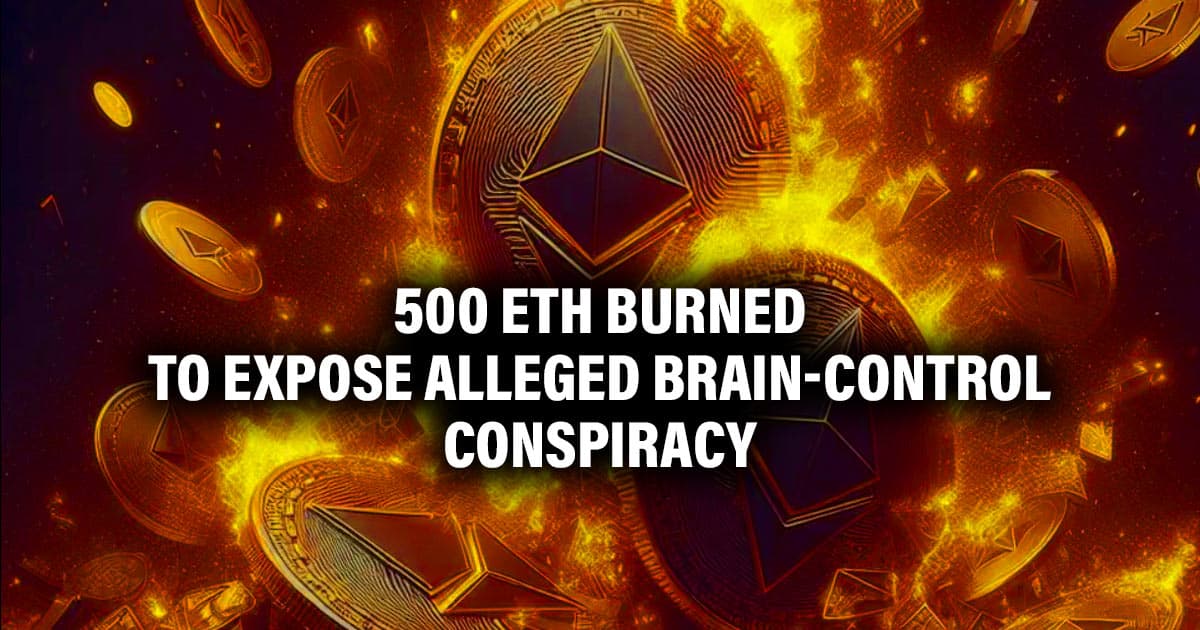
Hu Lezhi burned a staggering 500 ETH (worth about $1.38 million). He donated another 1,950 ETH (around $5.35 million) to organizations like WikiLeaks and Ukraine. But that’s not the craziest part.
Hu Lezhi claims that top executives of a Chinese hedge fund, Kuande Investment (WizardQuant), are using “brain-computer weapons” to control employees.
The Ethereum Burn and Massive Donations
Lezhi’s actions have shocked crypto users. Not only did he destroy over $1.3 million in Ethereum by sending it to a burn address (where no one can ever retrieve it), but he also made huge donations:
The transactions were all linked to wallets from crypto exchanges OKX and Binance. But why would someone destroy and give away millions in ETH? According to Lezhi, he’s trying to raise awareness of a dystopian crime—one in which people are supposedly turning into mind-controlled puppets.
The “Brain-Computer Weapons” Allegation
Lezhi’s on-chain messages accused two Kuande Investment executives—Feng Xin and Xu Yuzhi—of using these so-called “brain-computer weapons” to manipulate employees and themselves. Here’s a direct quote from his message:
That’s a huge claim. While there’s no evidence to support it, the fact that Lezhi chose to burn millions in Ethereum to broadcast this message has people questioning his motives. Is this a protest, a cry for help, or something else?
Tracking the Money Trail
Arkham tracked Lezhi’s transactions and found that his Ethereum movements totaled $5 million over the last week. He made repeated warnings through on-chain messages, with one stating: “There is a new mode of crime in which the victim is gradually deprived of his senses of desire until he becomes a complete slave to the digital machine.”
According to Arkham, Lezhi’s transfers included:
- $4.95M was sent to burn addresses, WikiLeaks, and the Ethereum Foundation.
- $825K ETH moved to a Coinbase deposit address.
- $273K ETH was sent to a newly created wallet.
Blockchain as a Public Bulletin Board
This incident highlights how blockchain isn’t only for financial transactions—it’s becoming a tool for activism. Since blockchains are permanent and censorship-resistant, Lezhi ensured that his allegations would live on forever, etched into Ethereum’s history.
His actions raise some key questions:
- Is this a new form of digital protest?
- Is he genuinely exposing something, or is this a delusion?
- Could this inspire others to use blockchain for ideological messaging?
What’s the Crypto Community Saying?
Some believe Lezhi’s story, calling him a whistleblower who risked everything to expose a secret crime. Others think this is a grand conspiracy theory with no factual basis. Some understand the expensive action of destroying $1.3M ETH as a showy stunt.
One indisputable fact remains that becoming the first person to burn over $1.3 million in ETH is an exceptional, non-routine act. Burning $1.3 million in ETH established Lezhi as an instant figure in crypto despite his doubts about his statements.
Conclusion
The ETH burn and the Kuande Investment allegations have surprised the crypto community. Whether Lezhi’s claims are valid or not, he’s found a way to use blockchain technology as an immutable megaphone for his beliefs.

Disclaimer
The information discussed by Altcoin Buzz is not financial advice. This is for educational, entertainment, and informational purposes only. Any information or strategies are thoughts and opinions relevant to the accepted levels of risk tolerance of the writer/reviewers and their risk tolerance may be different than yours. We are not responsible for any losses that you may incur as a result of any investments directly or indirectly related to the information provided. Bitcoin and other cryptocurrencies are high-risk investments so please do your due diligence. Copyright Altcoin Buzz Pte Ltd.
Next up

Bitcoin Core Speeds Up Fixes for AI found Bugs Drops
Bitcoin Core will backport and ship fixes for easily discoverable bugs as soon as possible, ending long embargoes for issues an LLM prompt can find.
 BTC
Related
More in Crypto NewsRelated
Collector Crypt Q3 Revenue Hits $433.5M, but 94% Goes Back Out
 SOL

DFINITY Founder Accuses NEAR of Using ICP Signing Research
 NEAR
 ICP

Longs Take 83% of $333M Crypto Liquidations as Bitcoin Holds $81K
BTCSOL
Sui's Hashi Adds Anchorage Digital as $500M Bitcoin Launch Nears
BTC SUI


