Bitcoin Miners Drop 12% as Hot CPI Doubles Rate Hike Odds
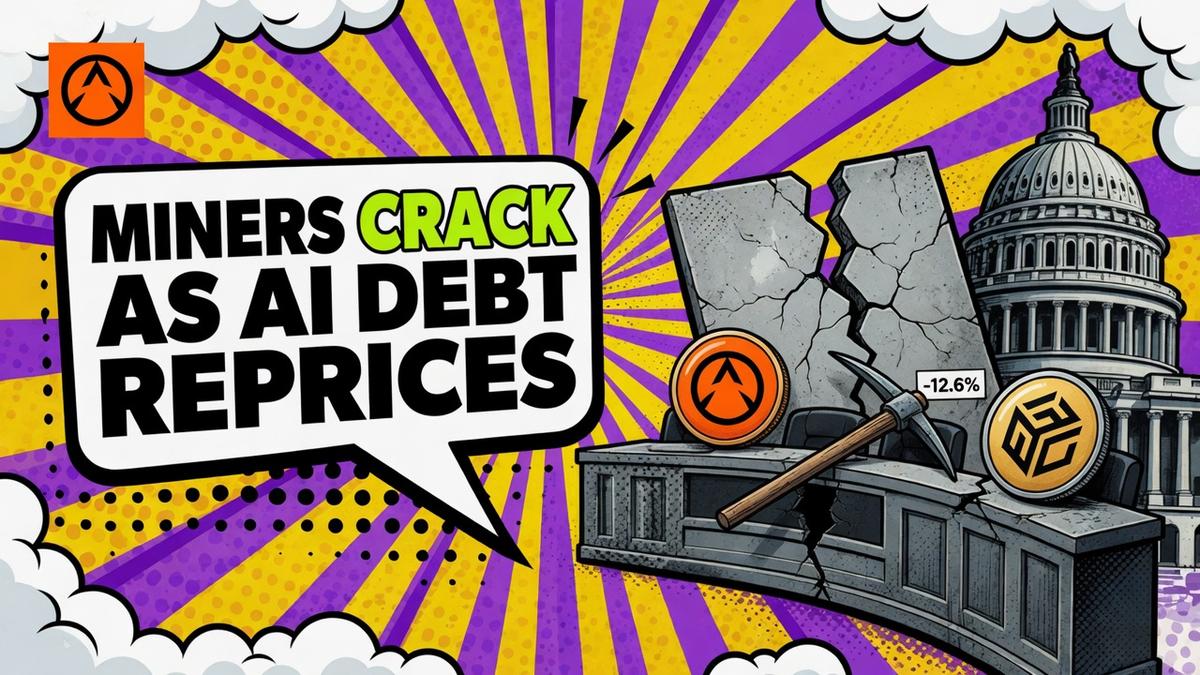
Bitcoin miners fell up to 12.6% after September CPI came in at 3.7% and October Fed hike odds doubled, with the dollar spiking to an 18-month high.

By Shitij GuptaResearcher
Updated 15 October 2026: The selloff's inputs are now in: September CPI at 3.7%, October Fed hike odds roughly doubled before Fed officials talked them back, and the dollar's spike to an 18-month high with Thursday's.
Bitcoin miners that now sell AI and high-performance computing capacity took the worst of Wall Street's sharpest selloff since July. TeraWulf fell 12.64% on Wednesday, Core Scientific 12.44%, Cipher Mining 12.35% and IREN 12.2%, with Riot Platforms, Bitdeer, MARA and CleanSpark also lower. The S&P 500 fell 1.1% and the Nasdaq Composite 1.9%, their biggest one-day declines since July 29 and July 23. The Dow Jones Industrial Average lost 0.1%.
The numbers behind the move are now in. September consumer prices ran 3.7% above a year earlier, up from 3.4% in August, and the odds of a Fed hike at its 27-28 October meeting roughly doubled within minutes of the release. The dollar rose with the yields, then handed most of that move back on Thursday as Fed officials argued against acting this month.
The miners traded with the AI complex, not with bitcoin. Data center operator CoreWeave fell 16%, AI infrastructure provider Nebius 11% and Oracle 9%. Of the 23 stocks in PRISM's AI Data Center and Infrastructure Index, 21 declined, with an average loss of 7.46%. Bitcoin hit an intraday low of $81,588.88 on 14 October and was down 1.5% at $82,142, with Ethereum down 2.8% to $2,440, Solana down 1.9% and XRP down 1.3%, while total crypto market cap shed 0.7% to $2.8 trillion.
September CPI Came In at 3.7%
US consumer prices rose 3.7% over the 12 months to September, above the 3.6% expected and up from 3.4% in August, the Bureau of Labor Statistics reported. All items rose 0.6% on the month, seasonally adjusted, after 0.4% in August. Core inflation, which strips out food and energy, ran at 2.6% over the year, against a 2.5% forecast, and 0.3% on the month.
Energy did the work: up 20.4% over 12 months, with gasoline up 34.2% and fuel oil up 74.2%. Gasoline alone rose 9.1% in September and accounted for more than half of the monthly all-items increase. The energy index rose 5.2% over the month. Oil had traded above $90 a barrel for most of the past two months during the war between the US and Iran, and Brent futures were up 0.2% at nearly $106 a barrel before the print.
Sonu Varghese, chief macro strategist at Carson Group, said:
"The only surprise is that investors keep getting surprised by broad-based inflation. And we've yet to see the full impact of higher diesel prices and the AI boom."
Rate Hike Odds Doubled, Then Faded
Rates repriced within minutes of the release. LSEG data had money markets pricing roughly a 47% chance of another October increase, up from closer to 20% beforehand. CME FedWatch put the odds of a 25 basis point hike at the October meeting at 53.7% against 22.1% a day earlier, and the odds of a second hike in December stood at 50%. Deutsche Bank analysts said the implied probability peaked intraday at 58%, staying about half an hour above 50%, before fears around AI and tightening credit conditions unwound it.
Then officials spoke. Fed Vice Chair for Supervision Michelle Bowman and San Francisco Fed President Mary Daly said the central bank could wait for a clearer picture ahead of the 27-28 October meeting. Daly had earlier said further hikes were likely needed to bring inflation under control but that there was no urgency to act that month. By Thursday, CME FedWatch had the odds of an October hike back to 31%, and ANZ's Khoon Goh said the market read the inflation print as not hot enough to force the Fed's hand in October, days before the midterm elections.
The Fed's own calendar lists the October meeting on 27-28 and the December meeting on 8-9. The committee raised its target range by a quarter point to 3.75% to 4.00% on 16 September by a 12-0 vote, saying inflation remains elevated and that the action supports a timelier return to its 2 percent goal.
The Dollar Leg of the Move
Wednesday was as much a dollar move as a rates move. The dollar rose 0.3% against a basket of currencies, the dollar index was up nearly 0.4%, not far from its highest since April 2025, the euro dropped 0.4% to $1.115 and sterling fell 0.25% to $1.322. The two-year Treasury yield, the tenor most sensitive to Fed expectations, jumped 7 basis points to 4.872% from around 4.77%.
Thursday reversed most of it. The dollar index was last down 0.2% at 102.03, off an 18-month high set the previous session. The euro bounced 0.5% to $1.1216, on track for its biggest daily gain in nearly two months, and sterling strengthened 0.5% to $1.3253. The 10-year Treasury yield fell 9 basis points to 5.099% and the 30-year was down more than 8 basis points to 5.439%, both around three-week lows, while the 2-year was 6 basis points lower at 4.74%.
The yields matter for bitcoin because interest-bearing dollar assets get more attractive as they rise, draining the cheap money speculative assets feed on. The 10-year had climbed to about 5.3% on Wednesday, near 24-year highs. Equities moved with the same current: S&P 500 futures fell 0.25% and Nasdaq futures 0.5% after the data, the Nasdaq 100 slid to a three-week low and the small-cap Russell 2000 fell to levels not seen since mid-May.
Societe Generale's Kit Juckes described the dollar picture as a tug of war:
"The overall picture is I think one of a little bit of a tug of war between people who would like to look for a correction in the dollar. Because positioning's too big, we've come a long way, there's not really much new news, we've got a lot of rate hikes priced in and so on. And then the economic data, which can flip it."
The Debt and Contracts Behind the Double-Digit Drops
Cipher Digital (CIFR) filed an 8-K on 13 October covering a proposed private offering of $850 million of 0.00% convertible senior notes due 1 November 2032, with an option for another $150 million. There is no cash coupon. The cost arrives at conversion, and Cipher also expects privately negotiated exchanges of part of its 1.75% convertible notes due 2030 into common shares. The equity paid for it: the shares traded at $10.72, down 5%, after a 13% fall the prior session, close to close, and nearly 18% across two sessions.
The contracted side is large. Cipher describes the amended Barber Lake lease as $9.1 billion in contracted revenue as of 30 September, including $5.2 billion of incremental rent, on a 20-year base term. It intends to put the note proceeds toward capped-call transaction costs, further equity in Barber Lake, high-performance computing pipeline development, site expansion and general corporate purposes.
IREN runs on $14 billion in committed financing and targets $4 billion in contracted annualized recurring revenue operating by year-end. Its AI Cloud revenue more than doubled sequentially to $70.5 million in Q4 FY2026. In August it disclosed a multiyear cloud contract with a frontier AI lab it could not name. A report tying that customer to Anthropic has not been confirmed by either company.
TeraWulf, the worst performer of the four, states on its own site that it holds a $19 billion Anthropic lease in Kentucky and controls 2.9 gigawatts, with 839 megawatts contracted across five locations.
Deribit Puts Sit at $76,000 to $80,000
Positioning was defensive into the print. On 12 October, Deribit showed concentrated put options at $76,000 to $80,000 for the 16 October expiry, which buyers use to protect against falling prices. More than $281 million in crypto derivatives positions were liquidated in the 24 hours to Wednesday, most of it in the last four hours and mostly bitcoin longs.
PPI, Retail Sales and the 28 October Decision
September producer prices, September retail sales and weekly jobless claims were all due Thursday. Economists polled by Dow Jones expect PPI up 0.6% on the month and 5.5% on the year. Fed Chair Kevin Warsh is due to appear at the IMF-World Bank annual meetings in Bangkok on Friday and to hold a conversation with IMF Managing Director Kristalina Georgieva.
The level that matters for the miners is the 10-year Treasury yield, last near 5.1% after Thursday's drop from about 5.3%. If the PPI print pushes it back toward the 24-year high, the refinancing math behind every debt-financed campus stays where Wednesday left it. If it holds near the three-week low, the trigger behind Wednesday's session goes with it.

Shitij Gupta
Shitij Gupta is an analyst and a researcher at Altcoin Buzz. Shitij has a vast banking experience at companies such as Morgan Stanley, ETRADE and UBS. He primarily built banking and lending products, Robo Advising solutions and Mutual Fund offerings for High Net worth clients. After his stint on Wall Street, Shitij runs a family office fund and consults businesses on strategy and execution.
More from ShitijNext up

Strategy Buys 485 Bitcoin for $33.4M, Spends Nearly 7x More on STRC Buybacks
Strategy bought 485 Bitcoin for $33.4 million in the week ending November 15, 2026.
 BTCMSTR
Related
More in Crypto NewsRelated
Luxor's Miner Hijack: Was AI Behind the Attack?
BTC
Zoom, CNN & Ledger Caught in Major Crypto Malware Attack Across 178 Sites
BTC ETH
Crypto Fear and Greed Index Hits Extreme Low Falls to 12 as BTC Trades at $64,500
BTC
Binance Lets Users Spend Against BTC, ETH and BNB With Pay Later
BTC BNB