BNY and Citadel Settle Tokenized Treasury, Then Use It as Collateral
BNY and Citadel Securities moved a tokenized 2-year Treasury in minutes, then pledged it in an overnight repo. What the trade changes, and what it does not.

By Saloni RathiSenior Editor
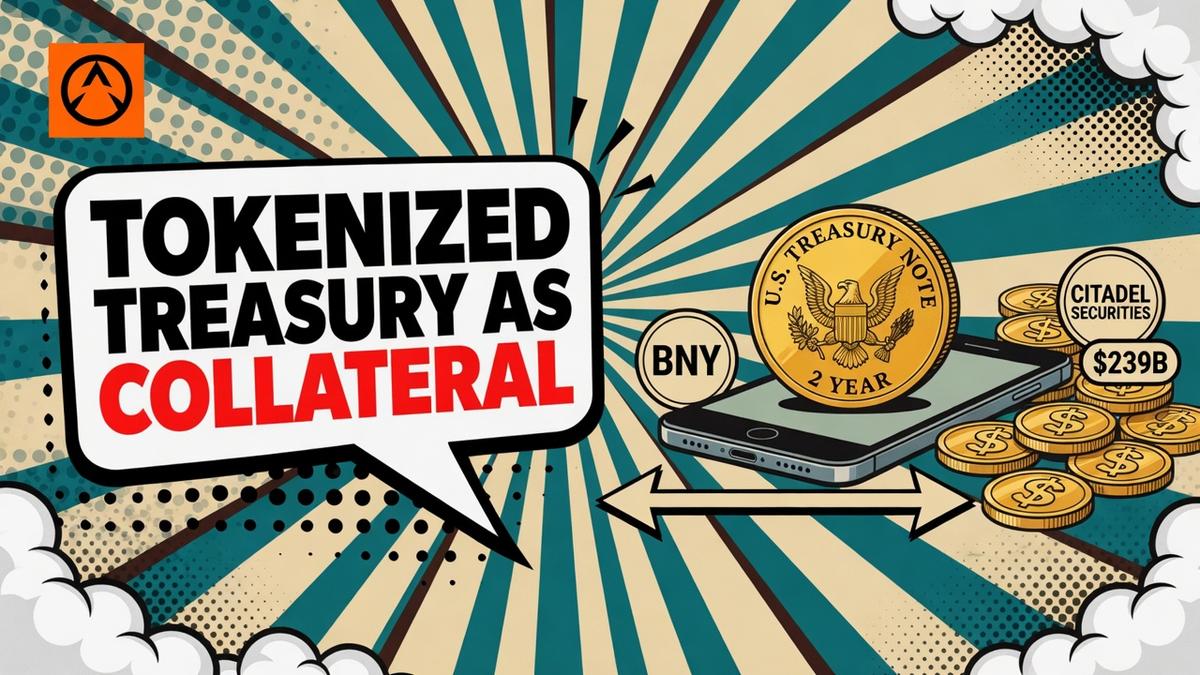
BNY and Citadel Securities completed a triparty repo workflow using a tokenized U.S. Treasury, the two firms said on Tuesday, October 13, 2026. BNY called it the first use of tokenized assets on a major triparty repo platform.
The trade moved a two-year Treasury note through the machinery that keeps Wall Street funded: purchase, settlement, then overnight borrowing. The aim was to show a tokenized government bond can move from settlement into financing, so a firm can reuse collateral sooner and free up cash for other trades.
From Tradeweb Trade to Overnight Repo in Minutes
Citadel Securities bought a 2-year U.S. Treasury note through BNY on Tradeweb. After execution, a tokenized representation of the security was recorded on BNY's private digital ledger and settled within minutes, well inside the standard T+1 settlement cycle.
After settlement, Citadel Securities used the tokenized Treasury as collateral in an overnight triparty repo, a short-term financing transaction, with BNY providing cash in return.
That is the whole workflow in three steps: buy the bond, settle it in minutes, pledge it, get cash. Normally those steps cross several accounts and settlement windows, and the delay is what ties up the money.
Why Moving Collateral Is the Whole Point
Banks and trading firms use U.S. government bonds to secure short-term loans and to fund trading activity. Moving those bonds between accounts and settlement systems takes time, and that time leaves assets sitting still instead of working.
BNY Institute puts a number on the drag: delays in repositioning resources across entities contribute to roughly $239 billion of activity that remains unsettled at the end of each day.
The mismatch is structural. Treasury trading venues stay open for up to 22 hours a day, and futures markets run from Sunday evening through Friday evening, while key elements of settlement infrastructure still work to fixed operating windows.
Brian Ruane, BNY's Global Head of Clearance and Collateral Management, Credit Services and Corporate Trust, framed the trade around that gap. "As Treasury market activity becomes more continuous, the infrastructure supporting liquidity, funding and collateral has to keep pace," he said. In his telling, the transaction shows tokenized collateral can reduce friction while still using the market structure participants already rely on.
Who Is Actually on the Other Side
The two sides of the trade are distinct. Citadel Securities is the cash borrower: it ends up holding the tokenized note and pledges it. BNY is both the custodian running the private ledger and the party handing over cash in the repo.
That overlap is the point of the exercise. BNY is not an outside vendor bolting a chain onto someone else's settlement. It is the custody bank, the collateral agent and the cash provider inside one flow.
Carolyn Weinberg, BNY's chief innovation and market transformation officer, said using a tokenized representation of a U.S. Treasury across both settlement and financing enables "more connected, efficient and always-on financial system." Laide Majiyagbe, BNY's Global Head of Markets, described the trade as "a real example of how tokenization solves for client needs, leveraging both digital rails and traditional infrastructure."
For scale, BNY says it oversees $62.6 trillion in assets under custody or administration and $2.2 trillion in assets under management as of June 30, 2026.
Where Tokenized Treasuries Already Trade
BNY's test lands in a market that already has leaders. RWA.xyz lists Ondo as the largest tokenized U.S. Treasury platform at about $3.0 billion in total value, ahead of Franklin Templeton Benji Investments at $2.6 billion and Circle at $2.4 billion. BlackRock's USD Institutional Digital Liquidity Fund, tokenized through Securitize, shows $2.2 billion on the same page.
Those figures measure the value of tokenized funds and products. BNY's transaction is a settlement and financing rail for Treasuries that already exist, which makes it a different kind of claim on the same market.
What BNY Says Comes Next
BNY says tokenization and longer operating hours are moving together. It expects to extend the operating hours of its traditional settlement systems for Federal Reserve-eligible securities and U.S. triparty transactions, aiming to reach European and Asian trading hours next year.
By 2027, the bank aims to support 24/7 clearing for both traditional and tokenized U.S. Treasuries, and 24/7 bilateral and triparty financing across a range of traditional and tokenized assets. BNY says the two efforts are evolving together to support greater programmability, transparency and more predictable settlement outcomes.
The firms did not disclose the size of the repo, or whether this was a live commercial trade or a test. The cash came from BNY, and no other lender is named. Until that detail is public, the transaction shows the pipe works end to end. It does not yet show how much money is running through it.

Saloni Rathi
Saloni Rathi has been part of Altcoin Buzz for over five years, working across content and marketing within the crypto and Web3 space. Her work focuses on creating clear, engaging and accessible content that helps readers understand complex cryptocurrency and blockchain topics. With a strong interest in storytelling and audience engagement, Saloni brings together research, creativity and marketing insight to turn complex ideas into simple and relatable stories. She believes great content starts with curiosity, creates clarity, and ultimately builds meaningful connections with readers.
More from SaloniNext up
Who Is Really Trading on the XRP Ledger? 10 Accounts Now Carry 65%
Evernorth's Q3 report shows XRP Ledger order-book volume at 4.51 million XRP a day, up 26%, while the 10 largest accounts carried 65% of it.
 XRP