ENS Drafts ENSv2 Activation, Pausing .eth Registrations for Hours
ENS founder Nick Johnson drafted a DAO proposal to activate ENSv2. New .eth registrations pause for a few hours, and the renewal rules conflict.

By Saloni RathiSenior Editor
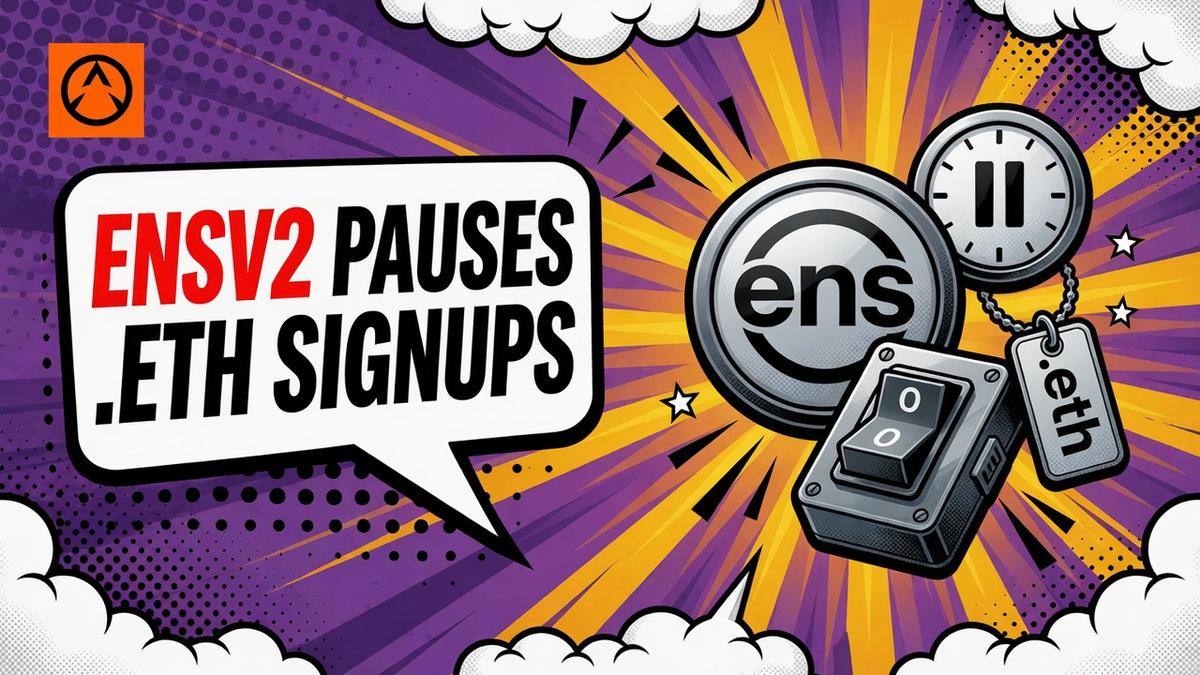
ENS wants its DAO to switch on ENSv2, the rebuilt Ethereum naming system. Nick Johnson (nick.eth) posted the draft proposal, titled "[Executable] Activate ENSv2", on the ENS DAO forum on October 11, 2026.
If you own a .eth name, the short version is reassuring. You do not have to do anything, and there is no migration deadline. The part to watch is a pause window of a few hours when nobody can register a new name. The proposal also gives two different answers on whether you can renew during that window.
What the Proposal Switches On
The proposal activates ENSv2 on Ethereum mainnet. Once it executes, it freezes new .eth registrations on the v1 registrar.
ENSv2 replaces the flat registry ENS has used since 2017 with a hierarchy of registries. It also uses fine-grained roles instead of irreversible fuses. Johnson calls the NameWrapper "the single most complex and least well understood part of ENS today."
Much of the groundwork is already done. ENS Labs has deployed the v2 contracts to mainnet. It has also reserved every active or in-grace v1 .eth second-level name on v2 for its current owner. So if you hold vitalik-style names today, your spot on v2 is already set aside for you.
The Pause Window and the Renewal Question
Activation runs in five stages, and only stage 2 needs a DAO vote. The gap between that vote executing and v2 going live depends on a final sync. The proposal expects it to take a few hours, but gives no exact length.
During that gap, registrations will not be possible on either ENSv1 or ENSv2. Other name operations continue as normal on v1.
Renewals are where the document contradicts itself. Its "How activation works" section says:
Renewals of unmigrated names will be possible once the DAO proposal executes, via the new renewer contract.
Its "What changes for name owners" section says the opposite:
Between this proposal executing and v2 going live, new names can't be registered, and existing names can't be renewed.
Both lines sit in the same forum post. Until ENS clarifies which is correct, it is unconfirmed whether you can renew during those hours. If your name is close to expiry, renewing well before any vote executes avoids the question entirely.
What Happens to Your Name if You Do Nothing
Owners who take no action keep a working name. You can keep renewing on v1, and each renewal also extends your reservation on v2.
The grace period gets shorter on v2: 28 days instead of 90. To make up for that, each name's v2 expiry is extended by 62 days, so it lapses on the same day it would have on v1.
Two points deserve your attention:
- Names already past their grace period are not carried across. They become open for anyone to register on v2.
- The v1 freeze can be reversed by a further DAO proposal. Migrating a name to v2 cannot.
For apps, compatibility comes down to resolving names through the UniversalResolver. The proposal says the majority of integrations are already v2-ready.
Who Controls ENSv2 After Activation
The proposal says that once activation finishes, the DAO controls ENSv2 just as it controls v1 today. ENS Labs holds no privileged role in either. At the end of the five stages, the DAO holds every privileged role over both versions.
The executable makes 15 calls, run in order from the DAO timelock. Registration fees on v2 go to that timelock, which owns the registrar from deployment. The proposal also notes that once a contract called ETHRenewerV1 owns the BaseRegistrar, the emergency path for disabling a registrar controller without a vote no longer applies.
How the Vote Would Work
The proposal is still a draft on the forum, and no onchain vote number has been assigned. Under the ENS governance process, executable proposals need 1% quorum and at least 50% approval. Onchain voting lasts seven days. A passed proposal then waits through a two-day timelock before it can execute.
Early forum feedback includes delegate FireEyes, posting as James, who said it will vote yes. The same post criticised what it called an abandoned L2, an underused delegation incentive program, an alleged takeover of the DAO through ENS Labs delegation, and a "purely cosmetic foundation".
Once a vote date is set, that date plus nine days marks the earliest point the pause window could open. If you plan to register a new name or renew an expiring one, that is the timeline to keep an eye on.

Saloni Rathi
Saloni Rathi has been part of Altcoin Buzz for over five years, working across content and marketing within the crypto and Web3 space. Her work focuses on creating clear, engaging and accessible content that helps readers understand complex cryptocurrency and blockchain topics. With a strong interest in storytelling and audience engagement, Saloni brings together research, creativity and marketing insight to turn complex ideas into simple and relatable stories. She believes great content starts with curiosity, creates clarity, and ultimately builds meaningful connections with readers.
More from SaloniNext up
THORChain Restarts Swaps on 10 of 13 Networks After Refund Bug Halt
THORChain reopened trading on 10 of 13 external networks after a reorg-triggered refund bug paid out an extra 10 ETH. BSC, Cosmos Hub and Solana stay flagged.
 ETH
 BTC
Related
More in Crypto NewsRelated
BitMart Founder Flags 'Severely Understaffed' Security After New Hack
BTCETH
Bitcoin Rebounds Above $78,000 as Ethereum Shows Signs of a Trend Reversal
BTCETH
Justin Drake Eyes 2028 for Ethereum's Post-Quantum Shift, a Year Early
ETH
Aztec Tierra Upgrade Patches Critical V5 Flaw and Doubles Proof Speed
ETH