Singapore has launched the Agentic Decentralized Finance Forum to bring AI, blockchain and digital finance leaders together around tokenization, DeFi and autonomous commerce.
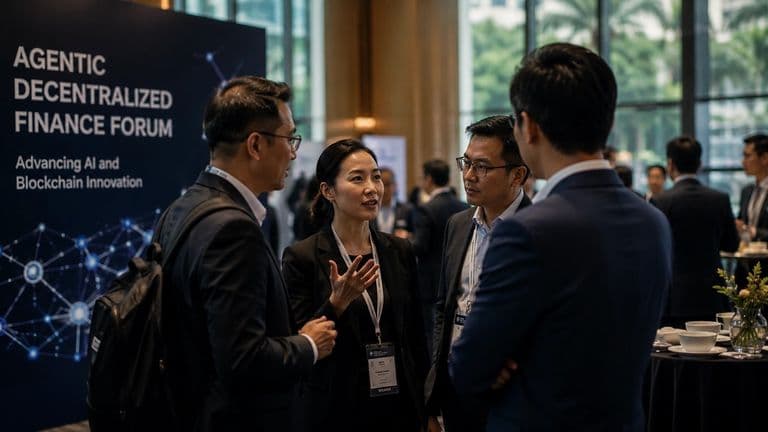
Singapore is bringing together leaders from artificial intelligence, blockchain, digital finance and academia to explore how emerging technologies could shape the next phase of the region’s digital economy.
The Agentic Decentralized Finance Forum was inaugurated on August 6, 2026, at the SMEICC 2026 event at the Suntec Singapore Convention & Exhibition Centre. The forum, supported by the Singapore Innovation Centre and Singapore Chinese Chamber of Commerce and Industry, focuses on the convergence of AI agents, decentralized finance (DeFi), tokenized real-world assets and digital financial infrastructure.
The event also serves as a media session ahead of Singapore Blockchain Week, scheduled for November 13–17, 2026.
The forum brought together representatives from government, financial institutions, technology companies, academia and the broader digital asset industry.
The organizers said the discussions would focus on how AI and blockchain are changing financial decision-making, capital markets and cross-border commerce.
Among the areas highlighted were:
The event was held under the broader SMEICC 2026 theme, “Beyond Partnerships: Where Growth Comes Next.” The wider conference was expected to attract more than 5,000 business leaders, while the Agentic Decentralized Finance Forum was expected to host around 250 invited participants.
One of the central themes of the forum was the emergence of AI agents that can participate in economic activity.
StraitsX CEO and co-founder Tianwei Liu said the next digital economy could increasingly involve AI agents participating in commerce rather than relying solely on human users.
This could create demand for financial infrastructure capable of allowing software agents to make transactions securely and within regulatory requirements.
The concept extends beyond using AI as a tool for financial analysis. In an agentic economy, AI systems could potentially interact with payment networks, digital assets and other financial infrastructure to execute transactions or perform financial tasks.
Singapore's existing digital and regulatory infrastructure could give it a role in developing these systems, according to the forum's organizers and participants.
The forum's speaker lineup included representatives from Anchorage Digital, Alpha Ladder Group, BitGo, Chainalysis, Canton Foundation, FOMO Pay, MetaComp, the National University of Singapore, Singapore FinTech Association, StraitsX, R25, Xapo Bank and Zenith, among other organizations.
Their discussions focused on the convergence of blockchain and financial services.

Tokenization was another major theme, particularly the use of blockchain infrastructure to represent real-world assets digitally.
For financial institutions, tokenization can potentially provide new ways to issue, transfer and settle assets on digital networks. The forum positioned this development alongside DeFi and AI as part of a broader shift in how financial infrastructure could operate.

Associate Professor Edward Tay of the National University of Singapore School of Computing highlighted the importance of collaboration between academia, industry and regulators.
According to Tay, Singapore's work in AI governance and accreditation, combined with its research capabilities, could provide a foundation for responsible adoption of agentic AI and digital assets.
The emphasis on governance is significant because the increased autonomy of AI systems introduces questions around security, accountability and compliance.
For Singapore, the challenge is therefore not only to encourage innovation but also to create an environment where emerging financial technologies can develop within trusted regulatory structures.
Singapore FinTech Association President Holly Fang also emphasized the role of cooperation between regulators, financial institutions and technology companies.
The association said the convergence of AI, blockchain and digital finance will make public-private collaboration increasingly important.
The Agentic Finance Forum is intended to provide a setting where industry participants can discuss these developments while exploring practical applications and partnerships.
This approach reflects Singapore's broader effort to position itself as a digital finance hub connecting financial institutions, technology companies and innovators across Asia.
The forum also marked the signing of a five-party Memorandum of Understanding (MOU) involving Singapore Blockchain Week and organizations spanning agentic commerce, entrepreneurship and artificial intelligence.
The collaboration includes Raffles Capital, VIA Labs with Animoca Brands, AIDX Tech, the China-Singapore AI Association and HICOOL Global Entrepreneur Summit, alongside Singapore Blockchain Week.
The partnership is designed to expand cross-border innovation networks and create opportunities for companies, entrepreneurs and technology communities across Singapore and Asia.
One planned initiative involves an AI-powered Agentic Commerce Ticketing Platform developed by VIA Labs in collaboration with Animoca Brands for Singapore Blockchain Week.
The partnership will also support Raffles Capital's AI x DeFi Convergence Pitch Competition, engagement with HICOOL's international ecosystem and cooperation between AI and DeFi researchers, companies and innovators in Singapore and China.
Stablecoin infrastructure is another part of Singapore's digital finance ecosystem highlighted by the event.
StraitsX, which issues the XSGD and XUSD stablecoins, said its infrastructure supports stablecoin issuance, payments, settlement, treasury management and connections between blockchain networks and traditional payment systems.
The company said it has processed more than $30 billion in stablecoin transactions and more than 3.6 million transactions.
StraitsX is licensed as a Major Payment Institution by the Monetary Authority of Singapore.
Stablecoins could become particularly relevant to the development of agentic commerce because autonomous systems require reliable ways to move value between participants and services.
MetaComp also highlighted Singapore's regulatory environment as an advantage for developing digital financial infrastructure.
The Singapore-based platform provides services covering digital payment tokens, cross-border payments, trading, custody, stablecoins and digital asset management.
MetaComp said it is expanding its StableX Network while developing AI-enabled infrastructure for the emerging financial economy.
The company also said it raised $35 million in pre-Series A funding in 2026 and is backed by Alibaba.
The Agentic Decentralized Finance Forum is part of the broader build-up to Singapore Blockchain Week, which will take place from November 13 to 17, 2026.
According to the event organizers, Singapore Blockchain Week will cover agentic commerce, decentralized finance, digital infrastructure, emerging technologies, institutional tokenization and real-world assets.
The program is expected to include conferences, industry forums, networking events and ecosystem initiatives.
The organizers describe Singapore Blockchain Week as a cross-border platform connecting Singapore with the Johor–Singapore Special Economic Zone in southern Malaysia.
The goal is to bring together policymakers, regulators, investors, enterprises and technology companies to develop partnerships around digital finance and emerging technologies.
The Agentic Decentralized Finance Forum highlights a broader shift in how Singapore is approaching blockchain.
Rather than focusing only on cryptocurrencies, the event brings together AI, DeFi, tokenization, stablecoins and digital infrastructure as interconnected parts of the emerging digital economy.
The rise of AI agents adds another dimension. If autonomous software systems eventually become participants in commerce, they will require infrastructure capable of handling payments, identity, compliance and settlement.
Singapore is seeking to position itself as a place where these technologies can be developed with participation from regulators, financial institutions, researchers and technology companies.
The success of that strategy will depend on whether the partnerships announced at the forum translate into real-world products and cross-border applications.
For now, the event signals that Singapore is placing increasing emphasis on the convergence of AI and blockchain as it seeks to strengthen its role as a regional digital finance hub.

Evernorth plans an XRP treasury of at least 473 million coins, but most would come from contributions rather than cash purchases.

The SEC’s revised buyback FAQ offers relief to functional networks without a central party, leaving many issuer-run programs outside its protection.

StablePair uses a fixed reference price and cached data that can leave LPs exposed when a stablecoin weakens. The available data does not prove better returns.


