AltcoinBuzzAltcoinBuzz
Subscribe
  • Crypto News
  • Crypto Research
  • Technical Analysis
AltcoinBuzzAltcoinBuzz

An independent digital media outlet delivering crypto research, news, and technical analysis to a community of 600,000+ users.

Follow us on:

Discover

  • Crypto Research
  • Crypto News
  • Technical Analysis
  • Key Opinions
  • Upcoming Launches

Categories

  • Bitcoin BTC
  • RWA
  • Technology
  • Altcoins
  • Regulation

Company

  • Affiliates
  • Partners & Sponsors
  • Careers
  • Contact
  • Terms of Use
  • Subscription Terms
  • About the ALTCOIN BUZZ
  • Privacy Policy
  • Contact ALTCOIN BUZZ
  • Advertise with us

Copyright 2026 ALTCOIN BUZZ. All rights reserved.Something is buzzzzzzzing.
HomeCrypto NewsSolana Nears Final Cut to 200-Millisecond Slots at Epoch 1053
Crypto NewsTechnologyAltcoins

Solana Nears Final Cut to 200-Millisecond Slots at Epoch 1053

Solana's SIMD-0525 sets a final cut to 200-millisecond slots at epoch 1053, doubling validator vote fees and shortening epochs to about one day.
SShitij Gupta•Oct 9, 2026
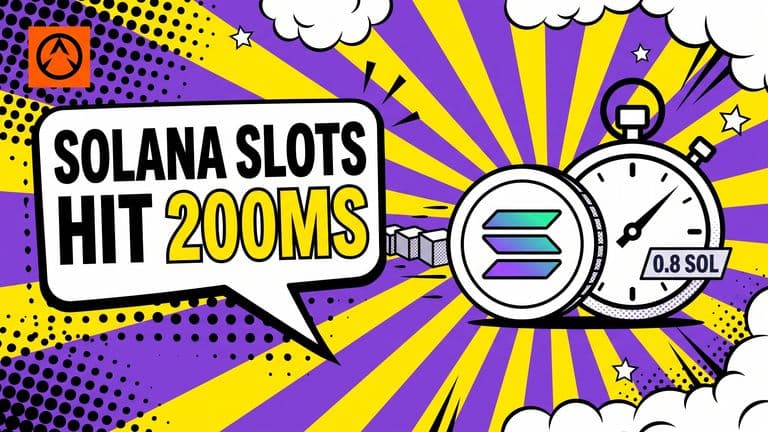
A comic-style Solana coin beside a large stopwatch with its hand sweeping toward a faster time, with a row of block cubes behind them and a speech bubble carrying the headline.
MentionedSOL$110.48-4.43%

Solana's target slot time falls to 200 milliseconds at epoch 1053, expected around 15:00 UTC, according to Anza, the developer of the Agave validator client. It is the final step of SIMD-0525, a proposal that reduces the target from 400 milliseconds in four feature-gated stages.

At 200 milliseconds the network targets five block-production opportunities per second, against 2.5 under the original 400-millisecond configuration. The proposal document, authored by Brennan Watt of Anza and created on 2026-05-01, still carries Draft status.

The Four Steps and a Disputed Timeline

The proposal sets out four steps: 350 milliseconds, 300 milliseconds, 250 milliseconds and 200 milliseconds. Each feature gate becomes effective one epoch after activation, a delay the document says is required because the gates cut the maximum data and coding shreds per slot, and Turbine shred filtering sits outside bank execution.

On September 18, 2026 the network moved its target from 300 to 250 milliseconds at the start of epoch 1037, bringing block production to four slots per second from roughly 3.3 before the change. At that stage, maximum compute units per slot were cut to 37.5 million from a 60 million baseline, with data shred limits adjusted in the same direction, and the epoch ran about 30 hours, down from around 36.

The earlier stages are dated inconsistently across the two secondary reports available. The on-chain activation dates for the 350-millisecond and 300-millisecond steps need checking against an explorer or an Anza announcement.

What Stays Fixed and What Scales

Per-slot work limits are reduced in proportion to the shorter slot time, so the corresponding wall-clock rate remains roughly unchanged. Ticks per slot stay at 64, leader windows stay at 4 slots, and epochs stay at 432,000 slots at every stage.

Two consequences follow from those constants. At 200 milliseconds a block carries at most 30 million compute units, down from 37.5 million at 250 milliseconds, which keeps theoretical processing capacity roughly unchanged. And because the epoch length in slots does not move, the epoch shortens in wall-clock terms to approximately one day.

The Validator Admission Ticket scales at each stage: 1.6 SOL at 400 milliseconds, 1.4 SOL at 350, 1.2 SOL at 300, 1.0 SOL at 250 and 0.8 SOL at 200. The scaling preserves the SIMD-0326 target of roughly 0.8 SOL per day instead of raising the daily Alpenglow validator admission cost during the rollout. Whether Alpenglow, and therefore the VAT mechanism, is live on mainnet was not confirmed by any source read for this article.

A Leader Window Halves to 800 Milliseconds

A leader's nominal control window falls from 1.6 seconds to 800 milliseconds at 200-millisecond slots. The proposal's stated aim is market structure: less worst-case time for a leader to delay, reorder or selectively include transactions before the next leader has an opportunity to produce a block.

Applications that interpret freshness in slots, such as oracle consumers and propAMM-style market makers, can make decisions with a smaller slot-time quantization error.

Vote Fees and Gossip Both Double at 200 Milliseconds

Non-Alpenglow vote transaction costs are not changed. Validators therefore pay more vote fees per wall-clock time as slots get faster, doubling at 200 milliseconds, and gossip traffic for votes and epoch slots also doubles. Validators that submit votes on every slot need to do so about twice as frequently as under the original configuration, increasing voting expenses and placing greater pressure on network connections.

Inflation is held flat in wall-clock terms, because slots_per_year is increased by the inverse ratio. The cost line moves; the reward line in wall-clock terms does not.

What Remains Unconfirmed

  • The 200-millisecond gate had not been confirmed as active at the time of writing. The schedule comes from Anza, and the proposal document is at Draft status, with no governance vote record read.
  • The final reduction had already been deployed on testnet and devnet. Developers have said the mainnet rollout depends on network conditions, particularly the rate at which validators miss their assigned block-production opportunities.
  • Solana Compass data shows the 250-millisecond configuration delivered average slot times of approximately 266 to 269 milliseconds across recent epochs, slightly slower than its target.
  • Shorter slots reduce the time available for leader handoff, block propagation, replay and vote landing. The staged rollout is part of the safety mechanism, and the change is consensus breaking and must be feature gated. Validators without the effective slot-time stage may produce or accept blocks, shreds or rewards using the wrong limits, and the proposal is not backwards compatible for validators.
  • SDK constants for default slot duration, ticks per second, slots per year and slot-to-time conversion may continue to describe the old 400-millisecond assumption while the running cluster uses faster banks.
  • Blockhash queue and status cache max entries are not changed, so client behaviour measured in slot counts gets shorter in wall-clock time. The shorter validity window could complicate transactions that require manual approval or offline signatures.

The figure to watch is the realised average slot time, not the target. The 250-millisecond stage ran slower than intended across recent epochs on Solana Compass data, so the 200-millisecond stage will be judged the same way, epoch by epoch, alongside the block-skip rate.

The information discussed by Altcoin Buzz is not financial advice. This is for educational, entertainment, and informational purposes only. Any information or strategies are thoughts and opinions relevant to the accepted levels of risk tolerance of the writer/reviewers and their risk tolerance may be different than yours. We are not responsible for any losses that you may incur as a result of any investments directly or indirectly related to the information provided. Bitcoin and other cryptocurrencies are high-risk investments so please do your due diligence.

Copyright Altcoin Buzz Pte Ltd.

Related

sDWF Labs-linked firms sue BitGo for $141 million over alleged early sales of locked crypto tokens
DeFi
Oct 9, 2026

DWF Labs Affiliates Sue BitGo for $141M Over Alleged Early Token Sales

DWF Labs-linked firms DWF Maas and Falcon Digital are suing BitGo for $141 million, alleging it sold Falcon Finance and ESPORTS tokens before contractual lock-ups expired.

FF
Bikash Deka
Sui Introduces Agent Pass
Altcoins
Oct 9, 2026

Sui Introduces Agent Pass to Set Spending Limits for AI Agents

Sui introduced Agent Pass at Basecamp 2026 to help developers control AI agent spending, adding to its wider push toward safer autonomous payments.

SUI
Saloni Rathi
Zcash Developers Address Mathocalypse Fears
AltcoinsPrivacy
Oct 9, 2026

Zcash Developers Push Back on ‘Mathocalypse’ Panic with Emergency Recovery Plan

Zcash developers are pushing back against Mathocalypse fears, outlining a proposed rapid token-holder vote and miner coordination to respond to potential cryptographic threats.

ZEC
Bikash Deka