Starknet is up 39%, Considers Becoming a Layer 1 to Reach Quantum Resistance by 2027
Starknet says it is considering becoming a Layer 1 to hit full quantum resistance by 2027. Nothing is proposed or voted on, and governance would decide it.

By Anmol BillaSenior Analyst
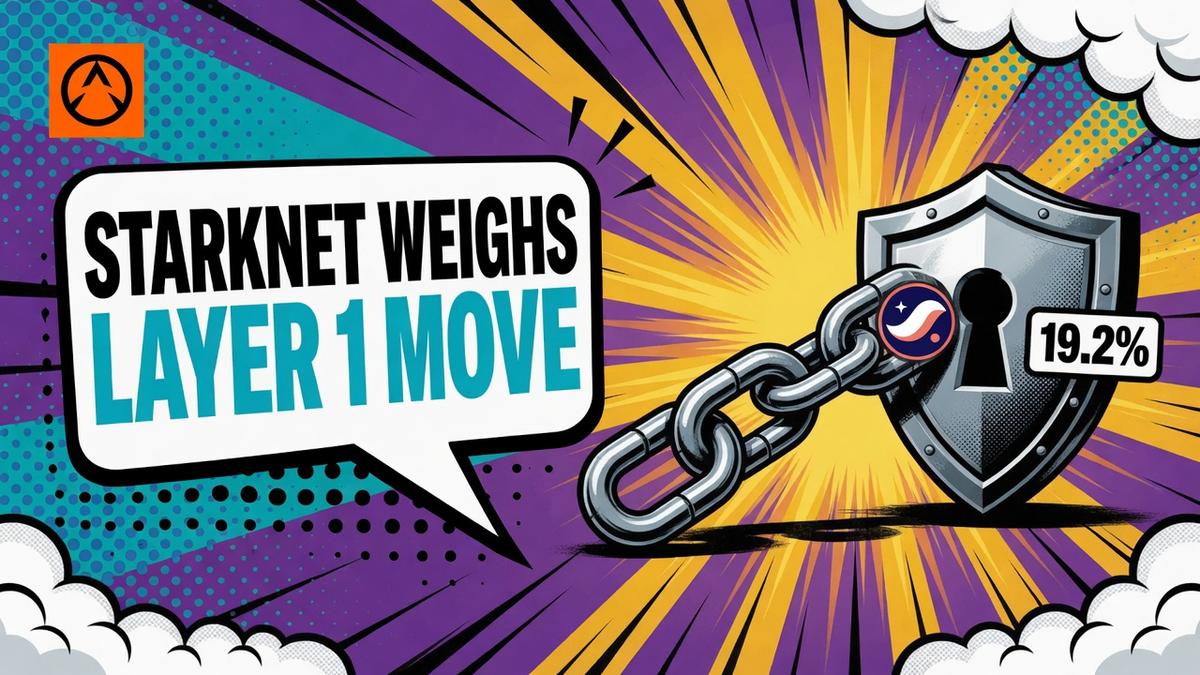
Starknet said it is "actively considering becoming an L1," a move that would take the network off Ethereum's settlement layer and let it run its own quantum-resistance timeline. In the same post it set 2027 as the target for being fully quantum-resistant.
For anyone holding STRK, the practical difference is who controls the upgrade clock. A Layer 2 inherits Ethereum's security, and with it Ethereum's schedule. A Layer 1 sets its own. Whether that trade is worth making is the question StarkWare chief executive Eli Ben-Sasson put to his followers minutes earlier, and it is nowhere near settled.
STRK traded at $0.06495 in the 24 hours around the posts, up 31.4%, with $229.46 million in volume, according to CoinGecko data. Market capitalisation was $429.534 million against a fully diluted valuation of $578.735 million, with 7.422 billion tokens circulating out of a 10 billion maximum. The 24-hour range ran from $0.04831 to $0.07013.
Ben-Sasson Asked the Question First
Ben-Sasson posted before Starknet did, asking his followers whether "Starknet becoming an L1 for post-quantum agility" is a good idea or a bad one. He said his post connects to a talk he gave at Token2049 on Thursday.
He named two pressures. The first was the quantum threat, which he said "may be MUCH closer than we think." The second was AI, which he said is "becoming more powerful than we can process." Together, he wrote, they call for "bunker mode."
He listed three requirements to future-proof a chain: the right cryptography, crypto agility and becoming an L1.
"We are actively considering becoming an L1. This would enable Starknet to become the first fully quantum-resistant network, with 2027 as our target."
Starknet, in a post on X
Why an L1 Would Move the Finish Line
As a Layer 2, Starknet publishes its state data to Ethereum as blobs and leans on Ethereum for security. That hands part of its quantum timeline to someone else. Two surfaces in its own roadmap, the bridge's messaging layer and the data availability layer, resolve only once Ethereum migrates. Both rely on elliptic-curve cryptography.
The Cairo VM's secp256k1/r1 syscalls, which support L1-to-L2 messaging and the Ethereum bridge, are quantum-vulnerable too. StarkWare says removing them before Ethereum migrates would break the bridge.
Ben-Sasson says Ethereum is targeting full quantum resistance by the end of 2029, and that Bitcoin has not committed to a date. Going L1 would let Starknet run its own security migrations instead of waiting on either.
The Proving Layer Was Never on the Migration List
Starknet's STARK proofs rest on collision-resistant hash functions, not elliptic-curve arithmetic. The part of the stack that produces proofs therefore never depended on the cryptography that other ecosystems have to replace.
The user-facing piece is further along than the label suggests. Native account abstraction lets contracts be made quantum-resistant without breaking changes at the protocol level, so Starknet users can deploy a post-quantum wallet today. S2morrow has already demonstrated a Falcon-512 account implementation in Cairo, and OpenZeppelin has begun work on a post-quantum account contract.
The June Roadmap Did Not Mention an L1
StarkWare published a three-phase post-quantum roadmap for Starknet on June 30, and becoming an L1 was not in it. The phases lay out what is left:
- Phase 1 replaces Pedersen hashing, which inherits elliptic-curve assumptions, with BLAKE2 across the state, chain environment and consensus layers. StarkWare said the OS config hash change was already live on testnet and would go live on mainnet in early July.
- Phase 2 extends post-quantum resistance to existing onchain contracts at the storage level, with StarkWare researching a migration toolkit. Its own timing is about a month after Phase 1, and the dapps side is still to be decided.
- Phase 3 is the pair that waits on Ethereum: the bridge's messaging layer and the data availability layer.
New features are also required to ship with quantum-safe implementations, including consensus signatures onchain using post-quantum schemes such as Falcon-512.
StarkWare draws the contrast with the largest chains directly: Bitcoin, Ethereum and Solana are each exposed at the authentication layer through elliptic-curve cryptography, and none offers native account abstraction that would let users adopt a new signature scheme without a protocol-level breaking change.
Governance Decides, and Nothing Has Been Filed
Every protocol-level change to Starknet goes through its governance process, and StarkWare states that no timeline or outcome it describes is guaranteed. Neither post said whether or when a decision on the L1 idea would be taken. There is no formal proposal and no vote.
Plenty is also still blank. Nothing has been set out on what the L1 architecture would look like: no bridge design, no sequencer or settlement design, and no word on whether the move would change anything for staking STRK. Published figures on how much value sits on the network disagree, with L2BEAT putting it near $520 million and CoinGecko's reading of total value locked at $312.751 million, which are not the same measure.
The next thing to watch is a governance proposal. Until one exists, 2027 is a target, not a schedule.
All protocol-level changes to the Starknet network are subject to approval through Starknet's governance process.

Anmol Billa
Anmol Billa is a Senior Analyst at Altcoin Buzz, with over five years of experience working across cryptocurrency markets and the broader digital asset industry. His work focuses on technical analysis, market research, investment insights, and evaluating emerging opportunities within the crypto ecosystem. At Altcoin Buzz, Anmol contributes to technical market analysis, research-driven insights, pitch decks, and funding-related initiatives. His experience combines analytical thinking with a practical understanding of crypto markets, helping translate market trends and emerging projects into clear, actionable insights for readers and industry stakeholders.
More from AnmolNext up
NVIDIA Posts 103% Revenue Growth as AI Crypto Projects Watch GPU Demand
NVIDIA's Q3 revenue climbed 103% year over year to $115.8 billion, with its Data Center business leading growth. The results could renew attention on decentralized GPU networks and AI-focused crypto projects.
 TAORENDER
Related
More in Crypto NewsRelated
Vitalik Buterin Flips to 'Total Bull' on leanPCS as Ethereum Eyes Quantum-Safe Future
 ETH
Withdrawals Resume at Lighter After Leak Drained $10.39M
ETH
Zoom, CNN & Ledger Caught in Major Crypto Malware Attack Across 178 Sites
 BTCETH
Bitcoin Recovers to $64,500 After $2 Billion Weekend Liquidation
BTCETH
