Tether says USDT is 'coming home' to Bitcoin. Here's what changes
Tether CEO Paolo Ardoino says USDT is 'coming home' to Bitcoin via RGB. Utexo is building the stack and says it met Morgan Stanley about adoption.

By Anmol BillaSenior Analyst
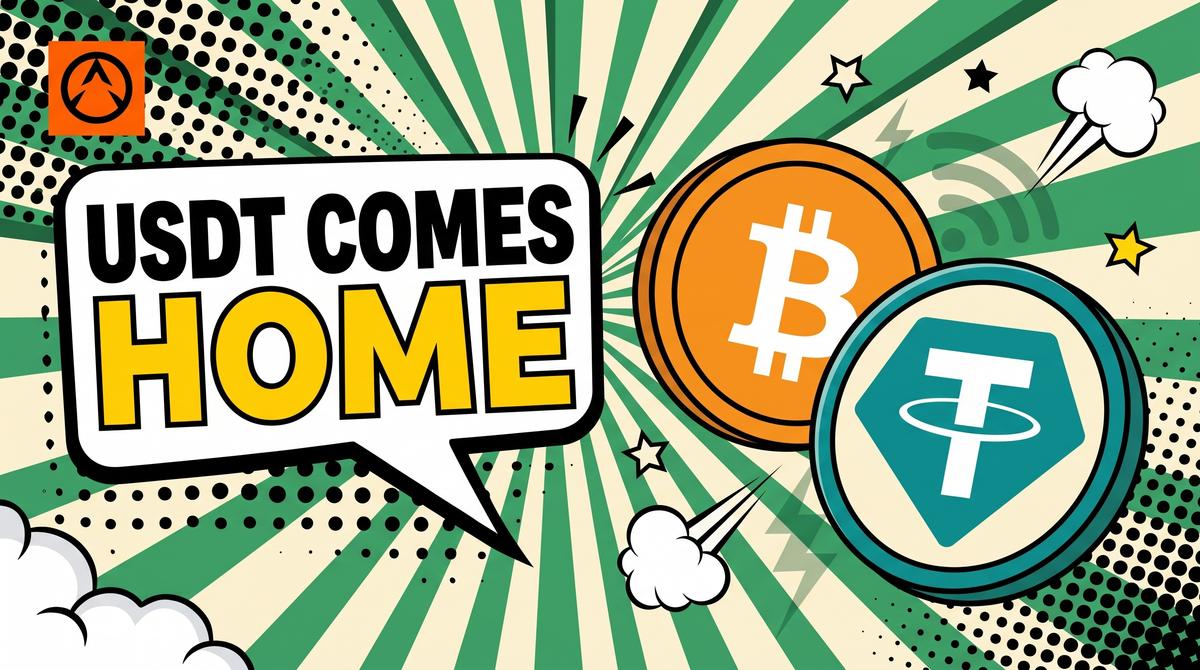
USDT is heading back to the chain where it started. Tether chief executive Paolo Ardoino said on X that USDT is "coming home" to Bitcoin, more than a decade after the stablecoin first launched there in 2014 and after most of its supply moved to Ethereum and Tron.
For a holder, the practical question is simple: what does this change? The version of USDT Tether killed in 2023 ran on Omni, a Bitcoin add-on that was slow and expensive to use. The new version runs on RGB, a protocol that issues assets on Bitcoin while keeping transaction data off-chain. Utexo, the company that builds the infrastructure, has also wired it into the Lightning Network. Together, that means a Bitcoin user could send or receive USDT the same way they send satoshis: instantly, cheaply, and without broadcasting the amount on the main chain.
Utexo says Morgan Stanley is in the room
Utexo chief executive Viktor Ihnatiuk said he met Morgan Stanley in Washington to discuss USDT on Bitcoin, and that the talks covered Utexo working with the bank on stablecoin adoption in Europe and globally. That is a meeting, not a published research note, and Morgan Stanley has not announced a formal partnership with Utexo. The bank's own crypto moves this year have been concrete: it launched its own spot Bitcoin ETF in April and opened E*Trade crypto trading in May.
The infrastructure is already being built
Tether led Utexo's $7.5 million seed round alongside Big Brain Holdings, Portal Ventures and Franklin Templeton, per the RGB Protocol Association. In August, Utexo added its RGB Lightning module to Tether's Wallet Development Kit, a toolkit developers use to build self-custody wallets. That gives any wallet built on the kit the option of USDT support out of the box, once the integration ships.
Tether's framing of the move was set out in August 2025, when Ardoino first announced the RGB plans. "Bitcoin deserves a stablecoin that feels truly native, lightweight, private, and scalable," he said at the time. Ardoino has also ruled out launching a Tether blockchain, preferring to use existing networks. That matters because the company has run into trouble with regulators in major markets: Tether rejected a bank-deposit rule in the EU's Markets in Crypto-Assets framework, which has limited USDT's reach in the bloc. A native Bitcoin version, settled on the most liquid crypto network in the world, is in part a workaround for that constraint.
UniSat is the first demand test
The first real test is UniSat, a wallet popular for Bitcoin Ordinals and tokens, which Utexo has named as its next launch partner. UniSat says it serves more than 1 million weekly active users, though that is the team's own figure and has not been independently audited. Neither firm has shared a release date. If the rollout pulls meaningful stablecoin volume onto Bitcoin, it would mark a quiet shift in the network's role: from a settlement layer for one asset to a venue where dollars and satoshis move side by side.

Anmol Billa
Anmol Billa is a Senior Analyst at Altcoin Buzz, with over five years of experience working across cryptocurrency markets and the broader digital asset industry. His work focuses on technical analysis, market research, investment insights, and evaluating emerging opportunities within the crypto ecosystem. At Altcoin Buzz, Anmol contributes to technical market analysis, research-driven insights, pitch decks, and funding-related initiatives. His experience combines analytical thinking with a practical understanding of crypto markets, helping translate market trends and emerging projects into clear, actionable insights for readers and industry stakeholders.
More from AnmolNext up
Why Is Everyone Talking About XRP, 401(k)s and Gopax Today?
Binance hackers swapped about $50 million of stolen XRP for bitcoin, the DOL's final 401(k) rule reached the White House, and Gopax halted withdrawals.
 XRP
 BTC