Vitalik Buterin says Ethereum is betting its future on quantum security and AI
Vitalik Buterin says Ethereum's updated roadmap puts quantum resistance, privacy, AI-assisted security and scalability at the center of its future development.

By Shitij GuptaResearcher
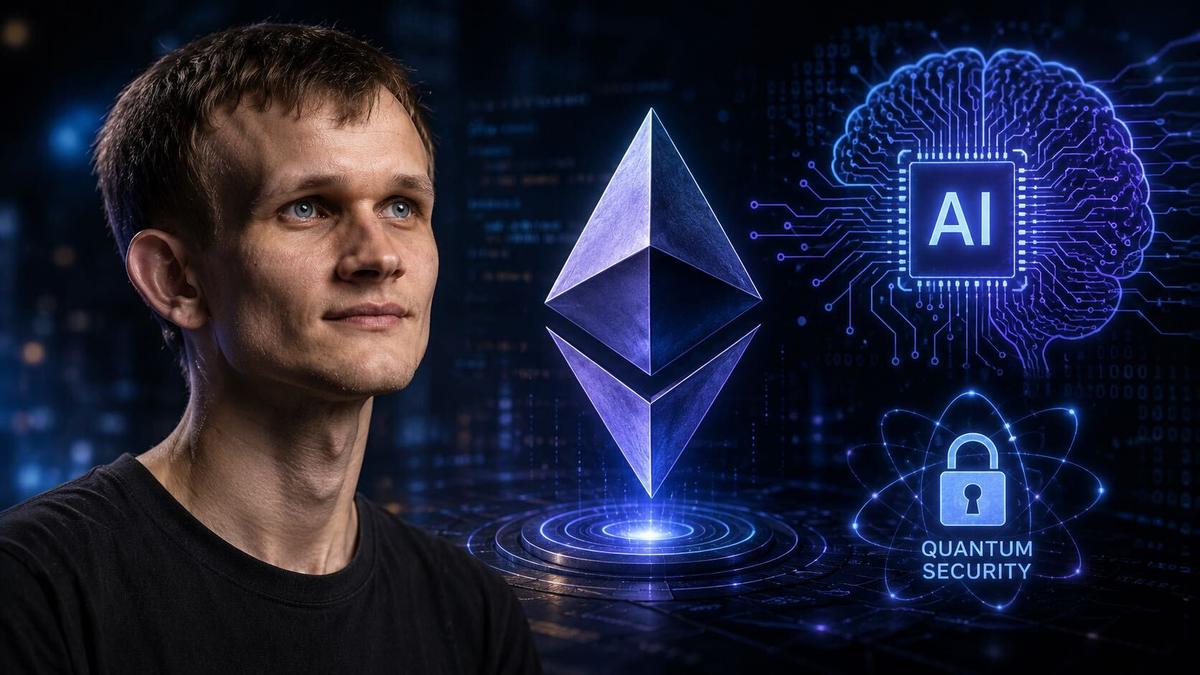
Ethereum is changing its long-term technical priorities as new risks and technologies emerge.
Ethereum co-founder Vitalik Buterin says quantum resistance, privacy and AI-assisted security are now playing a much bigger role in the network's development than they did when he published his roadmap in 2023.
Buterin recently shared an updated version of his roadmap on X, comparing the original plans with what he calls Ethereum's current "Strawmap," a working outline of the network's future development.
According to Buterin, several priorities now included in the Strawmap were not part of the 2023 roadmap. He said these changes reflect how Ethereum's needs have evolved.
Ethereum Roadmap Shifts Toward Quantum Security
One of the biggest changes is Ethereum's growing focus on quantum resistance.
Quantum computers could eventually threaten some of the cryptographic systems used by today's blockchains. While such machines are not currently capable of breaking Ethereum's security, developers are preparing for the possibility that the technology could become powerful enough to create a risk.
Buterin has repeatedly called for Ethereum to prepare before the threat becomes immediate.
The Ethereum Foundation has also created a dedicated team focused on post-quantum security. The broader goal is to replace cryptographic components that could become vulnerable to quantum computing with safer alternatives. Buterin's latest roadmap places this work alongside other major goals, including privacy and scalability.
Privacy Becomes a Bigger Ethereum Priority
Privacy is another area receiving more attention in Ethereum's updated plans.
Buterin says Ethereum's future scaling approach should focus on specialized systems that can handle important types of activity more efficiently rather than trying to maximize every part of the network at the same time.
This could allow Ethereum to better support high-demand applications while also making room for privacy-focused protocols. The approach is part of a broader effort to make Ethereum more efficient without compromising its security and decentralization goals.
AI Could Help Make Ethereum More Secure
Artificial intelligence is also becoming part of Ethereum's development strategy.
Buterin says advances in AI could make formal verification more practical. Formal verification uses mathematical methods to check whether software behaves according to its intended rules.
This is particularly important for blockchain infrastructure because bugs in the underlying protocol can have serious consequences.
Ethereum is increasingly using STARKs, a cryptographic technology that allows computations to be verified without revealing all of the underlying information. Buterin believes modern AI tools could help developers apply formal verification more widely and efficiently.
In simple terms, AI could help Ethereum developers find and verify potential problems in the network's code before they become security issues.
Ethereum Wants to Become Leaner
Another major goal in the updated roadmap is what Buterin calls the "lean-ification" of Ethereum's specifications.
The idea is to simplify the network's technical design while maintaining its core capabilities.
A simpler protocol could make Ethereum easier to understand, verify and maintain. It could also reduce the complexity developers face when building and upgrading the network.
This fits into Buterin's broader Lean Ethereum vision, which aims to make the network more efficient while preserving security, privacy and decentralization.
What the New Ethereum Roadmap Means
Ethereum's updated roadmap shows that the network's priorities are changing as technology and potential risks evolve.
The focus is no longer only on increasing transaction capacity. Ethereum is also preparing for quantum computing, stronger privacy requirements, AI-assisted security and a simpler protocol design.
Buterin's long-term vision is for Ethereum to remain secure and resistant to censorship while becoming more scalable and easier to maintain.
For users and developers, the most important changes could come from Ethereum's preparations for quantum computing and its increased use of advanced cryptography and AI-assisted verification.
If these efforts succeed, Ethereum could enter the next phase of its development with a network designed not only for today's applications but also for emerging technological risks.

Shitij Gupta
Shitij Gupta is an analyst and a researcher at Altcoin Buzz. Shitij has a vast banking experience at companies such as Morgan Stanley, ETRADE and UBS. He primarily built banking and lending products, Robo Advising solutions and Mutual Fund offerings for High Net worth clients. After his stint on Wall Street, Shitij runs a family office fund and consults businesses on strategy and execution.
More from ShitijNext up

Hyperliquid Trader Loses $1.54M Nvidia Position as Huang's Exit Sparks Sell-Off
A Hyperliquid trader's $1.54 million Nvidia long was liquidated after Jensen Huang resigned as CEO. Nvidia-linked perpetual futures also recorded more than $2 billion in 24-hour trading volume.
 HYPE