QuarkChain (QKC) Overview: DeFi and New Mainnet
In spite of making good progress in terms of technological developments and ecosystem growth, the project remained undervalued for a long time. During the challenging first half of 2020, QuarkChain made remarkable breakthroughs. In light of these developments, QuarkChain's coin…
By Deepika Garg
The blockchain industry has been seeking a scalability shift for a long now. QuarkChain is one of the top contenders addressing the lingering scalability issue. The project is trying to achieve this without compromising either decentralization or security.
Founded in 2018, QuarkChain (QKC) aims to offer a scalable, flexible, and user-oriented blockchain solution. Impressively, the project exhibited that it holds the potential to dethrone Ethereum during its infancy. That’s because it achieved a peak TPS of 14,000+ during a live demo of its testnet in July 2018.
In spite of the pandemic raging around the world, QuarkChain has successfully achieved a number of milestones in the first half of 2020. These milestones include mainnet major function upgrades, QPool launch, and many breakthroughs in partnerships with enterprises and governments. Thus, there is growing excitement around the project.
QuarkChain is contending against projects like Bitcoin, Ethereum, Zilliqa, Algorand, and more. It is quite unlikely that only one of these projects will rule the space. However, if QuarkChain solves the blockchain trilemma before the ETH 2.0 roll-out, we might see a massive migration of dApps from ETH to QuarkChain.
In this overview we will be talking about:
Table of Contents
Toggle- Technology behind QuarkChain
- Major technical updates
- Major partnerships
- DeFi entry and 2020 ahead
- Open staking DeFi products
- Mainnet of BigBang with multi-native token function
- RoadMap 2020
- Future price performance
- To wrap up
Technology behind QuarkChain
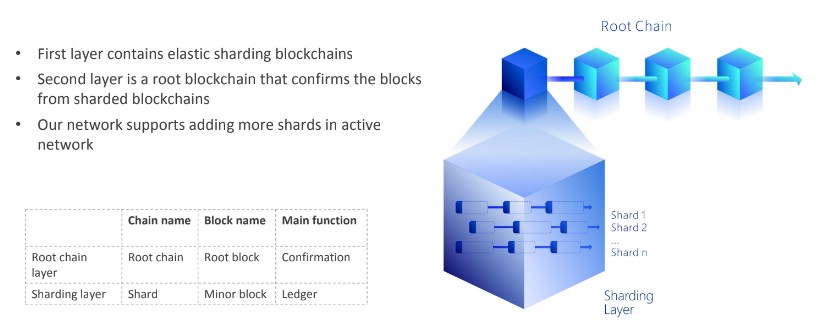
QuarkChain offers a 2 layered blockchain network which gives it greater scalability. With the implementation of these layers, it separates the primary functions of the blockchain.
Source: steemit.com
-
Ledger
The Sharding Layer acts as the ledger and is the first layer of the platform. As the layer is comprised of sharded (minor) blockchains, it renders scalability to QuarkChain.
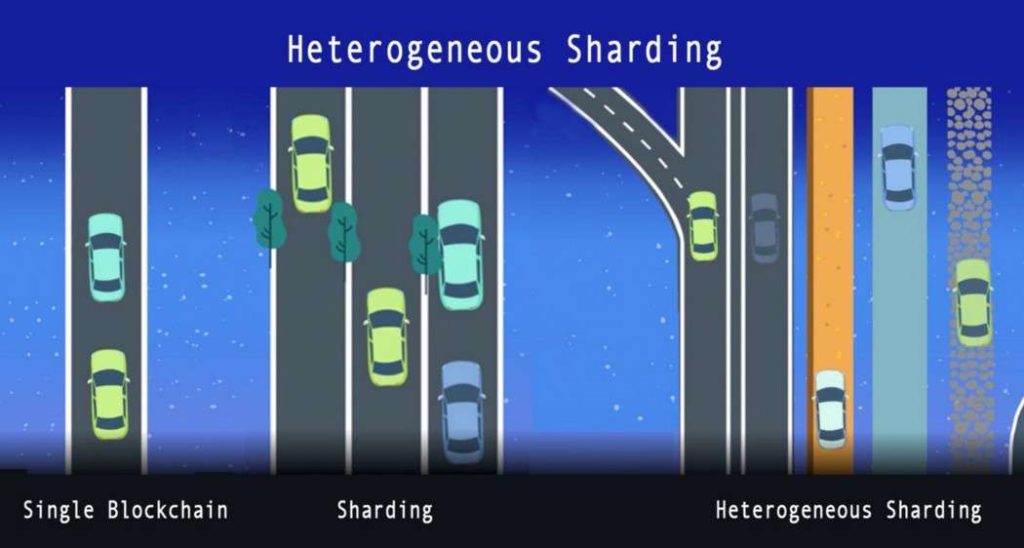
Sharding technology is used by many projects to improve scalability. QuarkChain has taken sharding to an advanced level by introducing heterogeneous sharding. Heterogenous sharding not only solves the scalability problem but also becomes capable of providing flexibility for the underlying infrastructure. We will explain heterogenous sharding in the next section.
It is important to note that these minor blockchains (shards) maintain the current state of the ledger, which is basically the user account and the transaction data.
2. Confirmation
The Root Blockchain is the second layer and confirms the transactions on the QuarkChain. It is this layer that offers higher TPS (transactions per second) to the platform.
As a next-generation, high-speed blockchain, QuarkChain aims to deliver a throughput of one million transactions per second. During QuarkChain’s 2nd TPS competition held in December 2019, the engineers were able to reach a final peak TPS of 318,052. This proves that the multi-chain heterogeneous design of QuarkChain holds the potential of reaching the desired TPS of one million transactions per second.
After six months of trying, one of the QuarkChain community members did achieve 1,000,000 TPS.
What is heterogenous sharding?
Any blockchain platform is essentially a combination of four major components:
- Consensus (POW/POS)
- Ledger
- Transaction mode
- Token economics
When we take a look at blockchains like Zilliqa, Harmony, or Elrond, all of them have a fixed set of these components that define their capabilities. Once these are selected, it is difficult to change them. Even when these blockchains employ sharding, each shard is a replica of these components only. Hence, scalability is achieved but these blockchains are neither flexible nor adaptable. This is where heterogenous sharding differs from normal sharding.
Source: quarkchain-official
QuarkChain‘s heterogeneous sharding technology allows each shard chain to configure different components. Thus, each shard can use a different consensus, a different ledger, different token economics, or a different transaction mode. This future proofs blockchains for enterprises as they can maintain some shards as public chains and other consortium chains.
In short, heterogenous sharding helps avoid three situations:
- forking due to upgrades,
- difficulty in building functionalities,
- wastage of resources.
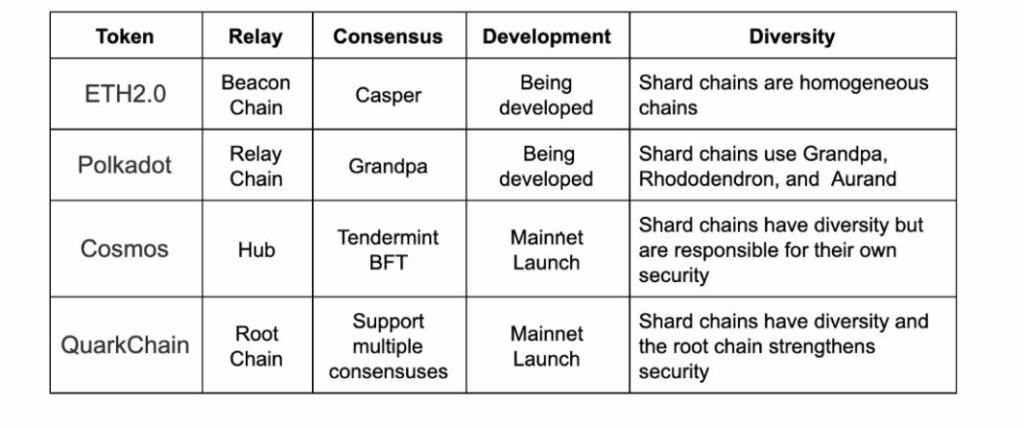
The entire crypto space is eagerly waiting for scalable blockchains. Projects like PolkaDot, Cosmos, and the much-awaited ETH 2.0 are employing sharding technology to provide users scalable and flexible blockchains. But the diversity all are able to achieve with heterogenous sharding is different. Here is the comparison of the four projects:
Source: quarkchain-official
Major technical updates
2020 has been a challenging year, but that did not deter team QuarkChain from delivering major updates. Here is the list of technical upgrades the platform has achieved so far:
- QuarkChain added a Java SDK in January 2020, which will help in creating an open-sourced project.
- The platform infrastructure received improved multi-cloud platform support.
- The team has conducted a test to understand the relationship between liquidity and depth of order book using the simulation of a Uniswap model.
- Mainnet 1.4.0 end-to-end automation test framework launched.
- The first native utility token, QNUT, launched on the network.
- Mainnet 1.4.2 released that supports native token auction and gas exchange function.
- QPool, the mining pool supporting the official mainnet, was launched in April 2020. This has offered miners a convenient and stable income opportunity. The QPool enables one-click switching between ETH and QKC mining.
- On April 30, 2020, QuarkChain announced the first major upgrade to its mainnet. It announced a multi-native token feature of the network. This is an upgrade from the smart contract tokens. Consequently, the multi-native tokens will help overcome a major limitation in the functionality of smart contract tokens.
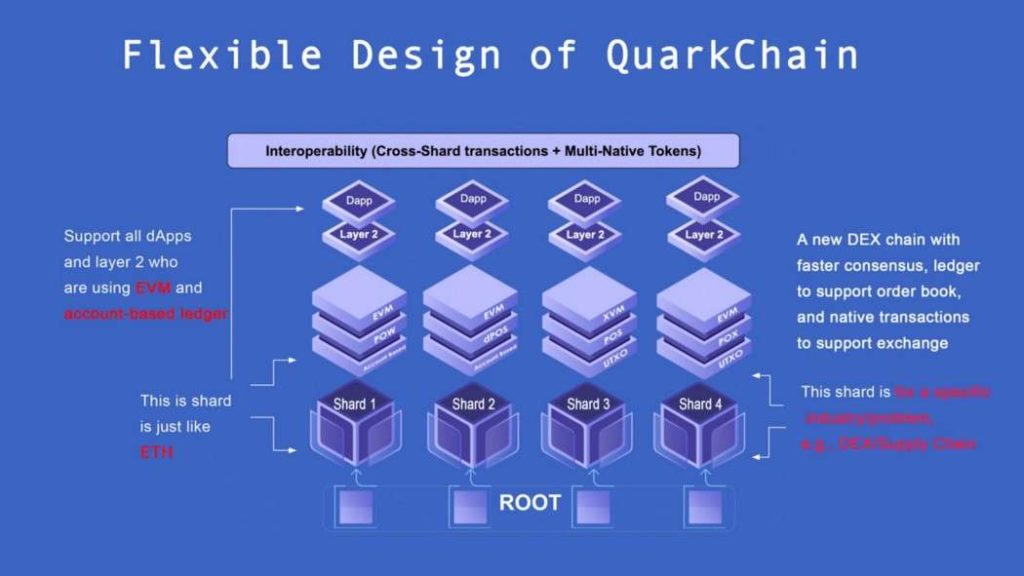
Source: quarkchain-official
The QuarkChain multi-native tokens will change the concept of DeFi forever. From a DeFi with security and scalability issues, we will move to a high efficiency, low gas, safer, and easier to use next-generation DeFi. These tokens will have the same rights as the native QKC tokens but can have more functional values. For example, contract development and transaction fee payment. The major advantage of these tokens is that it will lower the cost of development and will also lay the basis for more industry applications.
Major partnerships
2020 has proved to be a great year in terms of partnerships for QuarkChain.
- Partnership with Chinese provincial government
On July 7, the network announced an important cooperation. It has partnered with an ecological department under a Chinese provincial government. The two parties will develop an Environmental Governance Platform on Blockchain. Furthermore, the first province to use it would be a northwest province in China. The EGPB will be used for construction resource management and trading. - Partnership with AWS
QuarkChain has ventured into in-depth technical cooperation with Amazon Web Services (AWS). Together with Amazon, it will launch high-performance and highly flexible Blockchain as a Service. This will be a one-stop application platform on AWS on which clients can build highly customized applications.
DeFi entry and 2020 ahead
The rest of 2020 seems very busy and exciting for the QuarkChain team. This is because the team will be working on DeFi products and the mainnet with a multi-native token upgrade.
Here are some QuarkChain updates on the Altcoin Buzz YouTube channel.
In the month of August, the QuarkChain team launched five DeFi-related products. These products are offering users a taste of next-generation DeFi network. The five products are:
-
Multi-native token bidding system
This bidding system allows users an opportunity to create their multi-native tokens. The users will have to use QKC for bidding and these tokens will be burned. The multi-native tokens created in the process will be more secure than ERC20 and will have the same rights as ETH and QKC.
-
Gas liquidity pool
These multi-native tokens can be used to pay for the gas fees in place of ETH.
3. QSwap
This is the multi-native token version of Uniswap. While Uniswap only supports ERC20, QSwap will support the multi-native tokens. These tokens can be used on QSwap to pay the gas fee. With these tokens, users will not have to grant unlimited authorization, thus their tokens will always be secure.
4. Element Miner
It is an interesting trading and mining game where a player needs to collect five elements to join the reward pool.
5. Lockdrop
The users can stake mainnet QKC with a smart contract. For this, they can obtain the same amount of devnet QKC. These devnet QKC can be used on multi-native token bidding and QSwap.
Open staking DeFi products
QuarkChain has proposed a unique consensus algorithm which is a combination of PoS and PoW. Known as PoSW, it promises a consensus mechanism that is more human-friendly.
PoSW stands for proof of staked work. Firstly, this consensus makes miners compete using computing power just like PoW. Secondly, the miners who stake QuarkChain tokens (QKC) while mining can also enjoy lower mining difficulty. With more holdings, miners can gain more rights to verify the transactions. Additionally, this type of consensus provides a unique way for holders to increase their assets. The holders can stake QKC on behalf of miners. While the miners get more transaction verification rights, the holders enjoy QKC at discounted rates.
The staked miners are the ones who secure the network against 51% attacks because, by staking during mining, they enjoy reduced mining difficulty. Thus, such a set up where holders and miners work in collaboration is more human-friendly.
After the QuarkChain Staking 1.0 smart contract launch, token holders can stake their QKC together into the same contract to meet the minimum staking amount.
Staking 1.0
With Staking 1.0, the Staking Pool smart contracts are online. Moreover, the project also launched its mining pool, Qpool, to support the mainnet. If the token holders hold QKC in a smart contract address, the miners can also get involved. Effectively, token holders and miners can share the profits. According to the recent data, the monthly rate is 2% and the annual rate is close to 27%.
During Q3-Q4 of 2020, the network will launch an open-source dApp. Furthermore, it will have staking and mining functionalities. The DeFi platform might launch somewhere in Q4 of 2020. Once it launches, miners will be free to publish staking contracts. The token holders can then stake their QKC using these contracts. With this, QuarkChain promises to deliver a unique DeFi product.
Mainnet of BigBang with multi-native token function
QuarkChain uses a multi-chain heterogeneous blockchain structure. With the mainnet of BigBang going live in Q3 of 2020, it will start supporting the multi-native token functionality. These tokens will help overcome the challenges of smart contract tokens and will have multiple functionalities too.
RoadMap 2020
According to Dr. Zhou, founder and CEO of QuarkChain, in H2 of 2020, the team will be building an asset bridge to allow Ethereum assets to be transferred to QuarkChain. The first asset bridges will be built for tokens such as USDT.
In this way, every user can use ERC20 assets directly linked to QuarkChain multi-native tokens and use the multi-native tokens to participate in the QuarkChain dApp.
Future price performance
Since January 2020, the price of QKC has seen a jump from $0.00274178 to $0.00603379, which is close to 120% price growth. After years of hard work, QuarkChain’s technology developments and ecosystem growth are causing a stir in the community. We strongly believe this positive price movement will continue as the project has two major upgrades coming up in the next two quarters.
To wrap up
As a leading blockchain technology company, QuarkChain is exploring its unique consensus mechanism, its heterogeneous sharding technology, and 2-layer architecture to kick-off real adoption of blockchain.
In 2020, it plans to develop enterprise solutions based on blockchain that can serve smart cities, provide large-scale resource management, and offer high storage capacity with high processing efficiency in a safe and reliable manner.
With adoption as the focus, if QuarkChain is able to deliver what it promises, there is no looking back.
–
Disclaimer
The information discussed by Altcoin Buzz is not financial advice. This is for educational and informational purposes only. Any information or strategies are thoughts and opinions relevant to accepted levels of risk tolerance of the writer/reviewers and their risk tolerance may be different than yours. We are not responsible for any losses that you may incur as a result of any investments directly or indirectly related to the information provided.
Do your own due diligence and rating before making any investments and consult your financial advisor. The researched information presented we believe to be correct and accurate however there is no guarantee or warranty as to the accuracy, timeliness, completeness. Bitcoin and other cryptocurrencies are high-risk investments so please do your due diligence. This interview, overview, or update article has been compensated for media cooperation and has been sponsored for by the interviewed or reviewed organization. Copyright Altcoin Buzz Pte Ltd. All rights reserved.
Next up
Bitcoin Core Speeds Up Fixes for AI found Bugs Drops
Bitcoin Core will backport and ship fixes for easily discoverable bugs as soon as possible, ending long embargoes for issues an LLM prompt can find.
 BTC
BTCRelated
More in Crypto NewsRelated
Collector Crypt Q3 Revenue Hits $433.5M, but 94% Goes Back Out
 SOL
SOL
DFINITY Founder Accuses NEAR of Using ICP Signing Research
 NEAR
NEAR ICP
ICP
Longs Take 83% of $333M Crypto Liquidations as Bitcoin Holds $81K
BTCSOL
Sui's Hashi Adds Anchorage Digital as $500M Bitcoin Launch Nears
BTC SUI
SUI