VVV hit $34.51 in 2026, up 3,000%. What drives the token?
VVV hit $34.51 in September 2026, up 3,000% from its December 2025 bottom. What the Venice AI token does, how staking and burns work, and what the supply shows.

By Saloni RathiSenior Editor
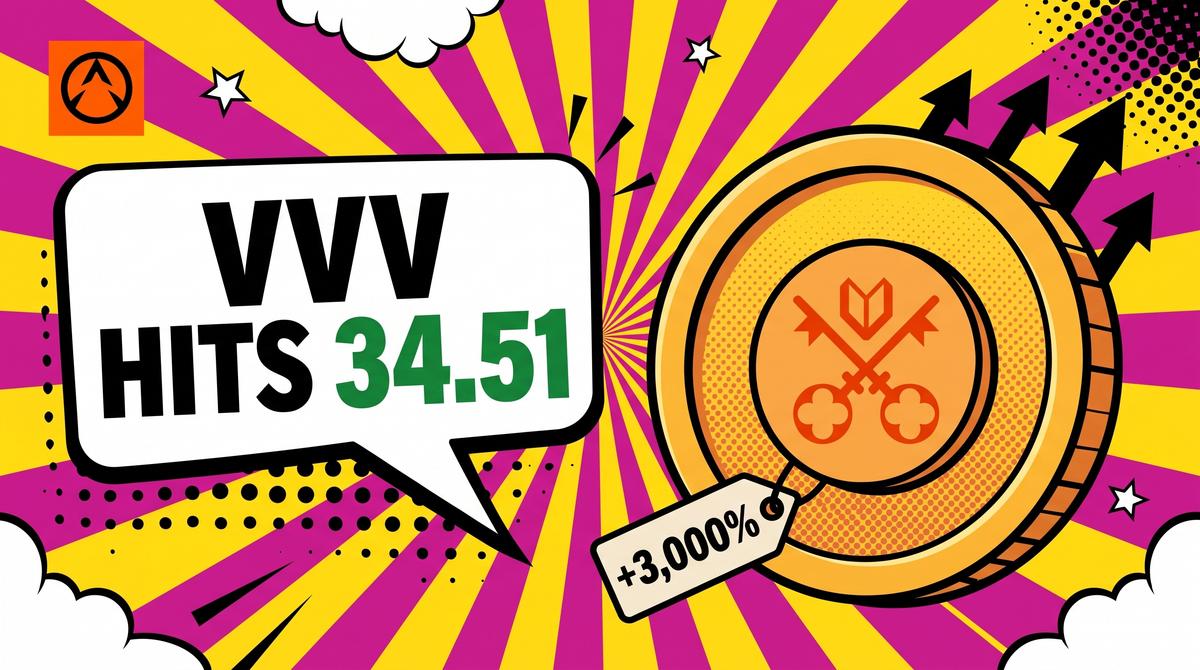
VVV, the native token of the privacy-focused AI platform Venice, hit a fresh all-time high of $34.51 on Sunday, up about 17% in 24 hours and roughly 3,000% from its $0.92 bottom in December 2025. The market cap sits near $1.6 billion, putting it behind NEAR and TAO as the third-largest AI-focused token.
What VVV actually is
VVV is the access key for Venice AI, a chatbot and image generator built by Erik Voorhees, the early Bitcoin entrepreneur who founded ShapeShift. Venice does not train its own frontier model; it routes prompts to open-source systems like Llama and DeepSeek, and runs both a consumer app and a developer API on a freemium model.
The platform claims more than 2 million users and over 1 million daily API calls, figures drawn from a project-tracker page. A separate April 2026 figure cited elsewhere put the active base at around 450,000 users with 50,000 daily actives. Those numbers do not match, and we could not reconcile them to a single primary source.
How the token does what it does
You do not pay per prompt. You stake VVV, which means locking it in a smart contract, to claim a daily share of the platform's inference, its compute. There are two layers on top of that:
- A second token, DIEM, is minted by locking staked VVV. Each DIEM grants the holder $1 of API credit every day, in perpetuity.
- A portion of Venice's revenue buys VVV on the open market and burns it, shrinking supply.
Venice says it does not log prompts, requires no account, and runs without the content filters that block certain requests elsewhere.
What the 3,000% run came from
The largest single jump in the recent rally came in early September, when VVV climbed 34% in a day on speculation tied to a public dispute over an OpenAI/NYU fluid-dynamics credit row. The token has added another leg since.
Sunday's push to $34.51 was amplified by a short squeeze. Of $1.34 million in liquidations over the prior day, $1.29 million sat on short positions, per public market data. We could not verify the underlying liquidation read on chain.
Supply, unlocks, and the 100-wallet problem
Genesis supply was 100 million VVV, with the token launched at a TGE on January 27, 2025, on Base, Coinbase's Layer 2. About 33.9 million VVV has been burned in total, though most of that came from one-time events in 2025-Q1: an unclaimed airdrop and a team allocation burn.
Organic buy-and-burn from platform revenue ran at roughly 37,000 to 57,000 VVV a month through early 2026. Venice also runs a discretionary monthly buyback of about $100,000, plus subscription-driven burns from its Pro, Pro+ and Max tiers since late April 2026.
As of September 2026, about 48.1% of supply is in circulation, with 41.6% still locked under a 24-month vesting schedule that ends January 27, 2027. The next unlock is on September 27: 312,500 tokens, or 0.3% of total supply and 0.5% of the current market cap. Annual issuance has been cut from 14 million VVV at launch to 2.5 million as of September 1, with a further cut to 2 million scheduled for October.
Concentration is the harder number. Market data puts the top 100 VVV wallets in control of roughly 98% of the supply, a level where a handful of holders can move the price more than any wave of retail buying. We did not open the underlying on-chain source for that figure.
Staking, funding, and where VVV trades
About 68% of circulating VVV is staked, with around 26% of that locked for DIEM minting. Unstaking carries a 7-day cooldown. Locked sVVV earns 80% of the normal emission yield, with Venice.ai keeping the remaining 20% as protocol revenue.
In July, Venice raised $65 million in a Series A led by Dragonfly at a $1 billion valuation, the first outside capital it had taken since launching in 2024. In August, the company said it had crossed a $100 million annualized revenue run rate, up from $70 million a month earlier. VVV trades on Coinbase, Kraken, KuCoin, MEXC, Gate.io and Aerodrome DEX on Base.
The next unlock lands on September 27. After that, the vesting schedule runs through January 27, 2027, when the last of the 100 million VVV genesis supply is fully vested.

Saloni Rathi
Saloni Rathi has been part of Altcoin Buzz for over five years, working across content and marketing within the crypto and Web3 space. Her work focuses on creating clear, engaging and accessible content that helps readers understand complex cryptocurrency and blockchain topics. With a strong interest in storytelling and audience engagement, Saloni brings together research, creativity and marketing insight to turn complex ideas into simple and relatable stories. She believes great content starts with curiosity, creates clarity, and ultimately builds meaningful connections with readers.
More from SaloniNext up

Forward Industries Expands Solana Treasury to 8.7 Million SOL as Per-Share Growth Slows
Forward Industries bought 226,396 SOL between 1 October and 9 November 2026 at an average cost of $75 each, lifting its holdings to 8,727,694 SOL.
 SOL
Related
More in Crypto NewsRelated
North Korea-Linked Hackers Create Fake Memecoins to Launder Stolen Binance Funds
 NEAR

Pyth Adds Live NYSE Data From Five Exchanges as ARR Reaches $13.67 Million
 PYTH
Why Did Zcash Fall Below $1,000 for the First Time Since September?
 ZEC
 UNI

Top Trending Cryptocurrencies Today: Bitway and Gram Lead
 BTW GRAM